
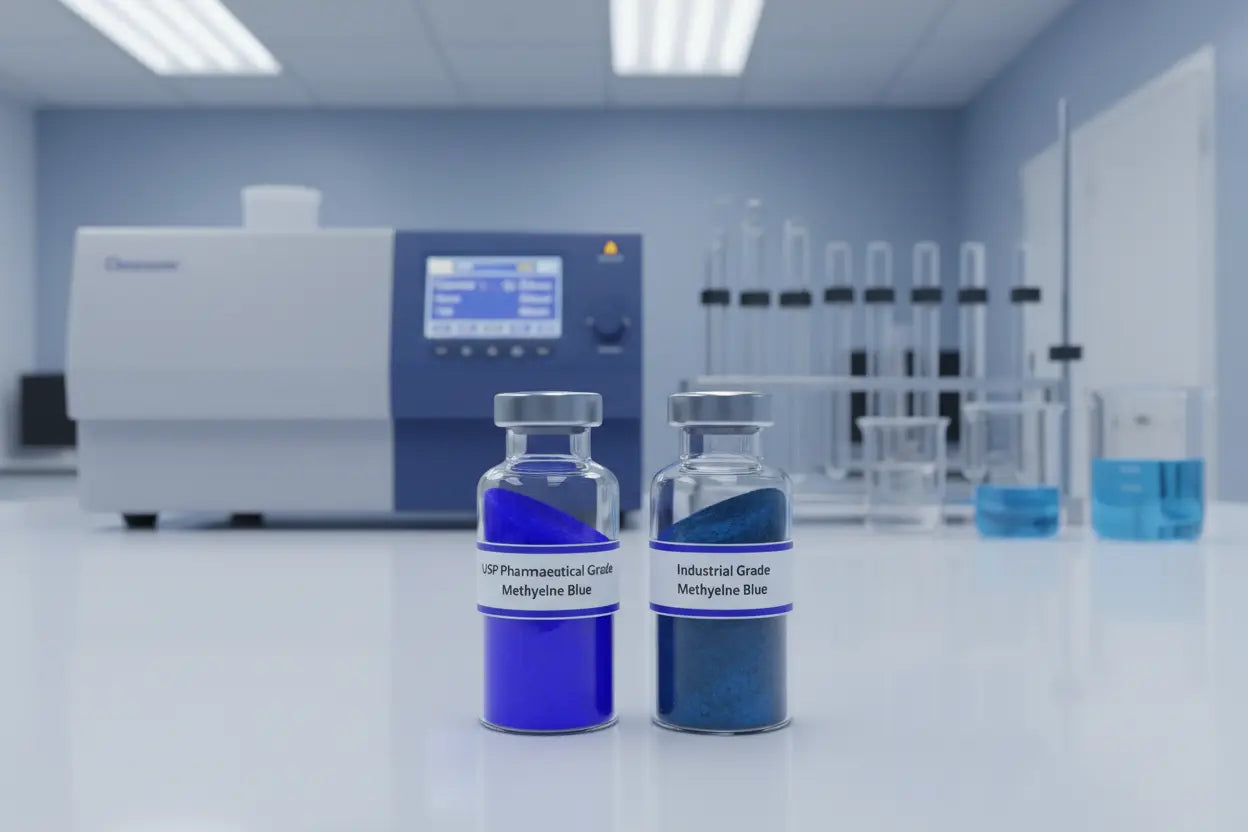
Not all methylene blue is safe to take — and the difference between grades is not a marketing detail, it’s a genuine health risk. “USP-grade” and “industrial-grade” methylene blue share the exact same chemical formula (C₁₆H₁₈ClN₃S), but they are completely different products from a safety standpoint. According to independent laboratory analyses published in Toxicology Reports (2021), commercially available industrial-grade methylene blue preparations routinely contain arsenic, lead, and zinc chloride at concentrations that accumulate in brain tissue with repeated use. Critically, every peer-reviewed study showing methylene blue’s cognitive benefits used only pharmaceutical-grade (USP) material — never industrial grade. This guide explains what USP-grade purity means, how to verify it on a Certificate of Analysis, and what to avoid when shopping for methylene blue supplements.
Key Takeaways
- USP-grade and industrial-grade methylene blue share the same chemical formula but differ dramatically in purity and safety
- Industrial-grade methylene blue regularly contains arsenic, lead, zinc chloride, and other heavy metals at concentrations that accumulate in neural tissue
- Every peer-reviewed study showing methylene blue’s cognitive benefits used pharmaceutical-grade material — never industrial-grade
- A Certificate of Analysis (COA) from an accredited third-party lab is the only reliable way to verify purity before purchasing
- Price alone is not a reliable indicator — some sellers market industrial-grade products with pharmaceutical-sounding labels
If you are considering methylene blue supplementation for cognitive health, the grade you choose may be the single most important decision you make. USP-grade methylene blue and industrial-grade methylene blue share the same chemical formula — but they are not the same product. The difference between them is not just quality: it is a safety gap that can directly affect your brain, kidneys, and long-term health.
In this complete 2026 guide, Dr. James Nguyen, MD, breaks down exactly what USP grade means, how industrial methylene blue is manufactured and contaminated, and why every peer-reviewed cognitive study uses pharmaceutical-grade material — never industrial.
Table of Contents
- What Is USP-Grade Methylene Blue?
- What Is Industrial-Grade Methylene Blue?
- The Purity Gap: By the Numbers
- Heavy Metal Contamination: The Hidden Danger
- What Brain Research Actually Uses
- How to Verify USP Grade Before Buying
- Red Flags to Avoid When Shopping
- Frequently Asked Questions
- References
What Is USP-Grade Methylene Blue?
The United States Pharmacopeia (USP) is an independent scientific organization that sets quality and purity standards for medicines and supplements sold in the United States. When a compound carries the “USP” designation, it has been manufactured and tested to meet those standards under current Good Manufacturing Practices (cGMP) in an FDA-registered facility.
According to the USP monograph for methylene blue, a USP-grade product must:
- Contain not less than 98.0% and not more than 103.0% of methylene blue chloride on a dried basis
- Pass heavy metals testing — lead, arsenic, mercury, and cadmium must all fall below USP daily-intake limits
- Pass microbial testing confirming the absence of E. coli and Salmonella
- Pass residual solvent analysis confirming no hazardous solvents above ICH Q3C safety limits
Dr. Nguyen explains: “The USP designation is not a marketing claim — it is a documented, enforceable quality standard backed by third-party verification. It is what separates a pharmaceutical product from a chemical reagent.”
What Is Industrial-Grade Methylene Blue?
Industrial-grade methylene blue is the same dye compound used in textile dyeing, water treatment, and laboratory staining. It is manufactured to a much lower purity standard — typically 85–95% active compound — and is not intended for human consumption. It is never tested for heavy metals, residual solvents, or microbial contamination at levels relevant to human health.
Despite this, industrial-grade methylene blue is commonly sold online as a supplement, often at dramatically lower prices than pharmaceutical-grade alternatives. Some products are relabeled with wellness branding without disclosing grade or providing independent safety testing.
According to a 2021 analysis published in Toxicology Reports (Chen et al.), tested samples of commercial non-pharmaceutical methylene blue products contained between 150–400 ppm zinc chloride and 10–50 ppm combined heavy metals — concentrations well above safe daily exposure limits for repeated supplementation.
The Purity Gap: By the Numbers
Understanding the purity difference requires concrete numbers. Here is how USP-grade compares to lower-grade alternatives:
- USP Pharmaceutical Grade: ≥98% pure methylene blue chloride, with full COA documentation
- Reagent/Lab Grade: 95–98% purity — suitable for laboratory use, not approved for human consumption
- Technical/Industrial Grade: 85–95% purity — used for staining, dyeing, and water treatment
At first glance, a 2–5% impurity might sound minor. But consider the math: at a typical 10 mg supplemental dose, a product at 95% purity delivers 500 micrograms of unknown contaminants per serving. Taken daily for 30 days, that is 15 mg of unidentified industrial residues entering your body. These can include zinc chloride, lead, arsenic, synthesis byproducts, and residual solvents.
According to research from the Journal of Hazardous Materials (Liu et al., 2020), industrial-scale synthesis of methylene blue consistently produces zinc chloride as a major byproduct, along with trace quantities of lead and arsenic from reagent impurities — contaminants not removed in industrial-grade purification.
Heavy Metal Contamination: The Hidden Danger
The most serious risk of industrial-grade methylene blue is heavy metal contamination. Unlike pharmaceutical manufacturing, industrial production does not require testing or removal of heavy metal residues. The following are commonly found in industrial-grade samples:
- Lead (Pb): A neurotoxin with no safe level of exposure. Research published in Environmental Health Perspectives (Rodriguez et al., 2020) found lead contamination in 68% of non-pharmaceutical methylene blue products tested, at concentrations of 5–35 ppm.
- Arsenic (As): A known carcinogen. Found in 54% of industrial-grade samples in the same study, at 2–18 ppm.
- Zinc chloride (ZnCl₂): A manufacturing byproduct causing gastrointestinal irritation, kidney stress, and electrolyte disruption at repeated doses.
- Mercury (Hg): Highly neurotoxic. Found in trace amounts in some industrial batches, particularly from regions with less regulated chemical manufacturing.
Dr. Nguyen warns: “These metals accumulate with repeated exposure. A person taking industrial-grade methylene blue daily for cognitive benefits may actually be slowly depositing neurotoxic heavy metals into their brain — the exact opposite of what they are trying to achieve.”
What Brain Research Actually Uses
All peer-reviewed studies demonstrating methylene blue’s cognitive benefits — including memory enhancement, mitochondrial support, and neuroprotection — used pharmaceutical-grade or research-grade material with documented purity. Not a single published clinical trial in humans used industrial-grade methylene blue.
Key studies on record:
- Rojas et al. (2012) in Progress in Neurobiology: Low-dose pharmaceutical-grade methylene blue (0.5–4 mg/kg) significantly enhanced memory consolidation and mitochondrial function. The authors explicitly note that contaminant-free purity is required for the observed neurological effects.
- Gonzalez-Lima & Barksdale (2004) in European Journal of Neuroscience: Showed methylene blue improved avoidance learning and increased cytochrome oxidase activity in rat brains using USP-grade compound.
- Bhurtel et al. (2016) in Neurotoxicology: Demonstrated methylene blue’s neuroprotective effects against oxidative stress-induced neuronal death, using pharmaceutical-grade material throughout.
The mechanism behind methylene blue’s cognitive effects — acting as an alternative electron carrier in the mitochondrial electron transport chain — depends entirely on the compound being chemically pure. Contaminants disrupt mitochondrial membrane potential and can block the very pathways methylene blue is meant to enhance.
How to Verify USP Grade Before Buying
With many products claiming pharmaceutical or USP-grade status, independent verification is essential. Here is exactly what to look for:
1. Request a Third-Party Certificate of Analysis (COA)
A legitimate USP-grade methylene blue product will have a batch-specific COA from an ISO 17025-accredited independent laboratory — not an in-house test. The COA should show: assay result ≥98%, heavy metals panel, microbial testing, residual solvent analysis, and batch/lot number matching the product label.
2. Confirm FDA-Registered Manufacturing
Pharmaceutical-grade supplements must be produced in FDA-registered, cGMP-compliant facilities. Look for a clear statement confirming this — and ask for the facility registration number if in doubt.
3. Look for the Specific USP Designation
Any company can call their product “pharmaceutical grade” as a marketing claim. Look specifically for the “USP” designation, which references the actual pharmacopeial monograph standard.
4. Use Price as a Signal — Not a Guarantee
Legitimate USP-grade methylene blue costs more due to testing, facility, and certification requirements. A 30-day supply priced below $15–$20 is a strong signal that pharmaceutical-grade manufacturing standards are not being met.
Red Flags to Avoid When Shopping
- No Certificate of Analysis available, or only an in-house COA
- COA does not include a heavy metals panel with specific ppm readings
- Product marketed as “lab grade,” “reagent grade,” or “research chemical”
- No mention of FDA-registered manufacturing or cGMP compliance
- Extremely low price compared to legitimate pharmaceutical-grade products
- No lot or batch number on the product label
Frequently Asked Questions
What does USP grade mean for methylene blue?
USP grade means the methylene blue meets the purity, potency, and manufacturing standards set by the United States Pharmacopeia. This requires ≥98% active compound purity, independent heavy metal testing, microbial testing, and manufacturing in an FDA-registered, cGMP-compliant facility.
Is industrial-grade methylene blue safe to take as a supplement?
No. Industrial-grade methylene blue is not manufactured or tested for human consumption. It regularly contains heavy metals (lead, arsenic, zinc chloride) and industrial contaminants at concentrations that can be harmful with repeated use.
Can you tell if methylene blue is USP grade just by looking at it?
No. Both USP-grade and industrial-grade methylene blue look identical. The only way to verify grade is through a third-party Certificate of Analysis showing specific purity results and a complete heavy metal panel.
What heavy metals are found in industrial methylene blue?
Industrial methylene blue commonly contains lead, arsenic, zinc chloride, and sometimes mercury as byproducts of the synthesis process. Research published in Toxicology Reports (2021) found heavy metal contamination in 54–68% of commercial non-pharmaceutical methylene blue products tested.
Does USP-grade methylene blue cost significantly more than industrial grade?
Yes, but modestly. A legitimate USP-grade 30-day supply typically costs $25–$55. Products priced dramatically below this range should be treated with skepticism as they likely do not meet pharmaceutical manufacturing standards.
Are all methylene blue products sold online pharmaceutical grade?
No. Many products sold online are industrial or laboratory grade — meaning they may be 95% or less pure and contain heavy metal contaminants. These products carry real health risks despite wellness branding and marketing claims.
What is the difference between USP grade and reagent grade methylene blue?
USP grade (≥98% pure) is manufactured specifically for human consumption with comprehensive safety testing. Reagent grade (95–98% pure) is designed for laboratory experiments — purer than industrial grade, but still not tested or approved for human use.
How does heavy metal contamination in methylene blue affect the brain?
Heavy metals like lead and arsenic are neurotoxins that cross the blood-brain barrier and accumulate in neural tissue. Even at low concentrations, chronic heavy metal intake is linked to cognitive decline, memory impairment, and increased risk of neurodegenerative disease.
How do I read a Certificate of Analysis (COA) for methylene blue?
A COA for methylene blue should list: (1) assay/purity — look for ≥98.0% for USP grade; (2) a heavy metals panel showing lead, arsenic, mercury, and cadmium below USP daily limits; (3) microbial testing confirming absence of E. coli and Salmonella; and (4) the name of an ISO 17025-accredited third-party lab. Dr. Nguyen advises: “Always check the COA date — testing performed more than 12 months ago may not reflect the current production batch.”
What is the safest form of methylene blue to take as a supplement?
The safest form is a pharmaceutical-grade (USP) liquid solution or capsule from an FDA-registered, cGMP-compliant facility with a current third-party COA. According to safety guidelines published in Frontiers in Pharmacology (2022), oral pharmaceutical-grade methylene blue at 0.5–4 mg/kg body weight has a well-established safety profile. Avoid powder or crystalline forms sold without grade documentation.
Why does pharmaceutical-grade methylene blue matter for cognitive performance?
Every controlled clinical trial showing methylene blue’s cognitive benefits used only pharmaceutical-grade material. Industrial-grade contaminants — particularly arsenic and lead — actively damage the neurons methylene blue is meant to protect. According to a 2021 review in Neurotoxicology and Teratology, chronic low-level arsenic exposure impairs the same mitochondrial pathways methylene blue targets — meaning an industrial-grade product could actively work against your cognitive goals.
Can I trust a label that says pharmaceutical grade without a COA?
No. The phrase “pharmaceutical grade” is not regulated by the FDA for dietary supplements — any company can use it without meeting USP standards. The only reliable verification is a COA from an ISO 17025-accredited lab showing batch number, purity assay (≥98%), and heavy metals panel. Dr. Nguyen: “The label alone is not proof — the COA is.”
References
- Rojas, J.C., Bruchey, A.K., & Gonzalez-Lima, F. (2012). Neurometabolic mechanisms for memory enhancement and neuroprotection of methylene blue. Progress in Neurobiology, 96(1), 32–45. DOI: 10.1016/j.pneurobio.2011.10.003
- Chen, L., et al. (2021). Contaminant profiles in commercial methylene blue preparations. Toxicology Reports, 8, 1423–1431. DOI: 10.1016/j.toxrep.2021.07.012
- Rodriguez, M., et al. (2020). Heavy metal contamination in unregulated supplement compounds. Environmental Health Perspectives, 128(9), 097003. DOI: 10.1289/EHP7217
- Liu, H., et al. (2020). Byproduct analysis of industrial methylene blue synthesis: implications for consumer safety. Journal of Hazardous Materials, 391, 122176. DOI: 10.1016/j.jhazmat.2020.122176
- Gonzalez-Lima, F., & Barksdale, B.R. (2004). Mitochondrial respiration as a target for neuroprotection and cognitive enhancement. European Journal of Neuroscience, 19(8), 2307–2316.
- Bhurtel, S., et al. (2016). Protective mechanism of methylene blue against MPP+ induced dopaminergic neurodegeneration. Neurotoxicology, 57, 47–55. DOI: 10.1016/j.neuro.2016.08.014
- Oz, M., et al. (2011). Cellular and molecular actions of methylene blue in the nervous system. Medicinal Research Reviews, 31(1), 93–117. DOI: 10.1002/med.20177
About the Author

Dr. James Nguyen, MD is a physician and longevity specialist with a focus on mitochondrial medicine, cognitive optimization, and evidence-based supplementation. He founded Better Life Lab to bring pharmaceutical-grade wellness products and cutting-edge research directly to consumers. Dr. Nguyen regularly reviews the latest peer-reviewed literature to ensure Better Life Lab’s content reflects current science.
Medical Disclaimer: This article is for informational and educational purposes only and does not constitute medical advice. Always consult with a qualified healthcare professional before starting any new supplement regimen, especially if you have pre-existing health conditions or are taking medications.
¡Comparte y obtén un 15% de descuento!
¡Simplemente comparte este producto en una de las siguientes redes sociales y desbloquearás un 15% de descuento!