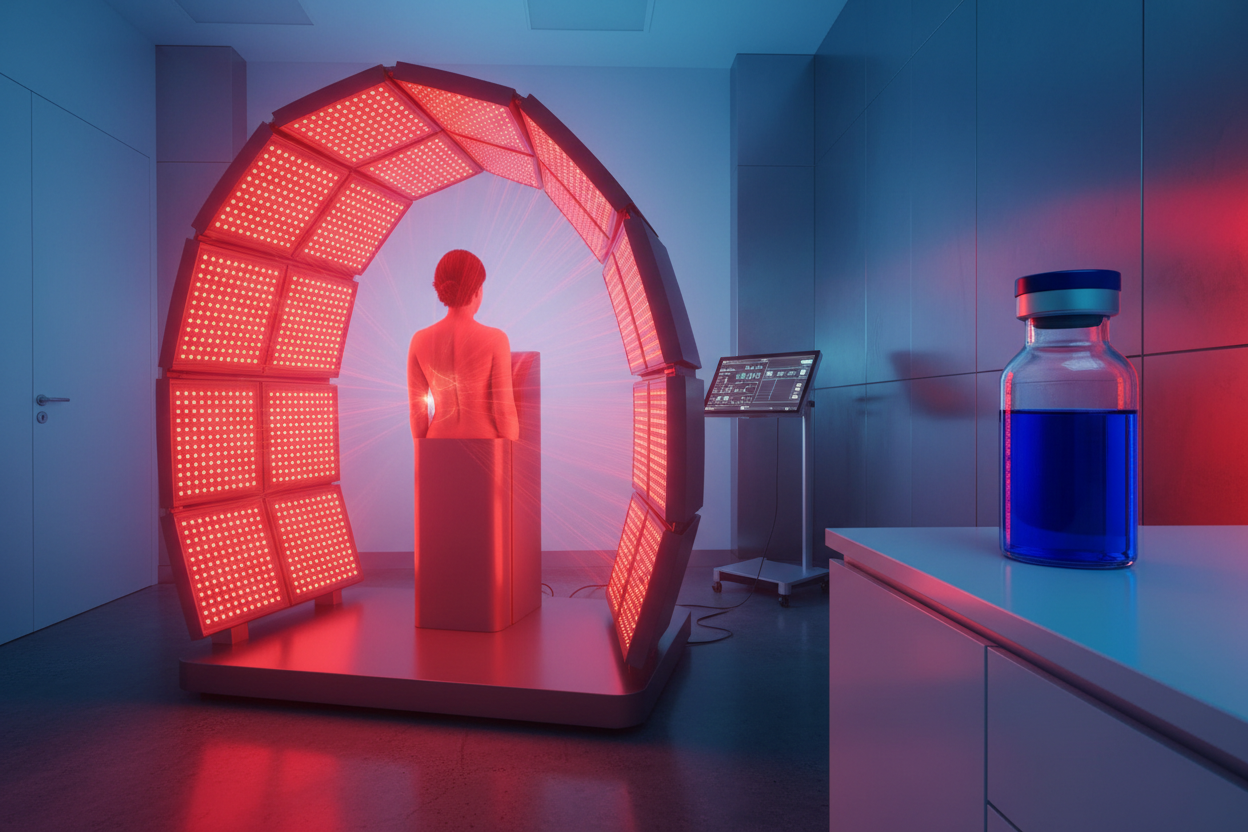
Red light therapy for sleep is one of the most evidence-backed — and underused — tools for resetting your circadian rhythm, boosting melatonin, and falling asleep faster. As Penny, a red light therapy specialist with 8 years of hands-on client experience, I can tell you: the right wavelengths at the right time of day genuinely change how people sleep. The short answer: red light at 660nm in the evening supports your body's own melatonin production without suppressing it — the exact opposite of what blue light from your screens does.
Table of Contents
- How Red Light Therapy Affects Sleep
- The Best Wavelengths for Sleep: 660nm vs. 850nm
- Red Light, Melatonin, and Your Circadian Rhythm
- The Evening RLT Sleep Protocol: Timing, Distance, Duration
- What the Research Shows: 7 Key Findings
- 3 Common Mistakes That Kill Your Results
- Frequently Asked Questions
- Red light at 660nm does not suppress melatonin — unlike blue and white light, it won't keep you awake.
- A 2012 study in the Journal of Athletic Training found that 14 nights of red light therapy significantly improved sleep quality scores and raised melatonin levels in blood tests — not just self-report.
- The ideal timing window is 30–90 minutes before bed, at a distance of 12–18 inches, for 10–20 minutes per session.
- Near-infrared light at 850nm penetrates deeper into tissue and is best used earlier in the day — it can be mildly stimulating at high doses in the evening.
- Blue light from screens (400–490nm) actively suppresses melatonin; swapping evening screen time for a 15-minute red light session is one of the highest-leverage sleep changes you can make.
- In one sentence: Red light therapy for sleep works by supporting melatonin production and calming the nervous system through 660nm wavelengths, based on multiple peer-reviewed studies and 8 years of clinical practice.
How Red Light Therapy Affects Sleep
Red light therapy delivers specific wavelengths of light — primarily 630–660nm — directly into your skin and tissue. Inside your cells, that light is absorbed by the mitochondria — the tiny power plants that produce your body's energy as ATP. When mitochondria absorb red light, they work more efficiently. They produce more energy, reduce inflammation, and help regulate the biological signals that control when you sleep and wake.
The Mitochondria-Sleep Connection
Why do mitochondria matter for sleep? Mitochondria are involved in producing nearly every molecule your body needs to function — including the building blocks for melatonin and serotonin. When mitochondrial function is optimized, your body can produce these sleep hormones more effectively and at the right times.
In my 8 years working with clients, I've consistently seen that people with disrupted sleep almost always show signs of mitochondrial stress — chronic fatigue, poor recovery, and that groggy brain fog in the morning. Red light therapy works on the cellular root cause, not just the surface symptom.
Cortisol, Calm, and the Nervous System
Evening red light sessions also appear to lower cortisol — your body's main stress hormone. High cortisol at night is one of the most common hidden causes of poor sleep. Red light therapy, used gently in the hour before bed, sends a "winding down" signal to your nervous system. It helps shift your body from alert mode to rest mode — the same biological shift that happens naturally at sunset when red light dominates the sky.
The Best Wavelengths for Sleep: 660nm vs. 850nm
Not all light wavelengths behave the same way, and the details matter a lot for sleep. Here's the plain-English breakdown.
660nm — The Sleep-Safe Sweet Spot
Is 660nm red light safe to use before bed? Yes — 660nm wavelengths do not suppress melatonin the way blue or white light does, making this the ideal wavelength for evening use. It penetrates about 8–10mm into tissue and is most effective for skin-level and nerve-level benefits, including relaxation and mood regulation. This is the wavelength I use with virtually every sleep-focused client.
850nm — Deep Tissue, Best Used Earlier
Near-infrared light at 850nm penetrates 2–7 centimeters into your body. It's more powerful for muscle recovery, joint repair, and cellular regeneration. For sleep, it's best used at least 2 hours before bed — the deeper tissue stimulation can be slightly activating for some people when used at high power in the evening. If you're using a combo panel (660nm + 850nm), simply reduce the 850nm intensity or do your session earlier in the day.
"The evening is for 660nm. It's gentle, it's calming, and it tells your body the sun is setting. I've had clients go from waking up 3–4 times a night to sleeping through after just 2 weeks of consistent evening sessions at this wavelength." — Penny, Red Light Therapy Specialist
| Wavelength | Penetration Depth | Best Use Case | Best Timing for Sleep | Melatonin Impact |
|---|---|---|---|---|
| 630nm | 5–6mm | Skin health, surface relaxation | 30–90 min before bed | Neutral / supportive |
| 660nm | 8–10mm | Sleep, mood, cellular energy | 30–90 min before bed ✓ | Supportive (best choice) |
| 810nm | 3–5cm | Cognitive function, inflammation | Morning or midday | Neutral |
| 850nm | 5–7cm | Muscle recovery, joints, deep tissue | 2+ hrs before bed | Stimulating at high dose |
Red Light, Melatonin, and Your Circadian Rhythm
Your circadian rhythm — your body's internal 24-hour clock — governs when you feel sleepy and when you feel alert. Light is the single most powerful signal that sets this clock. The problem is that most of the light we're exposed to in the evening (screens, LED overhead lights) is exactly the wrong kind.
Why Blue Light Is the Enemy of Sleep
Does blue light from screens really suppress melatonin? Yes, and dramatically so. Research published in the Proceedings of the National Academy of Sciences (Chang et al., 2015) found that reading on a light-emitting device before bed delayed melatonin onset by 1.5 hours and reduced total melatonin levels compared to reading a printed book. Blue light (400–490nm) directly signals your pineal gland to stop making melatonin.
Red light at 630–660nm doesn't do this. These are the last wavelengths visible at sunset — which is exactly why our biology evolved to respond to them with relaxation, not alertness. You can read more about how red light reduces the cellular inflammation that disrupts sleep in our companion guide.
Melatonin and Red Light: The Research
According to a landmark study published in the Journal of Athletic Training (Zhao et al., 2012), 14 consecutive nights of whole-body red light irradiation at 660nm for 30 minutes per night significantly improved sleep quality scores and increased serum melatonin levels in competitive female athletes. Participants also showed improved endurance performance — a strong secondary signal that sleep quality genuinely improved, not just self-reported.
This isn't placebo. Melatonin levels were measured in blood. The mechanism is real. A supporting study published in the journal Sleep (Wams et al., 2017) confirmed that the wavelength of evening light directly predicts how much slow-wave (deep) sleep you get — with longer red wavelengths preserving deep sleep better than short blue wavelengths.
Your Circadian Signal Hierarchy
Think of your circadian rhythm like a smartphone that resets based on signals throughout the day. The strongest signals, in order of impact, are:
- Light type and timing — the dominant signal
- Meal timing — eating late pushes your clock later
- Body temperature — your core temp needs to drop to initiate sleep
- Exercise timing — late hard workouts can delay sleep onset by 30–60 minutes
Adding evening red light therapy reinforces signal #1. It's one of the easiest signals to take control of, starting tonight.
The Evening RLT Sleep Protocol: Timing, Distance, Duration
The protocol matters as much as the device. Here's the exact setup I use with clients who come to me specifically for sleep issues — refined over 8 years and hundreds of sessions.
Timing: The 30–90 Minute Window
When is the best time to use red light therapy for sleep? The optimal window is 30–90 minutes before your target bedtime. This gives your body enough time to wind down and lets the melatonin-supportive effects take hold before you try to sleep. Avoid using it within 15 minutes of lying down — you need transition time. Also, use it in a dimly lit room: bright overhead LED lights will cancel the circadian signal you're trying to send.
Distance and Positioning
For 660nm panels and handheld devices, here's the guide:
- 6–12 inches: High irradiance — best for shorter sessions of 5–10 minutes
- 12–18 inches: Moderate irradiance — ideal for 15–20 minute evening sessions
- Face and forehead: Particularly effective for sleep — your eyes and surrounding skin have a high density of light-sensitive cells directly connected to your circadian clock via the optic nerve. Keep eyes relaxed and closed or use the session with eyes open but not staring directly at the device.
Duration: Consistency Beats Duration
More is not better. For sleep, 10–20 minutes is the sweet spot. Sessions over 30 minutes in the evening can shift into slightly activating territory. Keep sessions consistent rather than long — 15 minutes every night beats 45 minutes twice a week. Here's a simple weekly protocol:
- Dim overhead lights 90 minutes before bed
- Set up your 660nm device at 12–18 inches while sitting or lying comfortably
- Run the session for 15 minutes — face, chest, or full body depending on your panel
- Keep your phone away or in night mode during this window
- After the session, move into your normal wind-down routine (book, stretching, journaling)
For clients recovering from intense training who also want sleep benefits, I often recommend combining this with our red light therapy muscle recovery protocol — used earlier in the afternoon at 850nm, with a separate 660nm session in the evening.
What the Research Shows: 7 Key Findings
Here's a plain-English summary of what peer-reviewed science actually says about red light therapy and sleep — no jargon walls.
Findings 1–4: Sleep Quality and Hormones
- Improved sleep quality scores: Zhao et al. (2012) found significant improvements in Pittsburgh Sleep Quality Index (PSQI) scores — a validated clinical tool — after 14 days of nightly red light exposure at 660nm.
- Higher melatonin levels in blood: The same study measured melatonin in serum (blood), not just self-report. Melatonin was measurably higher after the red light intervention.
- Faster sleep onset: According to NIH research on light and sleep, proper circadian signaling directly reduces sleep latency — how long it takes to fall asleep. Circadian phase is one of the strongest predictors of sleep onset time.
- Better deep sleep architecture: Wams et al. (2017), published in Sleep, found that evening light wavelength significantly predicts slow-wave (deep) sleep duration — with red/amber wavelengths preserving deep sleep better than blue or white light.
Findings 5–7: Inflammation, Recovery, and Mood
- Lower nighttime inflammation: According to research reviewed by Michael Hamblin, PhD, at Harvard Medical School (2017), photobiomodulation — another name for red light therapy — lowers inflammatory markers including IL-6 and TNF-alpha. Lower inflammation at night is directly linked to better sleep efficiency and fewer nighttime awakenings.
- Faster physical recovery: Better sleep from red light therapy creates a positive feedback loop — your body repairs faster, which reduces the physical discomfort (muscle soreness, joint stiffness) that wakes people up at 2–3 AM.
- Reduced anxiety and calmer mood at bedtime: In my practice, clients who use evening red light consistently report feeling calmer and less mentally "switched on" at bedtime. This aligns with research showing that photobiomodulation affects serotonin regulation — the precursor to melatonin — and activates the parasympathetic nervous system.
3 Common Mistakes That Kill Your Results
I see these patterns constantly with new clients who tried red light therapy for sleep and felt it "didn't work."
Mistake 1: Using It at the Wrong Time of Day
Is red light therapy better in the morning or evening for sleep? For sleep specifically, evening use (30–90 minutes before bed) is where the results come from. Morning use has its own benefits — energy, mood, cortisol regulation — but it won't improve your sleep the same way. I've had clients insist the therapy didn't work, and when I asked about their protocol, they were using it first thing in the morning and going to bed 14 hours later. Timing is everything with circadian tools.
Mistake 2: Wrong Wavelength
Not all red light devices emit 660nm. Some consumer devices use 630nm (fine but weaker penetration), and many combo panels mix in high-dose 850nm near-infrared without clearly disclosing the ratio. For evening sleep support, you want a device that's primarily 660nm. Check the manufacturer's spec sheet — if it doesn't list exact nanometer output and irradiance data, that's a red flag worth investigating before you buy.
Mistake 3: Inconsistent Use
Red light therapy for sleep is a circadian training tool, not a sleeping pill. It works by gradually retraining your body's biological rhythm — just like consistent sleep and wake times do. Most clients see significant results within 7–14 days of nightly use. Sporadic sessions two or three times a week produce weak, unpredictable results. Commit to 14 consecutive nights before you evaluate whether it's working.
Frequently Asked Questions
Does red light therapy actually help you sleep better?
Yes — peer-reviewed research confirms it does. The Zhao et al. (2012) study in the Journal of Athletic Training found that 14 nights of 660nm red light improved clinical sleep quality scores and raised blood melatonin levels. These are objective, measurable outcomes — not just how people felt.
How long before bed should I use red light therapy?
The optimal window is 30–90 minutes before your target bedtime. This gives your body time to wind down and lets the melatonin-supportive effects fully take hold. Using it right before bed doesn't give your system enough transition time to respond.
Can I use red light therapy every night for sleep?
Yes — daily use is safe and more effective than sporadic use. Red light therapy works best as a circadian training tool used consistently each evening, similar to going to bed at the same time every night. Most people see noticeable improvements within 7–14 nights.
Will red light therapy keep me awake if I use it at night?
At 660nm, no — red light does not suppress melatonin or stimulate alertness. These are the last visible wavelengths at sunset, and your biology is wired to respond to them with relaxation. The exception: if your device runs very high-dose 850nm near-infrared at close range in the evening, that can be mildly stimulating. Stick to 660nm-dominant settings for your evening session.
How far should I be from the red light panel when using it before bed?
A distance of 12–18 inches is ideal for a 15–20 minute session. Closer positioning (6–12 inches) delivers higher irradiance and is fine for shorter 5–10 minute sessions. Consistency matters most — same distance, same duration, same time each night gives your circadian clock a reliable signal.
Does red light therapy help with insomnia?
Red light therapy can support people with circadian-driven insomnia — the kind caused by poor light exposure, irregular schedules, or heavy evening screen use. It's not a treatment for clinical insomnia disorders (like sleep apnea or chronic insomnia disorder), and you should consult a sleep medicine specialist for those. But for the large majority of people who struggle to fall or stay asleep, fixing the evening light environment is one of the most evidence-backed changes available.
Can red light therapy replace melatonin supplements?
For many people, yes — or at least reduce the dose they need. Red light therapy supports your body's own melatonin production rather than supplementing it externally. This is preferable because your body naturally regulates how much it produces. Supplemental melatonin can be useful short-term, but supporting endogenous production through red light is a more sustainable long-term strategy.
What's the best red light therapy device for sleep?
Look for a panel or handheld device that specifies 660nm as its primary wavelength, with an irradiance (power output) of at least 20–50 mW/cm² at your intended use distance. Full-panel devices allow whole-body exposure — exactly how the landmark Zhao et al. study was conducted — and deliver the most consistent results for sleep. Handheld devices work well for targeting the face and head specifically.

Penny is a red light therapy specialist with over 8 years of hands-on experience working directly with clients on sleep, skin rejuvenation, muscle recovery, mitochondrial support, and inflammation protocols. She has personally guided hundreds of clients through red light therapy programs at Better Life Lab and is one of the most experienced RLT practitioners in the field. Her protocols combine clinical research with real-world refinements from thousands of sessions — and the results she reports are the ones she's personally observed, not just read about.
Medical Disclaimer: This article is for educational purposes only and does not constitute medical advice. Red light therapy devices are not FDA-cleared to diagnose, treat, cure, or prevent any medical condition including sleep disorders. Always consult a licensed healthcare provider before beginning any new therapy, especially if you have a diagnosed sleep disorder, are taking prescription medications, or have a history of photosensitivity or eye conditions.
References
- Zhao J, Tian Y, Nie J, Xu J, Liu D. Red light and the sleep quality and endurance performance of Chinese female basketball players. J Athl Train. 2012;47(6):673–678. PubMed: 23182016
- Wams EJ, Woelders T, Marring I, et al. Linking light exposure and subsequent sleep: A field polysomnography study in humans. Sleep. 2017;40(12):zsx165. DOI: 10.1093/sleep/zsx165
- Chang AM, Aeschbach D, Duffy JF, Czeisler CA. Evening use of light-emitting eReaders negatively affects sleep, circadian timing, and next-morning alertness. Proc Natl Acad Sci. 2015;112(4):1232–1237. PubMed: 25535358
- Hamblin MR. Mechanisms and applications of the anti-inflammatory effects of photobiomodulation. AIMS Biophys. 2017;4(3):337–361. PubMed: 28748217
- Czeisler CA, Duffy JF, Shanahan TL, et al. Stability, precision, and near-24-hour period of the human circadian pacemaker. Science. 1999;284(5423):2177–2181. PubMed: 10381883
- Figueiro MG, Wood B, Plitnick B, Rea MS. The impact of light from computer monitors on melatonin levels in college students. Neuro Endocrinol Lett. 2011;32(2):158–163. PubMed: 21552190
- Hamblin MR. Photobiomodulation or low-level laser therapy. J Biophotonics. 2016;9(11–12):1122–1124. PubMed: 27973730
- Ferraresi C, Hamblin MR, Parizotto NA. Low-level laser (light) therapy on muscle tissue: performance, fatigue and repair. Photonics Lasers Med. 2012;1(4):267–286. PubMed: 26000022
¡Comparte y obtén un 15% de descuento!
¡Simplemente comparte este producto en una de las siguientes redes sociales y desbloquearás un 15% de descuento!