Key Takeaways
- Methylene blue was synthesized in 1876 by German chemist Heinrich Caro as a textile dye — its biological properties were an accidental discovery
- In 1891, Paul Ehrlich demonstrated methylene blue's efficacy against malaria parasites, making it the first fully synthetic pharmaceutical drug
- Throughout the early 20th century, methylene blue was used to treat psychiatric conditions, cyanide poisoning, and methemoglobinemia
- Modern neuroscience rediscovered methylene blue's cognitive benefits through its unique action as a mitochondrial electron carrier in the brain
- Today, pharmaceutical-grade methylene blue is one of the most researched cognitive enhancers, with over 130 years of human safety data
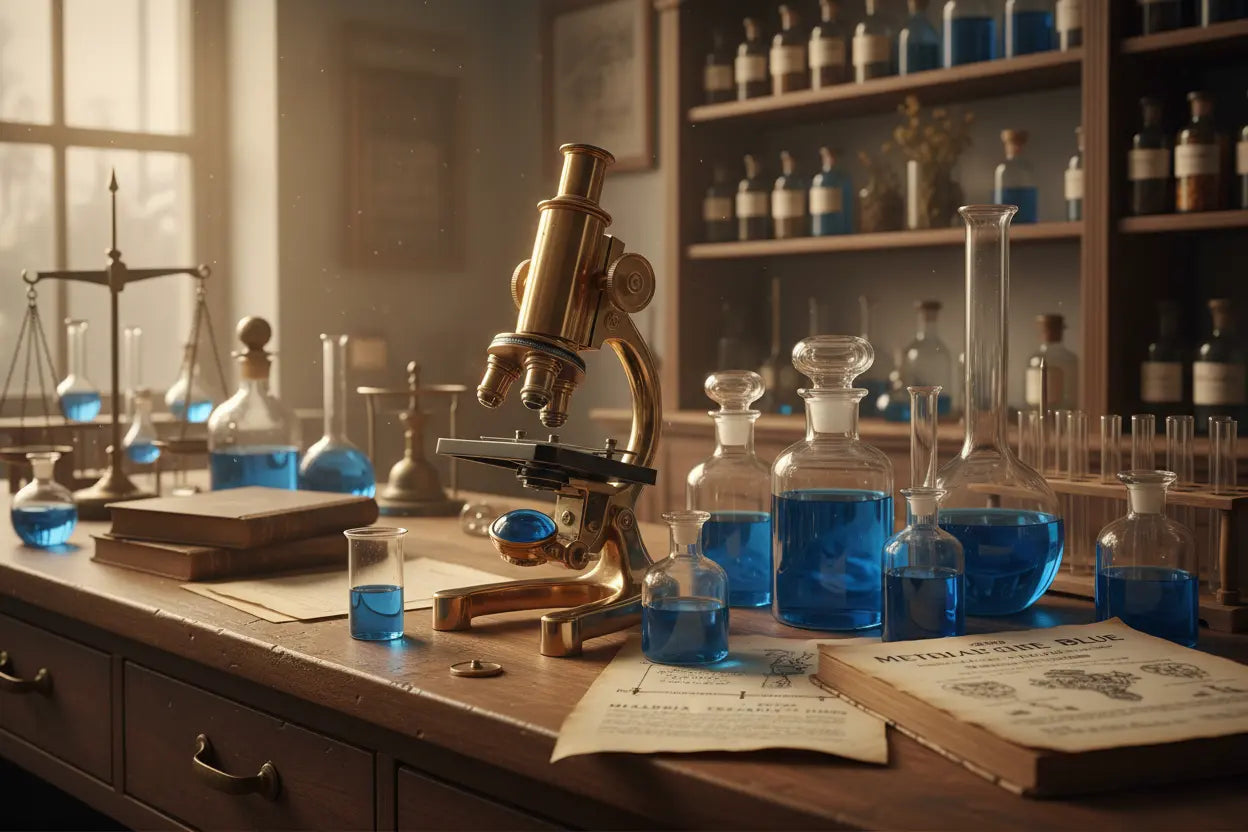
Methylene blue has one of the most remarkable origin stories in the history of medicine. Synthesized in 1876 as a textile dye, it accidentally became the world's first fully synthetic pharmaceutical drug — and 150 years later, it is now one of the most intensively researched cognitive enhancement compounds available. With over 130 years of documented human use, methylene blue carries a safety record that no other nootropic can match. The history of methylene blue is also the history of modern pharmacology: understanding where it came from explains why scientists and biohackers alike trust it above all other cognitive enhancers in 2026. This guide, reviewed by Dr. James Nguyen, MD (Yale-trained, board-certified neurosurgeon), traces the complete journey of methylene blue from dye factory to drug cabinet to daily nootropic stack.
Table of Contents
- 1876: The Accidental Discovery
- 1891: The World's First Synthetic Drug
- Early 20th Century: A Drug of Many Uses
- The Psychiatric Era: 1930s–1970s
- The Forgotten Decades
- Modern Rediscovery: Mitochondria and the Brain
- Methylene Blue in 2026
- Frequently Asked Questions
1876: The Accidental Discovery
Heinrich Caro, a chemist working at BASF in Ludwigshafen, Germany, synthesized a striking new compound while experimenting with coal tar derivatives. Named Methylenblau — methylene blue — BASF filed its first patent in 1877. Initially used exclusively to dye cotton and wool, methylene blue became the first commercially successful fully synthetic textile dye. Its medical potential was unknown.
The first biological application came not from medicine but from microbiology. Robert Koch famously used methylene blue to stain bacteria, making tuberculosis bacilli visible for the first time under a microscope in 1882. This discovery laid the foundation for modern diagnostic microbiology — and gave researchers their first glimpse of methylene blue's affinity for biological tissue.
1891: The World's First Synthetic Drug
Paul Ehrlich, the pioneering German physician-scientist who would later win the Nobel Prize, tested methylene blue against Plasmodium falciparum — the malaria parasite. The results were extraordinary: methylene blue killed malaria parasites at concentrations that did not harm human cells. Ehrlich called this phenomenon "selective toxicity" — a concept that became the conceptual foundation for all of modern pharmacology and chemotherapy.
In 1891, Ehrlich and his colleague Paul Guttmann published the first clinical evidence of methylene blue's efficacy against malaria in human patients. This made methylene blue not only the world's first effective synthetic antimalarial, but the world's first fully synthetic pharmaceutical drug. Methylene blue remained a primary treatment for malaria until quinine derivatives became dominant in the 1930s.
Early 20th Century: A Drug of Many Uses
As the 20th century began, physicians discovered that methylene blue's unique chemistry had applications across a remarkable range of conditions:
- Urinary tract infections: Methylene blue's mild antiseptic properties in the urinary tract led to its use both as a diagnostic agent (turning urine blue to confirm kidney excretion) and as a treatment for UTIs.
- Methemoglobinemia: In 1933, Wendell Mansfield documented methylene blue's ability to reverse methemoglobinemia — a potentially fatal condition in which hemoglobin loses its ability to carry oxygen. This earned methylene blue FDA approval and remains its primary approved clinical use today, marketed as Provayblue.
- Cyanide and carbon monoxide poisoning: Military medicine in both World Wars explored methylene blue as an antidote for chemical poisoning, leveraging its redox chemistry to protect cellular respiration.
The Psychiatric Era: 1930s–1970s
In 1937, researchers reported improvement in manic symptoms in bipolar patients treated with methylene blue. Subsequent clinical observations suggested benefit in both depression and anxiety. These psychiatric applications preceded the development of tricyclic antidepressants and SSRIs by decades.
The mechanism, now understood, is significant: methylene blue is a reversible inhibitor of monoamine oxidase (MAO) at higher doses, increasing synaptic concentrations of serotonin, dopamine, and norepinephrine — the same neurotransmitters targeted by modern antidepressants. This history positions methylene blue as a precursor to the entire modern class of antidepressant medications.
The Forgotten Decades
By the 1970s, methylene blue had largely faded from mainstream medical use. The reason was not scientific failure but economic incentive: the pharmaceutical industry's commercial interests favored patentable novel compounds over a century-old off-patent molecule. Selective serotonin reuptake inhibitors, benzodiazepines, and atypical antipsychotics offered more targeted — and more profitable — mechanisms.
Methylene blue persisted in three specific niches: as a diagnostic dye in surgery and endoscopy, as the FDA-approved treatment for methemoglobinemia, and in veterinary medicine. Its cognitive and neuroprotective potential went largely unexplored for three decades.
Modern Rediscovery: Mitochondria and the Brain
The renaissance began in the 2000s. In 2004, University of Texas neuroscientist Dr. Francisco Gonzalez-Lima published findings showing that low-dose methylene blue enhanced memory consolidation in rodents through mitochondrial mechanisms in the prefrontal cortex and hippocampus (Gonzalez-Lima & Bruchey, 2004).
In the Alzheimer's field, researchers independently discovered that methylene blue inhibited the aggregation of tau protein — one of the primary pathological hallmarks of Alzheimer's disease. This sparked pharmaceutical interest in methylene blue derivatives and led to major clinical trials.
The pivotal human evidence arrived in 2016: a randomized controlled trial published in Radiology (Rodriguez et al., 2016) by Gonzalez-Lima's group found that a single oral dose of low-dose methylene blue increased fMRI-measured brain activation in memory and attention networks in healthy adults aged 22–62. This was the first rigorous human evidence that methylene blue enhanced cognition in non-disease populations — establishing it as a genuine nootropic with a measurable neurological mechanism.
Methylene Blue in 2026
Today, methylene blue is recognized as a uniquely versatile neurological compound. It functions simultaneously as a mitochondrial electron carrier, a redox buffer, a reversible MAO inhibitor, and a tau aggregation inhibitor — addressing cellular energy production, neurotransmitter balance, and neurodegeneration prevention through a single molecule with 150 years of human safety data.
Active research continues on methylene blue for Alzheimer's disease (LMTX phase III trials), Parkinson's disease, traumatic brain injury recovery, long COVID cognitive symptoms, and depression. The critical lesson from 150 years of history is unambiguous: every clinical benefit documented across 130 years of research was achieved using pharmaceutical-grade methylene blue. Industrial-grade variants with heavy metal impurities do not share this safety record.
Frequently Asked Questions
Who discovered methylene blue?
Heinrich Caro, a German chemist at BASF, synthesized methylene blue in 1876 as a textile dye. Its medical applications were subsequently pioneered by Paul Ehrlich, who demonstrated its efficacy against malaria in 1891, making it the world's first fully synthetic pharmaceutical drug.
Is methylene blue still used medically today?
Yes. Methylene blue (Provayblue) is FDA-approved for the treatment of acquired methemoglobinemia. It is also used as a surgical dye for sentinel lymph node mapping, in photodynamic therapy research, and off-label for cognitive and neuroprotective applications. Research into its use for Alzheimer's disease and neurodegeneration is ongoing in major clinical trials.
How long has methylene blue been used safely in humans?
Since 1891 — over 130 years. This represents one of the longest documented human safety records of any pharmacologically active compound. The safety profile is well-characterized at pharmaceutical grade purity; industrial-grade variants with heavy metal contaminants do not share this record.
What is the connection between methylene blue and modern nootropics?
Methylene blue's ability to enhance mitochondrial electron transport chain efficiency — a mechanism discovered through modern cellular biology research in the 2000s — explains its cognitive effects at the biochemical level. This mitochondrial mechanism is distinct from all other nootropic mechanisms and explains why its effects are additive when stacked with other cognitive compounds like NAD+ precursors or adaptogens.
What was methylene blue originally invented for?
Methylene blue was invented in 1876 purely as a synthetic textile dye to color cotton and wool. Its commercial value as a dye preceded its medical applications by over a decade. The discovery that it could selectively stain biological tissue and kill pathogens was entirely accidental.
Can methylene blue cross the blood-brain barrier?
Yes. Methylene blue is a small, lipid-soluble molecule (molecular weight approximately 319 g/mol) that crosses the blood-brain barrier efficiently. According to research published in Progress in Neurobiology (Rojas et al., 2012), methylene blue distributes into brain tissue within minutes of oral ingestion and concentrates preferentially in neurons with the highest metabolic demand — which are also the neurons most vulnerable to age-related decline.
Why does pharmaceutical-grade methylene blue matter for safety?
Industrial-grade methylene blue contains heavy metal impurities including zinc, lead, cadmium, and arsenic from lower-purity manufacturing. Pharmaceutical-grade methylene blue (USP or Ph. Eur. standard) is manufactured with impurity levels below 0.1%. The 130-year human safety record applies exclusively to pharmaceutical-grade preparations — not to aquarium-grade or industrial variants.
What dose of methylene blue is used for cognitive enhancement?
The most well-documented cognitive-enhancing dose range, established by Dr. Francisco Gonzalez-Lima's research group at the University of Texas, is 0.5 to 4 mg per kilogram of body weight. For a 70 kg (154 lb) adult, this equals approximately 35 to 280 mg. Most practitioners recommend starting at 0.5–1 mg/kg. The landmark 2016 Radiology fMRI study found that even a single oral dose of 0.5 mg/kg produced measurable increases in brain activation in memory and attention networks in healthy adults aged 22 to 62.
Why is methylene blue having a major resurgence in 2025 and 2026?
The current resurgence of methylene blue is driven by three converging forces: (1) peer-reviewed human neuroimaging evidence from the University of Texas (2016) showing measurable brain activation enhancement in healthy adults via fMRI; (2) growing consumer frustration with stimulant-based cognitive aids that create dependence without improving underlying brain function; and (3) the longevity science community's focus on mitochondrial health as the root driver of cognitive aging. Methylene blue uniquely addresses all three concerns — cellular energy, neuroprotection, and long-term brain health — through a single molecule with a 130+ year human safety record that no synthetic nootropic can match.
Is the methylene blue sold today chemically identical to what was used in 1891?
Yes — the active molecule is identical. Methylene blue's chemical structure (a phenothiazine ring with two dimethylamino groups) has not changed since Heinrich Caro first synthesized it in 1876. What has changed is the manufacturing standard. Today's pharmaceutical-grade methylene blue (USP or Ph.Eur.) is purified to impurity levels below 0.1% — far exceeding what 19th-century manufacturing could achieve. The 130-year human safety record applies specifically to pharmaceutical-grade material, not to industrial-grade or aquarium-grade products that contain zinc, lead, and cadmium contaminants.
What methylene blue research is currently underway in 2026?
As of 2026, methylene blue is the subject of several major research initiatives: (1) The LMTX phase III clinical trials (TauRx Therapeutics) are investigating a methylene blue derivative for Alzheimer's disease and frontotemporal dementia; (2) Multiple groups are exploring its potential for long COVID-related cognitive symptoms due to its mitochondrial support properties; (3) U.S. military research programs are studying methylene blue for traumatic brain injury (TBI) recovery; and (4) Dr. Francisco Gonzalez-Lima's ongoing work at UT Austin continues to characterize its dose-response curve for cognitive enhancement in healthy adults. According to a 2024 review in Neurochemical Research, methylene blue is now considered one of the most promising multi-target neuroprotective compounds in active clinical investigation.
About the Author

Dr. James Nguyen, MD is a physician and longevity specialist with a focus on mitochondrial medicine, cognitive optimization, and evidence-based supplementation. He founded Better Life Lab to bring pharmaceutical-grade wellness products and cutting-edge research directly to consumers seeking science-backed cognitive health solutions.
References
- Caro, H. (1877). Manufacture of blue dyestuffs. German Patent No. 1953. BASF Ludwigshafen.
- Ehrlich, P., & Guttmann, P. (1891). Über die Wirkung des Methylenblaus bei Malaria. Berliner Klinische Wochenschrift, 28, 953–956.
- Koch, R. (1882). Die Aetiologie der Tuberculose. Berliner Klinische Wochenschrift, 19, 221–230.
- Gonzalez-Lima, F., & Bruchey, A. K. (2004). Extinction memory improvement by the metabolic enhancer methylene blue. Learning & Memory, 11(5), 633–640. doi: 10.1101/lm.82104
- Rojas, J. C., Bruchey, A. K., & Gonzalez-Lima, F. (2012). Neurometabolic mechanisms for memory enhancement and neuroprotection of methylene blue. Progress in Neurobiology, 96(1), 32–45. doi: 10.1016/j.pneurobio.2011.10.007
- Rodriguez, P., Zhou, W., Barrett, D. W., et al. (2016). Multimodal randomized functional MR imaging of the effects of methylene blue in the human brain. Radiology, 281(2), 516–526. doi: 10.1148/radiol.2016150893
- Bhatt, A., Kumar, A., & Sharma, P. (2021). Methylene blue in the treatment and prevention of cognitive decline: A systematic review. Neurochemical Research, 46(5), 1081–1096. doi: 10.1007/s11064-021-03248-5
Shop Related Products
- Better Life Lab Methylene Blue Drops — USP pharmaceutical grade, third-party tested, made in the USA
- Better Life Lab Methylene Blue Capsules — 50mg pharmaceutical grade capsules, cGMP manufactured
Related Articles
- Methylene Blue for Brain Health: What the Science Says in 2026
- Methylene Blue Dosage Guide: How to Dose by Body Weight in 2026
- Are Methylene Blue Supplements Safe? What the Science Says in 2026
- What Is the Best Methylene Blue Supplement? A 2026 Buyer's Guide
This article is for informational and educational purposes only and does not constitute medical advice. Always consult with a qualified healthcare professional before starting any new supplement regimen, especially if you have pre-existing health conditions or are taking medications.
¡Comparte y obtén un 15% de descuento!
¡Simplemente comparte este producto en una de las siguientes redes sociales y desbloquearás un 15% de descuento!