Key Takeaways
- Oxidative stress occurs when reactive oxygen species (ROS) production exceeds the body's antioxidant capacity, damaging cellular components including DNA, proteins, and lipid membranes
- The brain is disproportionately vulnerable to oxidative stress due to its high oxygen consumption (20% of total body oxygen), abundant polyunsaturated fatty acids, and relatively modest intrinsic antioxidant defenses
- Unlike conventional antioxidants that are consumed when they neutralize a free radical, methylene blue is a catalytic antioxidant — it cycles between oxidized and reduced states repeatedly, neutralizing multiple ROS molecules per molecule of methylene blue
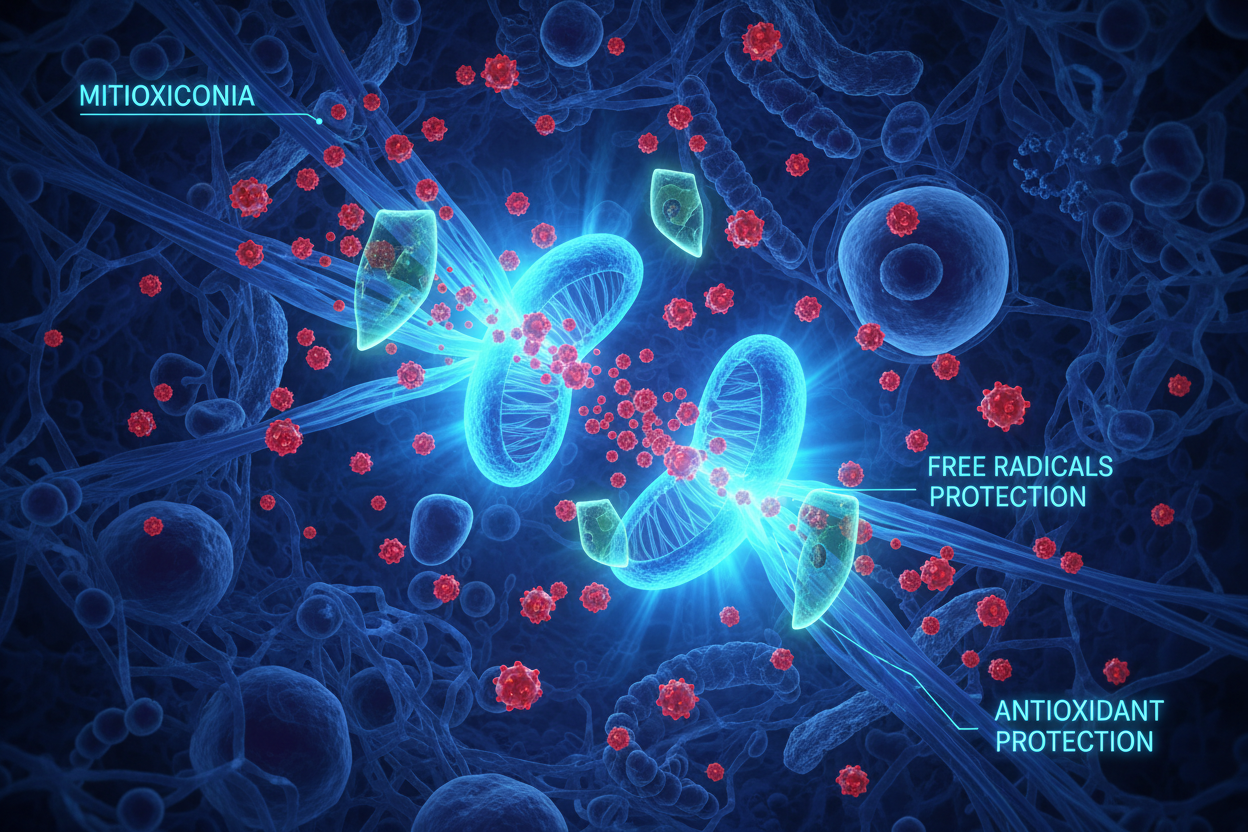
- Methylene blue reduces superoxide and hydrogen peroxide production specifically within mitochondria, targeting oxidative stress at its primary source in the brain
- The hormetic dose-response applies to antioxidant activity as well: low doses are antioxidant, high doses become pro-oxidant
Reviewed by Dr. James Nguyen, MD — Yale-trained, board-certified neurosurgeon. This guide covers the biochemistry of oxidative stress in the brain, methylene blue's catalytic antioxidant mechanism, and why this mechanism is uniquely valuable for neuroprotection.
Table of Contents
- Understanding Oxidative Stress
- Why the Brain Is Especially Vulnerable
- The Limits of Conventional Antioxidants
- Methylene Blue's Catalytic Antioxidant Mechanism
- Targeting Mitochondrial ROS at the Source
- Dose Dependence: The Hormetic Antioxidant Window
- Frequently Asked Questions
Understanding Oxidative Stress
Every cell in the body produces reactive oxygen species (ROS) as an inevitable byproduct of mitochondrial energy production. Superoxide (O₂•⁻), hydrogen peroxide (H₂O₂), and the hydroxyl radical (•OH) are the primary culprits — highly reactive molecules that oxidize nearby biological structures. At low concentrations, ROS serve essential signaling functions: they mediate immune responses, regulate gene expression, and trigger adaptive responses to exercise. When ROS production outpaces the antioxidant defense system, the balance tips into oxidative stress.
Chronic oxidative stress is implicated in the pathogenesis of Alzheimer's disease, Parkinson's disease, ALS, cardiovascular disease, type 2 diabetes, and accelerated aging. The oxidative damage to mitochondrial DNA is particularly consequential: mitochondrial DNA lacks the protective histones and repair mechanisms of nuclear DNA, accumulating mutations over time that progressively impair energy production in a self-reinforcing cycle.
Why the Brain Is Especially Vulnerable
Despite comprising only 2% of body mass, the brain consumes approximately 20% of the body's total oxygen. This disproportionate oxygen consumption generates proportionally large ROS loads. Compounding the problem:
- High polyunsaturated fatty acid (PUFA) content: Neural cell membranes are exceptionally rich in DHA and arachidonic acid — PUFAs with multiple double bonds that are extremely susceptible to lipid peroxidation. Oxidized neural lipids disrupt membrane fluidity and ion channel function, impairing signal transmission.
- Dopamine auto-oxidation: In dopaminergic neurons, dopamine itself can auto-oxidize to form dopamine quinones and hydrogen peroxide — making the substantia nigra (the primary dopaminergic hub) one of the highest intrinsic oxidative stress environments in the brain.
- Modest catalase activity: The brain has lower catalase activity compared to the liver, limiting hydrogen peroxide clearance.
- Post-mitotic neurons: Unlike most cells, neurons cannot dilute accumulated oxidative damage through cell division. Every oxidative insult is cumulative over a lifetime.
The Limits of Conventional Antioxidants
Conventional dietary antioxidants — vitamin C, vitamin E, coenzyme Q10, resveratrol — neutralize free radicals through stoichiometric reactions: one molecule of antioxidant neutralizes one molecule of ROS and is consumed in the process. This "sacrificial" mechanism is biologically valuable but has practical limits.
Large clinical trials of high-dose vitamin E and vitamin C supplementation for cognitive protection have been disappointing, partially because these compounds do not efficiently penetrate mitochondria (where most neuronal ROS are generated) and partially because stoichiometric antioxidants cannot maintain protective concentrations against the continuous ROS flux of active neural tissue.
The PREADVISE trial, the SU.VI.MAX trial, and multiple Cochrane reviews have concluded that supplemental vitamin E, vitamin C, and beta-carotene do not reduce cognitive decline in well-nourished adults. This failure does not mean antioxidant defense is irrelevant — it means the conventional approach is insufficient.
Methylene Blue's Catalytic Antioxidant Mechanism
Methylene blue's antioxidant mechanism is categorically different from conventional antioxidants. Rather than being consumed when it neutralizes a radical, methylene blue is regenerated and can repeat the cycle indefinitely. This is the defining characteristic of a catalytic antioxidant.
The cycle works as follows:
- Methylene blue (oxidized, blue form, MB⁺) accepts two electrons from NADH or FADH₂ in mitochondria, becoming leucomethylene blue (reduced, colorless form, MBH₂)
- Leucomethylene blue donates these electrons to molecular oxygen or directly to superoxide, reducing them to water or non-radical hydrogen peroxide while being reoxidized back to methylene blue
- Methylene blue is now available to repeat the cycle, having neutralized ROS without being consumed
A single molecule of methylene blue can theoretically cycle this reaction thousands of times before any degradation occurs. This catalytic efficiency means that low concentrations of methylene blue can have antioxidant effects that would require far higher concentrations of stoichiometric antioxidants to match.
Targeting Mitochondrial ROS at the Source
The subcellular location of antioxidant activity matters as much as the mechanism. Approximately 90% of neuronal ROS are generated within mitochondria, specifically at Complex I and Complex III of the electron transport chain, where electrons occasionally escape the chain and reduce oxygen to superoxide before reaching the controlled Complex IV reaction.
Most conventional antioxidants remain in the cytoplasm or extracellular space. Methylene blue, by contrast, accumulates within mitochondria due to the mitochondrial membrane potential — the electrochemical gradient that draws positively charged lipophilic cations into the negatively charged mitochondrial matrix. This mitochondrial targeting places methylene blue precisely at the site of highest ROS generation, where its catalytic antioxidant activity is most needed.
Research from the University of Texas confirmed that methylene blue significantly reduces mitochondrial superoxide levels and hydrogen peroxide production in neuronal mitochondria at nanomolar to micromolar concentrations — concentrations readily achievable at standard supplemental doses.
Near-infrared light at 810–850 nm activates the same cytochrome c oxidase (Complex IV) target through photonic stimulation, reducing electron leakage from upstream complexes that generates mitochondrial superoxide. Red light therapy and methylene blue address mitochondrial ROS through complementary mechanisms — methylene blue through biochemical electron shuttling, NIR light through photonic enzyme activation — making them a naturally synergistic pair for mitochondrial antioxidant defense. How red light therapy targets the same mitochondrial pathway →
Dose Dependence: The Hormetic Antioxidant Window
Methylene blue's antioxidant activity is dose-dependent in a biphasic (hormetic) manner that differs from most antioxidants:
- Low doses (0.5–4 mg/kg body weight): Antioxidant. Methylene blue accepts electrons from the mitochondrial chain and delivers them in a controlled fashion, reducing superoxide leakage and maintaining redox balance.
- High doses (>10 mg/kg): Pro-oxidant. At high concentrations, methylene blue competes with endogenous electron acceptors in ways that can increase ROS production rather than reduce it. This pro-oxidant activity has been deliberately exploited in photodynamic therapy for cancer — but represents the opposite of the intended supplemental effect.
The antioxidant window of 0.5–4 mg/kg is well-established in the preclinical literature and consistent with the dose ranges used in positive human trials. Supplemental use should stay within this range, with conservative starting doses of 0.5–1 mg/kg per day.
Frequently Asked Questions
Does methylene blue work better than NAC or glutathione for brain antioxidant protection?
They work through different mechanisms and are complementary. NAC (N-acetylcysteine) boosts glutathione synthesis, supporting the enzymatic antioxidant system. Glutathione directly neutralizes reactive species but is not efficiently absorbed into mitochondria from supplements. Methylene blue's catalytic, mitochondria-targeted mechanism addresses the primary source of neuronal ROS generation that neither NAC nor exogenous glutathione reaches efficiently. The combination of methylene blue (mitochondrial ROS suppression) and NAC (cytoplasmic and extracellular antioxidant defense) addresses different compartments with minimal overlap.
Can I take antioxidant supplements alongside methylene blue?
Generally yes, with attention to timing around exercise. High-dose vitamin E and C taken immediately post-workout may blunt exercise-driven mitochondrial adaptations. For general daily antioxidant support, dietary polyphenols and NAC combine well with methylene blue without known interactions.
Does methylene blue prevent neurodegenerative disease?
Methylene blue's antioxidant and mitochondrial support mechanisms are directly relevant to the pathophysiology of neurodegenerative diseases. Clinical trials are ongoing for Alzheimer's and Parkinson's applications. Current evidence supports methylene blue as a neuroprotective agent at supplemental doses, but no compound has been proven to prevent neurodegenerative disease in humans, and this compound should not be marketed as such.
Related Reading
- What Is Red Light Therapy? — How photobiomodulation activates the same cytochrome c oxidase target to reduce mitochondrial ROS
- Red Light Therapy for Recovery — The mitochondrial evidence for NIR as a recovery and cellular health tool
About the Author

Dr. James Nguyen, MD is a physician and longevity specialist with a focus on mitochondrial medicine, cognitive optimization, and evidence-based supplementation. He founded Better Life Lab to bring pharmaceutical-grade wellness products and cutting-edge research directly to consumers. Dr. Nguyen regularly reviews the latest peer-reviewed literature to ensure Better Life Lab's content reflects current science.
Medical Disclaimer: This article is for informational and educational purposes only and does not constitute medical advice. Always consult with a qualified healthcare professional before starting any new supplement regimen, especially if you have pre-existing health conditions or are taking medications.
¡Comparte y obtén un 15% de descuento!
¡Simplemente comparte este producto en una de las siguientes redes sociales y desbloquearás un 15% de descuento!