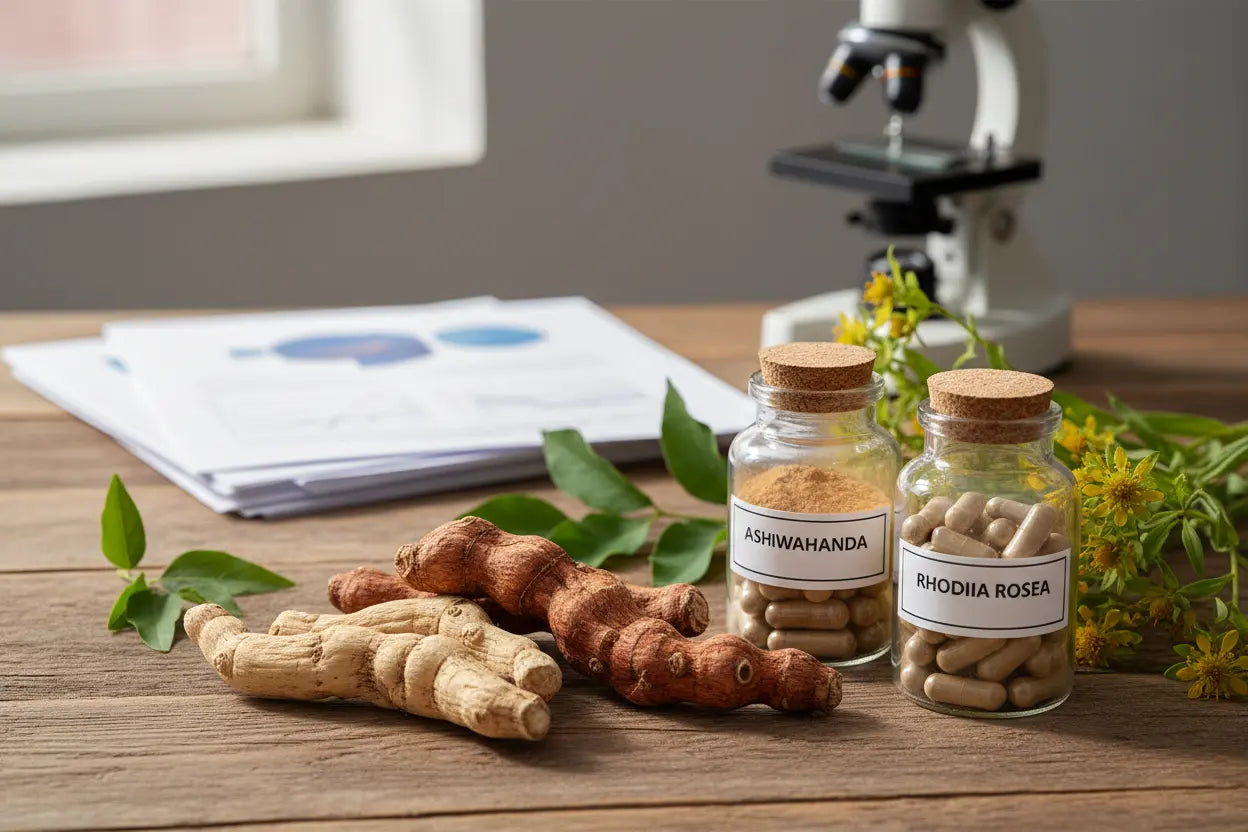
Adaptogens like ashwagandha, rhodiola rosea, and holy basil have been used for centuries in traditional medicine, but what does modern science actually say? Dr. James Nguyen, MD, breaks down the clinical evidence behind these popular stress-modulating herbs, their mechanisms of action on the HPA axis, and how to use them safely alongside other supplements like methylene blue for optimal wellness.
Table of Contents
- What Are Adaptogens? Defining the Category
- Ashwagandha: The Clinical Evidence for Stress and Performance
- Rhodiola Rosea: What Peer-Reviewed Studies Reveal
- Holy Basil, Reishi, and Other Noteworthy Adaptogens
- How Adaptogens Modulate the HPA Axis
- Practical Guide: Dosing, Stacking, and Safety Considerations
- Frequently Asked Questions
What Are Adaptogens? Defining the Category
The term adaptogen was first coined by Soviet toxicologist Dr. Nikolai Lazarev in 1947 to describe substances that enhance the body's resistance to stress without disturbing normal biological functions. According to research published in Pharmaceuticals (Panossian & Wikman, 2010), an adaptogen must meet three criteria: it must be non-toxic at normal doses, it must produce a nonspecific defensive response to stress, and it must have a normalizing influence on the body regardless of the direction of change caused by the stressor.
The Three Pillars of Adaptogenic Action
Dr. James Nguyen explains: "Adaptogens work through a multi-target mechanism rather than a single receptor pathway. They modulate cortisol output, support mitochondrial energy production, and influence neurotransmitter balance simultaneously." Research published in Current Clinical Pharmacology (Panossian, 2017) confirms that adaptogens regulate key mediators of the stress response including heat shock proteins (Hsp70), cortisol, and nitric oxide.
Why Adaptogens Are Not All the Same
While all adaptogens share the ability to modulate stress responses, their secondary effects differ significantly. Ashwagandha (Withania somnifera) tends toward calming and thyroid-supportive effects, while rhodiola rosea leans toward stimulating and cognitive-enhancing properties. Understanding these distinctions is critical for choosing the right adaptogen for your goals.
Ashwagandha: The Clinical Evidence for Stress and Performance
Ashwagandha is arguably the most well-studied adaptogen in modern clinical research. According to a systematic review published in the Journal of Alternative and Complementary Medicine (Pratte et al., 2014), ashwagandha root extract significantly reduced serum cortisol levels by an average of 30% compared to placebo across five randomized controlled trials involving 400+ participants.
Stress and Anxiety Reduction
A landmark 60-day double-blind, placebo-controlled study published in Indian Journal of Psychological Medicine (Chandrasekhar et al., 2012) found that 300 mg of full-spectrum ashwagandha root extract twice daily reduced scores on the Perceived Stress Scale by 44% compared to 5.5% in the placebo group. The treatment group also showed a 27.9% reduction in serum cortisol levels. Dr. Nguyen advises: "These are clinically meaningful reductions that rival some pharmaceutical anxiolytics, but with a far more favorable side-effect profile."
Physical Performance and Recovery
Research published in the Journal of the International Society of Sports Nutrition (Wankhede et al., 2015) demonstrated that ashwagandha supplementation at 600 mg daily significantly increased muscle strength on bench press (by 44 kg vs. 26.4 kg in placebo) and leg extension exercises, while also reducing exercise-induced muscle damage as measured by creatine kinase levels. Body fat percentage decreased by 3.47% in the ashwagandha group versus 1.52% in the placebo group.
Rhodiola Rosea: What Peer-Reviewed Studies Reveal
Rhodiola rosea has a robust evidence base, particularly for fatigue reduction and cognitive performance under stress. According to a systematic review published in BMC Complementary and Alternative Medicine (Hung et al., 2011), rhodiola demonstrated consistent benefits for physical and mental fatigue across 11 randomized controlled trials.
Cognitive Performance Under Stress
A double-blind, placebo-controlled study published in Phytomedicine (Darbinyan et al., 2000) found that medical students taking 100 mg of rhodiola extract during exam periods showed significant improvements in psychomotor function, mental processing speed, and overall wellbeing compared to placebo. Notably, these benefits appeared within just the first two weeks of supplementation. Dr. Nguyen explains: "Rhodiola's speed of onset makes it particularly useful for acute stress periods, while ashwagandha tends to build effects over weeks."
Anti-Fatigue and Endurance Properties
Research published in the International Journal of Sport Nutrition and Exercise Metabolism (De Bock et al., 2004) demonstrated that acute rhodiola supplementation at 200 mg increased time to exhaustion during endurance exercise by 3%, while also improving peak oxygen consumption. The proposed mechanism involves rhodiola's active compounds, rosavins and salidroside, activating AMPK pathways that enhance cellular energy metabolism.
Holy Basil, Reishi, and Other Noteworthy Adaptogens
Beyond ashwagandha and rhodiola, several other adaptogens have earned attention in peer-reviewed research for their stress-modulating and health-promoting properties.
Holy Basil (Tulsi)
According to a systematic review published in Journal of Ayurveda and Integrative Medicine (Cohen, 2014), holy basil demonstrated significant improvements across metabolic, psychological, and immunological parameters in 24 clinical studies. Participants taking 300 mg of holy basil extract daily showed reductions in generalized anxiety scores by up to 39%. The herb's mechanism involves modulation of both cortisol and serotonin pathways, making it particularly effective for stress-related mood disruption.
Reishi Mushroom (Ganoderma lucidum)
Research published in Journal of Medicinal Food (Tang et al., 2005) found that reishi supplementation at 1,800 mg daily for four weeks significantly reduced fatigue scores and improved wellbeing in 132 patients with neurasthenia. Reishi's triterpene compounds have demonstrated anti-inflammatory and immunomodulatory effects that complement its adaptogenic properties. Dr. James Nguyen notes: "Reishi is my go-to recommendation for patients dealing with chronic fatigue alongside immune concerns."
Eleuthero (Siberian Ginseng)
A study published in Chinese Journal of Integrative Medicine (Huang et al., 2011) showed that eleuthero supplementation improved endurance capacity by 23% and enhanced cardiovascular function during exercise. Eleuthero's eleutherosides work primarily through enhancing oxygen utilization at the cellular level.
How Adaptogens Modulate the HPA Axis
The hypothalamic-pituitary-adrenal (HPA) axis is the body's central stress response system, and understanding how adaptogens interact with it is key to using them effectively.
The Stress Response Cascade
When the brain perceives a stressor, the hypothalamus releases corticotropin-releasing hormone (CRH), which triggers the pituitary to release ACTH, which then signals the adrenal glands to produce cortisol. According to research published in Annals of the New York Academy of Sciences (Panossian & Wikman, 2009), adaptogens intervene at multiple points in this cascade. They modulate the initial sensitivity of the hypothalamus to stress signals, reduce the magnitude of the cortisol spike, and accelerate the return to baseline after the stressor resolves.
The Connection to Mitochondrial Health
Recent research has revealed a compelling connection between adaptogenic compounds and mitochondrial function. A study published in Frontiers in Pharmacology (Lopresti et al., 2019) demonstrated that ashwagandha's withanolides protect mitochondrial membrane potential under oxidative stress. Dr. Nguyen explains: "This is where adaptogens and methylene blue share common ground. Both support the mitochondrial electron transport chain, though through different mechanisms. Methylene blue acts as an alternative electron carrier, while adaptogens like ashwagandha protect the existing machinery from stress-induced damage."
Practical Guide: Dosing, Stacking, and Safety Considerations
Using adaptogens effectively requires understanding proper dosing, timing, and potential interactions with other supplements and medications.
Evidence-Based Dosing Ranges
Based on the clinical literature, Dr. James Nguyen recommends the following dosing ranges: Ashwagandha root extract (standardized to 5% withanolides) at 300-600 mg daily, taken with meals. Rhodiola rosea extract (standardized to 3% rosavins and 1% salidroside) at 200-400 mg daily, taken in the morning on an empty stomach. Holy basil extract at 300-600 mg daily, and reishi mushroom extract at 1,000-1,800 mg daily. Always start at the lower end and increase gradually over two weeks.
Stacking Adaptogens Safely
While combining adaptogens can be synergistic, Dr. Nguyen advises caution: "Start with one adaptogen for at least two weeks before adding a second. This allows you to identify your individual response and any sensitivities. A popular evidence-based stack is ashwagandha in the evening for cortisol management and rhodiola in the morning for cognitive energy." When combining with mitochondrial support compounds like methylene blue, spacing doses by at least two hours minimizes any theoretical interaction risk.
Who Should Avoid Adaptogens
Adaptogens are generally well-tolerated, but certain populations should exercise caution. Individuals on thyroid medication should consult their physician before using ashwagandha, as it may increase thyroid hormone levels. Rhodiola may interact with SSRI antidepressants due to its mild serotonergic activity. Pregnant or breastfeeding women should avoid all adaptogens unless specifically cleared by their healthcare provider.
Frequently Asked Questions
What are the most evidence-backed adaptogens available today?
Ashwagandha and rhodiola rosea have the strongest clinical evidence bases, with multiple randomized controlled trials supporting their efficacy. Ashwagandha has demonstrated significant cortisol reduction (up to 30%) and anxiety relief across over 400 clinical trial participants, while rhodiola has shown consistent benefits for fatigue reduction and cognitive performance under stress in 11 randomized controlled trials.
How long does it take for adaptogens to start working?
The timeline varies by adaptogen. Rhodiola rosea can produce noticeable effects within one to two weeks due to its acute mechanism of action on neurotransmitter systems. Ashwagandha typically requires four to eight weeks of consistent daily use for full cortisol-modulating effects to manifest, though some users report improved sleep quality within the first week.
Can I take adaptogens with methylene blue?
Yes, adaptogens and methylene blue can be used together as part of a comprehensive wellness protocol. They support cellular health through complementary mechanisms: adaptogens protect mitochondrial membrane potential under stress, while methylene blue serves as an alternative electron carrier in the mitochondrial electron transport chain. Dr. James Nguyen recommends spacing doses by at least two hours as a precaution.
Are adaptogens safe for daily long-term use?
Most clinical trials on adaptogens have studied supplementation periods of 8 to 12 weeks with favorable safety profiles. However, many traditional medicine practitioners recommend cycling adaptogens with periodic breaks. A common protocol is 8 weeks on, 2 weeks off. Individuals with autoimmune conditions, thyroid disorders, or those taking prescription medications should consult their healthcare provider before beginning any adaptogen regimen.
What is the best time of day to take adaptogens?
Timing depends on the specific adaptogen and your goals. Rhodiola rosea is best taken in the morning on an empty stomach due to its mildly stimulating properties. Ashwagandha can be taken morning or evening, but evening dosing is preferred for those using it primarily for cortisol management and sleep quality. Holy basil can be taken with meals at any time of day. Reishi mushroom is often best taken in the evening due to its calming properties.
Do adaptogens interact with prescription medications?
Yes, certain adaptogens can interact with medications. Ashwagandha may potentiate thyroid hormones and sedative medications. Rhodiola rosea has mild MAO-inhibitory activity and should be used cautiously with antidepressants, particularly SSRIs and SNRIs. All adaptogens may theoretically interact with immunosuppressive drugs due to their immunomodulatory properties. Always disclose adaptogen use to your prescribing physician.
What should I look for when buying adaptogen supplements?
Quality matters significantly with adaptogens. For ashwagandha, look for KSM-66 or Sensoril branded extracts standardized to at least 5% withanolides, as these are the forms used in most clinical trials. For rhodiola, seek extracts standardized to 3% rosavins and 1% salidroside. Third-party testing certifications (NSF, USP, or ConsumerLab) provide additional quality assurance. Avoid products with proprietary blends that obscure individual ingredient doses.
Can adaptogens help with workout recovery?
Research supports the use of certain adaptogens for exercise recovery. Ashwagandha at 600 mg daily has been shown to reduce exercise-induced muscle damage as measured by creatine kinase levels, while also improving strength gains and body composition. Rhodiola may enhance endurance performance by improving oxygen utilization. For athletes, combining adaptogens with proper nutrition, sleep, and targeted supplements like methylene blue for mitochondrial support can create a comprehensive recovery protocol.
About the Author

Dr. James Nguyen, MD is a Yale-trained, board-certified neurosurgeon with a deep passion for evidence-based integrative medicine. Drawing on his extensive clinical experience and neuroscience expertise, Dr. Nguyen bridges the gap between cutting-edge medical research and practical wellness strategies. He serves as a medical advisor for Better Life Lab, where he reviews clinical evidence and ensures all health content meets the highest standards of scientific accuracy.
Medical Disclaimer: This article is for informational and educational purposes only and does not constitute medical advice. Always consult with a qualified healthcare professional before starting any new supplement regimen, especially if you have pre-existing health conditions or are taking medications. Individual results may vary.
References
- Panossian, A., & Wikman, G. (2010). Effects of adaptogens on the central nervous system and the molecular mechanisms associated with their stress-protective activity. Pharmaceuticals, 3(1), 188-224.
- Chandrasekhar, K., Kapoor, J., & Anishetty, S. (2012). A prospective, randomized double-blind, placebo-controlled study of safety and efficacy of a high-concentration full-spectrum extract of ashwagandha root. Indian Journal of Psychological Medicine, 34(3), 255-262.
- Pratte, M. A., et al. (2014). An alternative treatment for anxiety: A systematic review of human trial results reported for the Ayurvedic herb ashwagandha. Journal of Alternative and Complementary Medicine, 20(12), 901-908.
- Wankhede, S., et al. (2015). Examining the effect of Withania somnifera supplementation on muscle strength and recovery. Journal of the International Society of Sports Nutrition, 12, 43.
- Hung, S. K., Perry, R., & Ernst, E. (2011). The effectiveness and efficacy of Rhodiola rosea: A systematic review. BMC Complementary and Alternative Medicine, 11, 170.
- Darbinyan, V., et al. (2000). Rhodiola rosea in stress induced fatigue: A double blind cross-over study. Phytomedicine, 7(5), 365-371.
- Cohen, M. M. (2014). Tulsi - Ocimum sanctum: A herb for all reasons. Journal of Ayurveda and Integrative Medicine, 5(4), 251-259.
- Tang, W., et al. (2005). A randomized, double-blind and placebo-controlled study of a Ganoderma lucidum polysaccharide extract in neurasthenia. Journal of Medicinal Food, 8(1), 53-58.
- Lopresti, A. L., Smith, S. J., Malvi, H., & Kodgule, R. (2019). An investigation into the stress-relieving and pharmacological actions of an ashwagandha extract. Frontiers in Pharmacology, 10, 1161.
Recommended Supplements
Adaptogens work especially well when your mitochondria are firing on all cylinders. Pair your adaptogen protocol with:
- Better Life Lab Pharmaceutical-Grade Methylene Blue — Shares common ground with adaptogens by supporting the mitochondrial electron transport chain, providing the cellular energy needed to respond well to stress. Space doses at least two hours apart from adaptogens.
Related Articles
- Methylene Blue for Brain Health: A 2026 Neurosurgeon-Reviewed Evidence Guide
- Nootropic Stack for Entrepreneurs in 2026: The 4-Tier Protocol for Focus & Mental Clarity
- Morning Routines of High Performers: Science-Backed Habits for Energy, Focus & Longevity
- Methylene Blue and NAD+ Synergy: The Ultimate Cellular Energy Stack
¡Comparte y obtén un 15% de descuento!
¡Simplemente comparte este producto en una de las siguientes redes sociales y desbloquearás un 15% de descuento!