
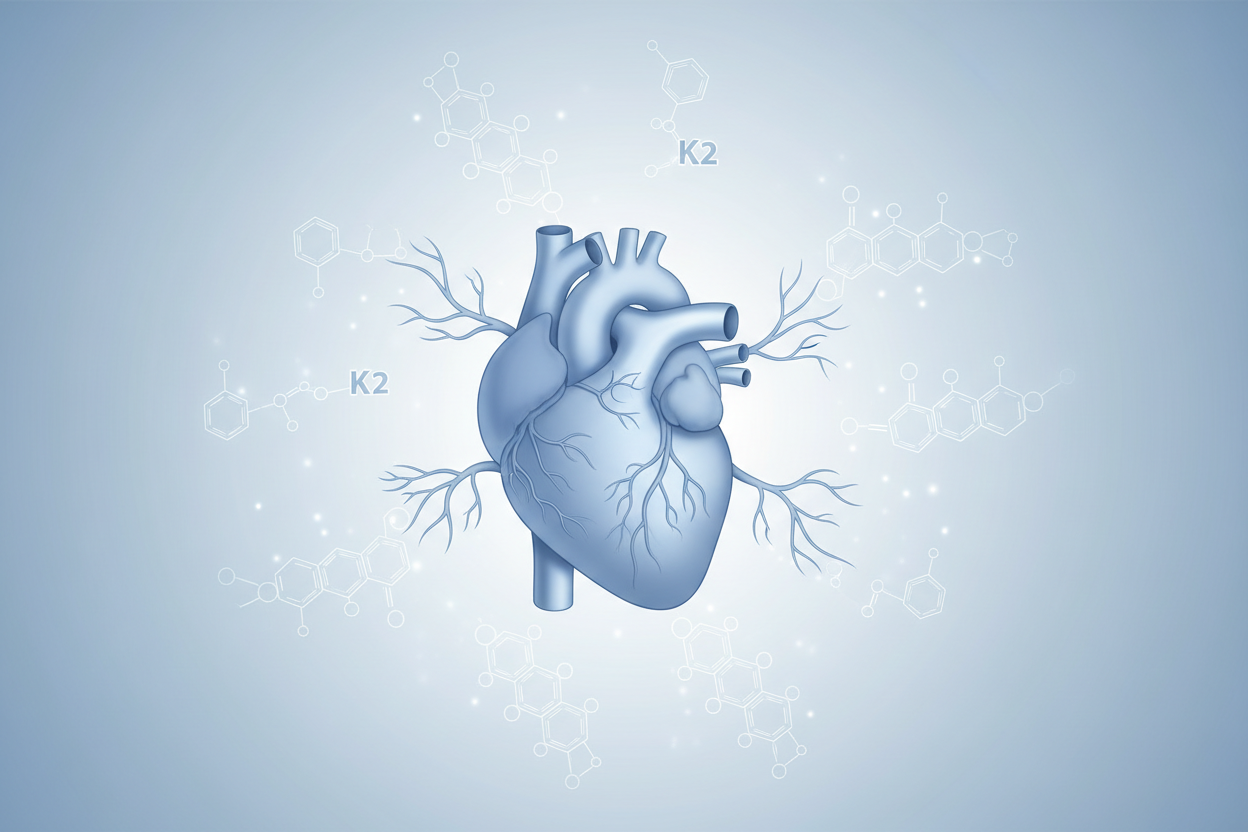
Vitamin K2 is the most under-appreciated nutrient in the longevity conversation. Dr. James Nguyen, MD, explains why this fat-soluble vitamin — not calcium, not even vitamin D alone — may be the single most important factor for keeping your arteries soft, your bones strong, and your biological clock slow. If you care about cardiovascular aging, vitamin K2 for arterial health is a non-negotiable.
Table of Contents
- What Is Vitamin K2 and Why Is It Critical for Longevity?
- The Calcium Paradox: How K2 Directs Calcium to Bones, Not Arteries
- Vitamin K2 and Cardiovascular Disease Risk
- K2, Bone Health, and the Longevity Connection
- Getting Enough K2: Food Sources, Dosage, and Stacking
- A Practical Longevity Protocol for Vitamin K2
- Frequently Asked Questions
- References
What Is Vitamin K2 and Why Is It Critical for Longevity?
Vitamin K2 (menaquinone) is a fat-soluble vitamin that activates a small family of proteins responsible for moving calcium to the right places in your body. While vitamin K1 (phylloquinone) handles blood clotting and comes primarily from leafy greens, K2 governs something arguably more important for healthy aging: where your body deposits calcium.
The Two Forms: MK-4 vs. MK-7
K2 exists in multiple subtypes called menaquinones (MK-4 through MK-13). Two dominate the research: MK-4, found in grass-fed animal products, and MK-7, found in fermented foods like natto. MK-7 has a half-life of approximately 72 hours, while MK-4 clears the bloodstream in about 1-2 hours. For longevity protocols, MK-7 is preferred because a single daily dose maintains steady tissue saturation.
The K1/K2 Confusion Most People Make
Eating a salad does not give you adequate K2. According to research published in the American Journal of Clinical Nutrition, conversion of K1 to K2 in humans is inefficient — often less than 10%. Leafy greens support clotting; they do not meaningfully protect your arteries.
Why K2 Deficiency Is Widespread in Modern Diets
The industrialization of food supply has collapsed K2 intake. Grain-fed cattle produce milk and meat with a fraction of the K2 found in their pasture-raised counterparts. Natto remains a Japanese staple, but most Western populations consume almost none. One Dutch cohort found more than 30% of adults had sub-optimal circulating K2 levels, correlating with higher arterial calcification on imaging.
The Calcium Paradox: How K2 Directs Calcium to Bones, Not Arteries
The so-called calcium paradox describes a counter-intuitive finding in vascular medicine: people who supplement calcium without adequate K2 often develop worse arterial calcification despite modest bone benefits. K2 is the traffic controller that prevents this outcome.
Matrix Gla-Protein (MGP) Activation
Matrix Gla-Protein is the most potent known inhibitor of vascular calcification — but only in its carboxylated (active) form. K2 is the required cofactor for this carboxylation. Without enough K2, MGP remains inactive (dp-ucMGP), and calcium progressively accumulates in the arterial wall. Serum dp-ucMGP levels are now used in cardiology research as a functional marker of K2 status.
The Rotterdam Study and Arterial Calcification
According to research published in the Journal of Nutrition, the landmark Rotterdam Study followed 4,807 adults for roughly a decade and found that the highest tertile of dietary K2 intake was associated with a 52% lower risk of severe aortic calcification and a 57% lower risk of coronary heart disease mortality compared to the lowest tertile. K1 intake showed no such protection.
What Happens Without Adequate K2
Dr. James Nguyen explains: "When MGP cannot be activated, calcium that would otherwise end up in bone instead deposits in the tunica media of arteries. Over decades, this is what hardens vessels, raises pulse pressure, and drives the cardiovascular events we spend most of our medical budget trying to prevent."
Vitamin K2 and Cardiovascular Disease Risk
If your goal is to add healthy years rather than merely extend lifespan, vascular aging is the primary enemy. Pulse-wave velocity, arterial stiffness, and coronary calcium are among the strongest predictors of all-cause mortality in adults over 50. K2 affects all three.
Reducing Arterial Stiffness
A 3-year randomized placebo-controlled trial in postmenopausal women (Knapen et al., Thrombosis and Haemostasis) administered 180 mcg of MK-7 daily. The K2 group showed a statistically significant reduction in carotid-femoral pulse wave velocity and Stiffness Index Beta, while placebo participants saw both metrics worsen. Functionally, the K2 group aged more slowly at the vascular level.
Coronary Artery Calcium Scores
According to research published in Atherosclerosis, higher circulating K2 and lower dp-ucMGP correlate with slower progression of coronary artery calcium, one of the most actionable imaging markers for heart disease risk. No pharmaceutical has yet been shown to regress established calcium deposits, making prevention via K2 especially valuable.
Meta-Analyses on K2 and Heart Events
A 2021 meta-analysis in Nutrients pooled 21 studies and found higher K2 intake was associated with approximately a 30% reduction in coronary heart disease risk. Effect sizes were larger for MK-7 than MK-4, likely reflecting the longer half-life and more stable plasma concentrations of MK-7.
K2, Bone Health, and the Longevity Connection
Bones and arteries are mirror images of the same calcium story. A population that loses calcium from bone often deposits it in vessels — a phenomenon sometimes called the "bone-vascular axis." K2 helps close this loop.
Osteocalcin Activation
Osteocalcin is a bone-matrix protein produced by osteoblasts. Like MGP, it must be carboxylated by K2 to bind calcium into hydroxyapatite crystal. Undercarboxylated osteocalcin (ucOC) is a validated marker of functional K2 deficiency, and higher ucOC predicts hip fracture risk independently of bone mineral density.
Fracture Risk Reduction in Postmenopausal Women
Japanese registry data on 45 mg/day of MK-4 show reductions in vertebral fracture incidence by up to 60% in osteoporotic women, although doses used clinically in Japan are roughly 250-fold higher than typical supplement levels in the US. Lower-dose MK-7 trials (180-360 mcg) consistently improve bone turnover markers and slow bone mineral density loss at the femoral neck.
Why Bones and Arteries Are Two Sides of the Same Coin
Dr. James Nguyen explains: "Patients who present with osteoporosis often have vascular calcification on imaging — they are displaying the same underlying failure to traffic calcium. Treating only one side with bisphosphonates or statins misses the shared mechanism K2 addresses directly."
Getting Enough K2: Food Sources, Dosage, and Stacking
Adequate K2 status is achievable with either a deliberate diet or a well-chosen supplement. Most longevity-focused practitioners recommend both.
Natto, Cheese, and Grass-Fed Dairy
Natto is the densest natural source of MK-7, containing roughly 900-1,100 mcg per 100 g. Hard aged cheeses — Gouda, Edam, Brie — supply moderate amounts of MK-8 and MK-9. Grass-fed butter, egg yolks from pastured hens, and the dark meat of grass-fed poultry contribute MK-4. Conventional US supermarket dairy provides almost none.
MK-7 Dosage Recommendations
Clinical longevity protocols typically use 90-200 mcg of MK-7 daily. Above this range, benefits plateau for cardiovascular endpoints. All-trans MK-7 is the only isomer validated in major trials — look for third-party certificates of analysis confirming at least 99% trans configuration.
Stacking with Vitamin D3 and Magnesium
Vitamin D3 increases intestinal calcium absorption; K2 determines where that calcium ends up; magnesium is required for D3 activation and bone mineralization. Stacking all three is a foundational longevity move. Typical pairing: 2,000-5,000 IU D3, 100-200 mcg MK-7, and 300-400 mg of magnesium glycinate or malate, taken with a fat-containing meal.
A Practical Longevity Protocol for Vitamin K2
The following framework reflects how Dr. James Nguyen structures K2 for patients focused on cardiovascular and skeletal longevity. It is educational — not a substitute for individualized medical advice.
Baseline Testing
Two practical markers move the conversation from guesswork to data: serum dp-ucMGP (a functional K2 status marker) and a coronary artery calcium (CAC) score via non-contrast CT. A high dp-ucMGP combined with a rising CAC is the most compelling signal that K2 optimization is warranted.
Target Doses
For preventive longevity: 100-180 mcg of MK-7 daily with the largest fat-containing meal. For patients with documented arterial calcification or low bone mineral density: 180-360 mcg MK-7 daily, optionally combined with 5 mg MK-4 dosed three times per day. Reassess dp-ucMGP every 6 months.
Avoiding Interactions (Warfarin)
Vitamin K antagonists such as warfarin work by blocking K-dependent clotting factors. Patients on these drugs must coordinate any K2 supplementation directly with their prescribing clinician; abrupt initiation can destabilize INR. Direct-acting oral anticoagulants (DOACs) do not have this interaction.
Frequently Asked Questions
Can I get enough vitamin K2 from food alone?
Possibly, but only if your diet regularly includes natto, aged hard cheeses, grass-fed dairy, and pasture-raised egg yolks. For most Western diets, supplementation is a reliable way to achieve the 100-180 mcg/day associated with cardiovascular benefit.
Is MK-7 or MK-4 better for longevity?
For day-to-day cardiovascular protection, MK-7 is preferred because its 72-hour half-life produces steady plasma levels with a single daily dose. MK-4 has stronger osteocalcin effects at high doses but requires multiple daily doses.
Can vitamin K2 reverse arterial calcification?
Some trials suggest K2 can slow progression and modestly reduce arterial stiffness, but robust evidence of established calcium deposit regression is limited. Prevention and early intervention remain the highest-yield strategies.
Is vitamin K2 safe to take with vitamin D3?
Yes — and the combination is synergistic. D3 raises calcium absorption; K2 ensures it goes to bone rather than soft tissue. The two are routinely stacked in longevity protocols.
What is dp-ucMGP, and should I test for it?
Dp-ucMGP is the inactive form of matrix Gla-protein and serves as a functional marker of vitamin K2 status. High values indicate insufficient K2 for arterial protection. Testing is most useful if you already have cardiovascular risk factors or a high CAC score.
Can K2 interfere with blood-thinning medications?
It can interfere with vitamin K antagonists like warfarin by restoring clotting-factor activation. It does not interact meaningfully with DOACs such as apixaban or rivaroxaban. Always coordinate with your prescriber.
How long does it take to see benefits from vitamin K2 supplementation?
Functional markers like dp-ucMGP shift within 4-8 weeks. Structural markers — arterial stiffness, bone density, and coronary calcium — typically require 12-36 months of consistent supplementation to show measurable change.
Is vitamin K2 worth taking if I already take a multivitamin?
Most multivitamins contain K1, not K2, and even when K2 is included, the dose is usually below 50 mcg. A dedicated K2 supplement at a longevity-relevant dose is usually warranted.
About the Author

Dr. James Nguyen, MD is a Yale-trained, board-certified neurosurgeon with deep expertise in cerebrovascular and systemic vascular aging. He has reviewed the vitamin K2 and cardiovascular literature extensively and writes on evidence-based longevity strategies rooted in vascular preservation and mitochondrial health.
Medical Disclaimer
This article is for educational purposes only and is not intended as medical advice. Statements regarding dietary supplements have not been evaluated by the FDA and are not intended to diagnose, treat, cure, or prevent any disease. Always consult your physician or qualified healthcare provider before starting any supplement, especially if you are taking vitamin K antagonists, have a history of clotting disorders, or are pregnant or nursing.
References
- Geleijnse JM, Vermeer C, Grobbee DE, et al. Dietary intake of menaquinone is associated with a reduced risk of coronary heart disease: the Rotterdam Study. Journal of Nutrition. 2004;134(11):3100-3105.
- Knapen MHJ, Braam LAJLM, Drummen NE, et al. Menaquinone-7 supplementation improves arterial stiffness in healthy postmenopausal women: a double-blind randomised clinical trial. Thrombosis and Haemostasis. 2015;113(5):1135-1144.
- Schurgers LJ, Teunissen KJF, Hamulyak K, et al. Vitamin K-containing dietary supplements: comparison of synthetic vitamin K1 and natto-derived menaquinone-7. Blood. 2007;109(8):3279-3283.
- Beulens JWJ, Bots ML, Atsma F, et al. High dietary menaquinone intake is associated with reduced coronary calcification. Atherosclerosis. 2009;203(2):489-493.
- Zwakenberg SR, den Braver NR, Engelen AIP, et al. Vitamin K intake and all-cause and cause-specific mortality. Clinical Nutrition. 2017;36(5):1294-1300.
- Shea MK, OHanlon CE, Wengreen HJ, et al. Circulating vitamin K and the risk of cardiovascular disease in older adults. American Journal of Clinical Nutrition. 2020;111(6):1170-1177.
- Rodriguez-Olleros Rodriguez C, Diaz Curiel M. Vitamin K and Bone Health: A Review on the Effects of Vitamin K Deficiency and Supplementation and the Effect of Non-Vitamin K Antagonist Oral Anticoagulants on Different Bone Parameters. Journal of Osteoporosis. 2019;2019:2069176.
- Halder M, Petsophonsakul P, Akbulut AC, et al. Vitamin K: Double Bonds beyond Coagulation Insights into Differences between Vitamin K1 and K2 in Health and Disease. International Journal of Molecular Sciences. 2019;20(4):896.
- Ma ML, Ma ZJ, He YL, et al. Efficacy of vitamin K2 in the prevention and treatment of postmenopausal osteoporosis: a systematic review and meta-analysis. Frontiers in Public Health. 2022;10:979649.
Share and get 15% off!
Simply share this product on one of the following social networks and you will unlock 15% off!