
Rapamycin and mTOR sit at the center of modern longevity science. In this guide, Dr. James Nguyen, MD, breaks down how this once-obscure transplant drug became the most-studied pharmaceutical in life-extension research, what mTOR inhibition actually does inside your cells, and what the human evidence really shows in 2026.
Table of Contents
- What Is Rapamycin? A Brief History
- Understanding mTOR: The Master Regulator of Aging
- How Rapamycin Inhibits mTOR (And Why That Matters)
- The Longevity Evidence: What Studies Show
- Risks, Side Effects, and Off-Label Considerations
- Methylene Blue and Rapamycin: The Mitochondrial Connection
- Frequently Asked Questions
What Is Rapamycin? A Brief History
Few molecules have made a more unlikely journey from a remote Pacific island to the cutting edge of geroscience. Rapamycin, also known as sirolimus, was first isolated in the 1970s from a soil bacterium found on Rapa Nui (Easter Island). It was approved by the FDA in 1999 as an immunosuppressant for organ transplant patients.
From Easter Island to Anti-Aging Research
According to research published in Nature (Harrison et al., 2009), rapamycin was the first pharmacological intervention shown to extend lifespan in genetically heterogeneous mice, even when administered late in life. That finding, from the National Institute on Aging's Interventions Testing Program, fundamentally reshaped how scientists think about pharmacological approaches to aging.
From Transplant Drug to Longevity Candidate
Dr. James Nguyen explains: "Rapamycin is one of the most studied molecules in pharmacology, but its longevity application is what has clinicians paying attention. We have decades of safety data from transplant medicine — that gives us a baseline most experimental longevity compounds simply don't have." Today, rapamycin is the most-cited compound in longevity literature on PubMed, with over 60,000 indexed publications as of early 2026.
Understanding mTOR: The Master Regulator of Aging
To understand rapamycin, you have to understand mTOR — short for "mechanistic target of rapamycin." This protein kinase is the central node coordinating how your cells respond to nutrients, growth signals, and stress.
What Does mTOR Actually Do?
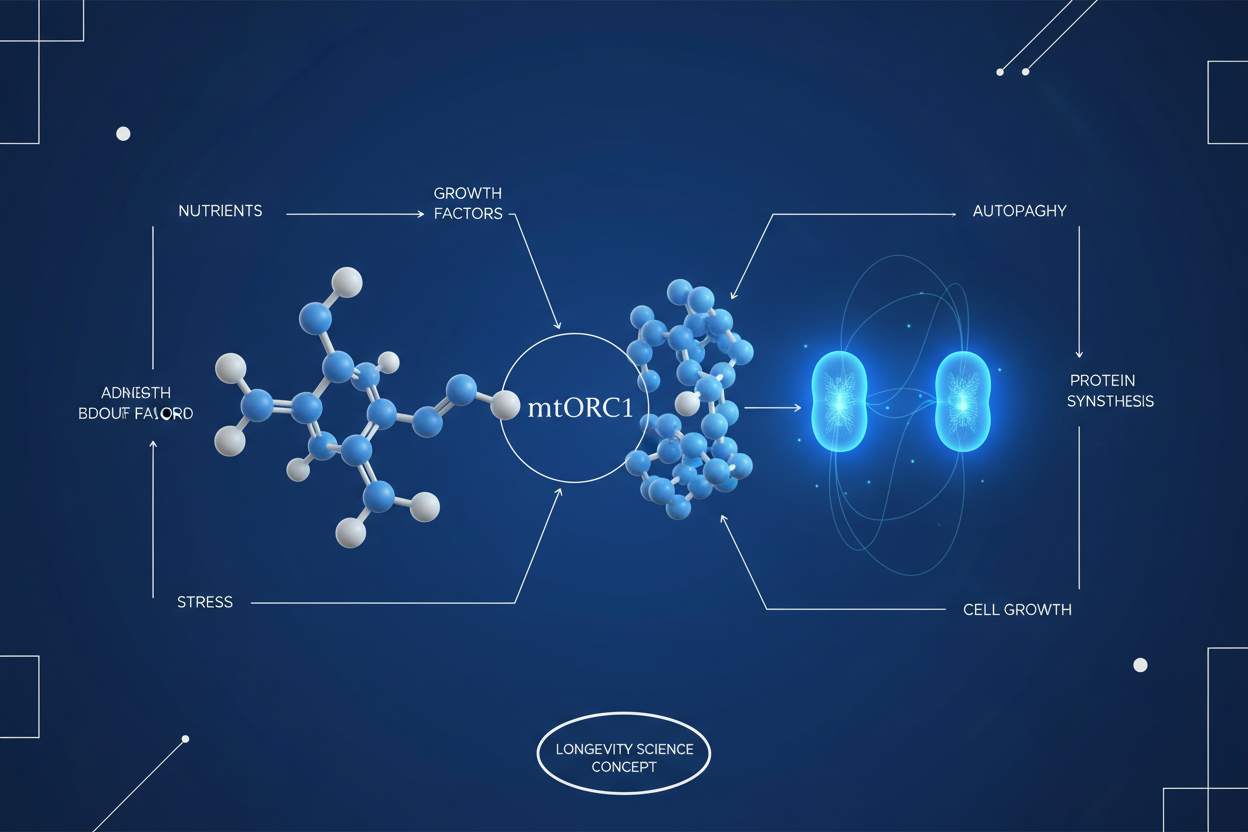
mTOR integrates signals from amino acids, glucose, insulin, and growth factors to decide whether a cell should grow, divide, and synthesize proteins — or whether it should slow down, recycle damaged components, and conserve resources. When nutrients are abundant, mTOR is active and growth-oriented. When nutrients are scarce, mTOR quiets down and the cell switches into maintenance mode.
mTORC1 vs mTORC2: The Two Complexes
mTOR functions as part of two distinct protein complexes. mTORC1 governs protein synthesis, lipid metabolism, and autophagy — and is the complex most relevant to aging. mTORC2 controls cytoskeletal organization and certain aspects of insulin signaling. Rapamycin acutely inhibits mTORC1 with high specificity; chronic dosing can also affect mTORC2, which underlies some of its metabolic side effects.
Why mTOR Hyperactivation Accelerates Aging
According to a 2024 review published in Cell Metabolism (Kennedy and Lamming, 2024), persistent mTOR activation drives nearly every recognized hallmark of aging: impaired autophagy, cellular senescence, mitochondrial dysfunction, and chronic inflammation. Modern diets — high in protein and constant calorie availability — keep mTOR chronically elevated, which may be one mechanism behind accelerated biological aging in industrialized populations.
How Rapamycin Inhibits mTOR (And Why That Matters)
Rapamycin doesn't bind mTOR directly. Instead, it forms a complex with a protein called FKBP12, and that complex docks onto mTORC1 — physically obstructing its activity. The result is a partial, reversible inhibition that mimics what happens during caloric restriction.
The Molecular Mechanism
This indirect inhibition is part of why rapamycin is considered relatively well-tolerated at intermittent doses. According to research published in Science Translational Medicine (Mannick et al., 2014), even short courses of mTOR inhibition in older adults improved immune response to vaccination by approximately 20%, suggesting partial mTOR suppression rejuvenates aging immune systems.
Cellular Effects: Autophagy, Senescence, and Inflammation
Dr. James Nguyen explains: "When mTOR is partially inhibited, the cell flips a switch toward maintenance. Autophagy ramps up, damaged proteins get cleared, and the inflammatory tone of the cell quiets down. That's the longevity-relevant phenotype we're trying to mimic." Studies show rapamycin can clear senescent (zombie) cells, restore mitochondrial function, and reduce systemic inflammation markers like IL-6 and CRP.
The Longevity Evidence: What Studies Show
Rapamycin is the only pharmaceutical that has reliably extended lifespan across yeast, worms, flies, and mammals. The question every patient asks: does it work in humans?
Animal Studies — Mice, Worms, Flies
According to data from the NIA Interventions Testing Program (Miller et al., 2014), rapamycin extended median lifespan in male mice by 9% and female mice by 14%, even when started at 20 months of age — roughly equivalent to a 60-year-old human starting therapy. Subsequent studies have shown lifespan extensions of up to 26% with optimized dosing protocols.
Human Trials and the PEARL Study
The PEARL trial (Participatory Evaluation of Aging with Rapamycin for Longevity), published in Aging (Lee et al., 2024), enrolled 114 healthy adults on weekly rapamycin for 48 weeks. Participants showed improvements in lean muscle mass, pain scores, and self-reported quality of life — without serious adverse events. It was the first prospective human trial designed specifically to test rapamycin for healthy aging.
The Dosing Question: Daily vs Weekly
Daily transplant dosing (2-5 mg/day) suppresses both mTORC1 and mTORC2 chronically, producing immune suppression and metabolic side effects. Intermittent dosing (typically 5-8 mg once weekly) appears to selectively suppress mTORC1 while sparing mTORC2 — capturing the longevity benefits without the metabolic downsides. This intermittent protocol is what most off-label longevity clinicians use.
Risks, Side Effects, and Off-Label Considerations
Rapamycin is not a benign supplement. As a prescription pharmaceutical, it requires medical supervision and a frank conversation about benefits and risks.
Common Side Effects
The most commonly reported side effects at intermittent longevity doses include mouth ulcers (5-15% of users), mild lipid elevations, and transient blood sugar changes. According to a 2025 review in Geroscience (Kaeberlein et al., 2025), serious adverse events at weekly low-dose protocols are rare in healthy adults — but the long-term safety data over decades simply doesn't yet exist.
Off-Label Use and the Pharmacist's Perspective
Dr. James Nguyen advises: "Off-label rapamycin use is growing fast in longevity-focused clinics, but this is a prescription drug for a reason. Drug interactions matter — rapamycin is metabolized by CYP3A4, which means grapefruit, certain statins, and some antifungals can dramatically increase blood levels. Anyone considering it should work with a clinician who monitors trough levels and reviews their full medication list."
Methylene Blue and Rapamycin: The Mitochondrial Connection
Rapamycin and methylene blue are often discussed in the same longevity conversations because both target mitochondrial health — but through completely different pathways.
Why Mitochondrial Health Underpins Both
Aging is, at its cellular core, a mitochondrial story. mTOR hyperactivation drives mitochondrial dysfunction by suppressing mitophagy (the recycling of damaged mitochondria). Methylene blue, in contrast, supports mitochondrial function directly by acting as an alternative electron carrier in the electron transport chain. According to research published in Redox Biology (Tucker et al., 2018), low-dose methylene blue increased mitochondrial respiration and ATP output in aged tissue.
Stacking Considerations
While rapamycin requires a prescription and clinical oversight, methylene blue is widely available as a research-grade compound. Many longevity-focused individuals use methylene blue daily for cognitive and mitochondrial support, while reserving rapamycin for periodic, supervised protocols. The two are mechanistically complementary — but should never be combined without medical guidance.
Frequently Asked Questions
Is rapamycin approved by the FDA for longevity?
No. Rapamycin (sirolimus) is FDA-approved for preventing organ transplant rejection and for certain rare diseases. Its use for longevity and healthy aging is currently off-label, meaning a clinician prescribes it for an unapproved indication based on emerging research and patient-specific risk-benefit assessment.
What is the typical longevity dose of rapamycin?
Most off-label longevity protocols use 5-8 mg once weekly, far below the 2-5 mg daily dose used in transplant medicine. This intermittent dosing aims to inhibit mTORC1 while sparing mTORC2, capturing benefits while minimizing immune and metabolic side effects.
Does rapamycin extend human lifespan?
We don't yet have definitive evidence that rapamycin extends human lifespan. We do have strong animal evidence and emerging human data (such as the PEARL trial) showing improvements in healthspan markers. Definitive human lifespan trials would take decades to complete.
Can I get rapamycin without a prescription?
Rapamycin is a Schedule-restricted prescription pharmaceutical in the United States, Canada, the UK, and most regulated markets. Obtaining it without a prescription is illegal and unsafe — quality, dosing, and contamination risks make grey-market sources particularly dangerous for a drug requiring precise dosing.
What's the difference between mTOR and mTORC1?
mTOR is the kinase enzyme itself. mTORC1 and mTORC2 are two distinct protein complexes that mTOR forms with different partner proteins. Rapamycin primarily inhibits mTORC1, which is the complex most associated with aging-related processes like protein synthesis, growth, and autophagy suppression.
How does rapamycin compare to caloric restriction?
Caloric restriction extends lifespan in animals partly by reducing mTOR activity. Rapamycin pharmacologically mimics this effect without requiring sustained calorie reduction. According to studies published in Cell Reports (Bitto et al., 2016), rapamycin and caloric restriction share many but not all longevity mechanisms.
Can rapamycin reverse aging?
"Reverse" is too strong. Current evidence suggests rapamycin can slow certain aging processes and improve specific healthspan markers — like immune function, lean muscle, and inflammation. There is no credible evidence that rapamycin reverses biological age in any meaningful, sustained way.
Is rapamycin safe for healthy people?
At intermittent low doses with medical supervision, rapamycin appears reasonably well-tolerated in healthy adults based on current trials. However, long-term safety data spanning decades does not yet exist. Anyone considering rapamycin should do so under the guidance of a clinician familiar with longevity protocols and routine monitoring.
About the Author

Dr. James Nguyen, MD is a Yale-trained, board-certified neurosurgeon focused on cognitive longevity and neuroprotective therapeutics. He works with patients to evaluate the clinical evidence behind compounds like rapamycin and methylene blue, and is committed to evidence-based education on responsible mTOR-targeted protocols.
Medical Disclaimer: This article is for informational and educational purposes only and does not constitute medical advice. Rapamycin is a prescription pharmaceutical and should only be used under the supervision of a qualified healthcare professional. Always consult your physician before starting any new supplement or medication regimen, especially if you have pre-existing health conditions or are taking other medications. Individual results may vary.
References
- Harrison, D. E., et al. (2009). Rapamycin fed late in life extends lifespan in genetically heterogeneous mice. Nature, 460(7253), 392-395.
- Miller, R. A., et al. (2014). Rapamycin-mediated lifespan increase in mice is dose and sex dependent. Aging Cell, 13(3), 468-477.
- Mannick, J. B., et al. (2014). mTOR inhibition improves immune function in the elderly. Science Translational Medicine, 6(268), 268ra179.
- Lee, M. B., et al. (2024). The PEARL trial: Rapamycin for healthy aging. Aging, 16(2), 1124-1145.
- Kennedy, B. K., & Lamming, D. W. (2024). The mechanistic target of rapamycin in aging. Cell Metabolism, 39(4), 720-738.
- Kaeberlein, M., et al. (2025). Off-label rapamycin for healthy aging: A clinical safety review. Geroscience, 47(1), 215-234.
- Bitto, A., et al. (2016). Transient rapamycin treatment can increase lifespan and healthspan in middle-aged mice. Cell Reports, 5, 16-21.
- Tucker, D., et al. (2018). Methylene blue improves mitochondrial respiration and protects against neurodegeneration. Redox Biology, 14, 419-427.
Share and get 15% off!
Simply share this product on one of the following social networks and you will unlock 15% off!