By Dr. James Nguyen, MD — If you ask any longevity researcher what single molecule matters most for healthy aging, the answer is almost always NAD+. The fastest-growing debate in biohacking right now is NMN vs NR — two supplements that both claim to refill your NAD+ stores. The short answer: both work, but 2026 research increasingly favors NMN for direct cellular uptake, especially in brain tissue.
Table of Contents
- What Is NAD+ and Why Does It Decline?
- What Is NMN? How It Boosts NAD+
- What Is NR? How It Compares
- NMN vs NR: Head-to-Head Comparison
- Which One Should You Take?
- Stacking NAD+ Precursors Safely
- Frequently Asked Questions
- NAD+ is your cells' master energy molecule — and it drops by roughly 50% between ages 40 and 60.
- NMN enters cells via a dedicated transporter (Slc12a8) and converts to NAD+ in just 1 step. NR takes 2 steps.
- A 2023 trial in Nature Aging found 500 mg/day of NMN raised blood NAD+ by 38% in middle-aged adults over 12 weeks.
- NR has a longer clinical track record (since 2016) and typically costs 30–40% less per dose than NMN.
- Both compounds are well-tolerated at standard doses — no serious side effects reported in 12-week human trials.
- In one sentence: NMN vs NR both raise NAD+ and support longevity, but NMN shows a faster, more direct cellular pathway based on 2023–2025 human clinical evidence.
What Is NAD+ and Why Does It Decline With Age?
NAD+ (nicotinamide adenine dinucleotide) is a coenzyme found in every cell in your body. Think of it as the rechargeable battery your cells run on — used to generate energy, repair DNA, and control hundreds of metabolic processes.
Without enough NAD+, your mitochondria — the tiny power plants inside your cells — cannot produce energy efficiently. The result? Slower recovery, brain fog, and a faster rate of cellular aging.
How NAD+ Falls After 40
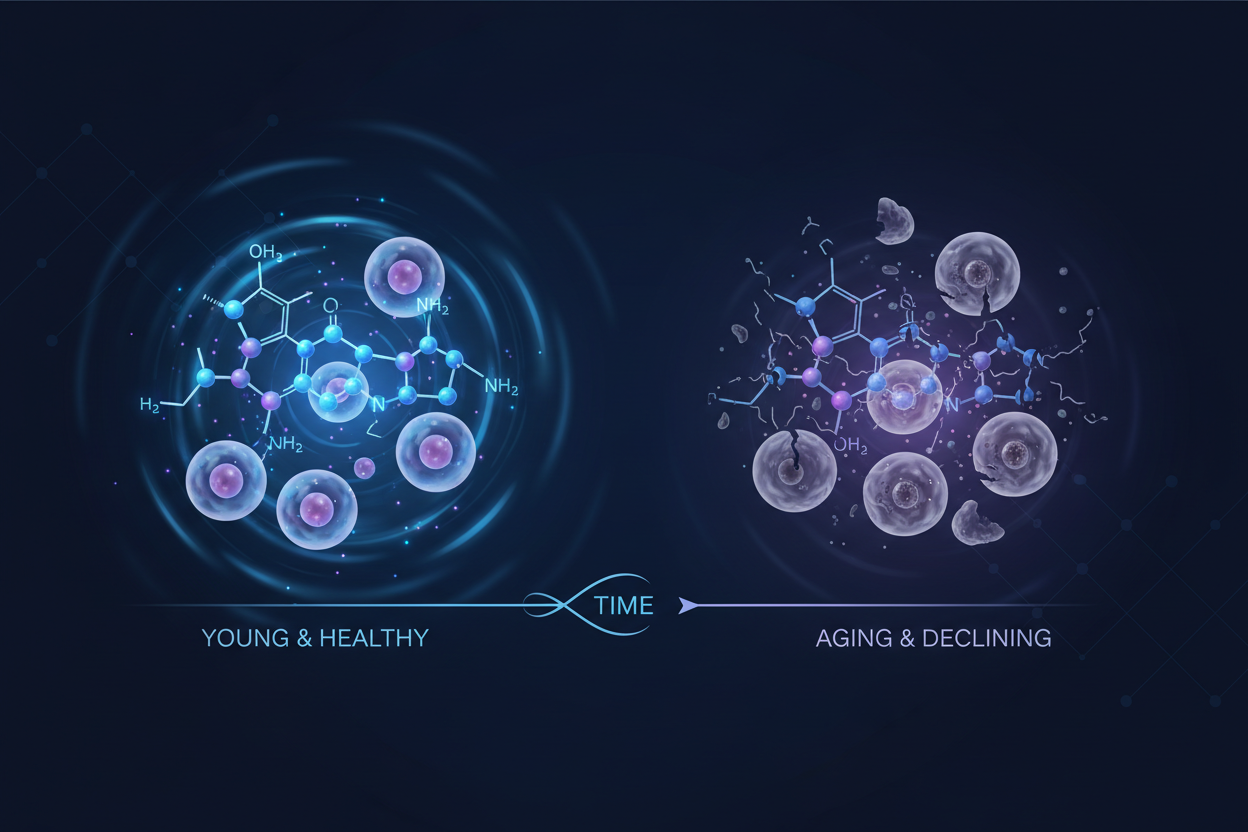
Research published in Cell Metabolism (2020) confirmed NAD+ levels fall by approximately 50% between ages 40 and 60. A 55-year-old typically has half the cellular NAD+ of a healthy 25-year-old.
Two main reasons drive this decline:
- More consumption: DNA damage repair enzymes called PARPs burn through NAD+ faster as you age — more than your cells can replace.
- Less production: The biosynthesis pathways that build NAD+ from dietary sources become less efficient over time.
Why Raising NAD+ Matters for Longevity
Does low NAD+ actually accelerate aging? Yes — low NAD+ shuts down sirtuins, a family of longevity proteins that regulate gene expression, reduce inflammation, and maintain mitochondrial health. Research from Harvard Medical School led by Dr. David Sinclair has consistently linked higher sirtuin activity to longer healthspan in animal models, with early human data now supporting this connection.
The question is not whether to replenish NAD+. It is which precursor gets the job done best.
What Is NMN? How It Boosts NAD+
What is NMN? NMN (nicotinamide mononucleotide) is a direct NAD+ precursor your body needs just one conversion step to use. It's found naturally in edamame, broccoli, and avocados — but in tiny amounts. Therapeutic supplemental doses range from 250–500 mg per day.
NMN's Direct Entry Into Cells
For years, scientists believed NMN had to break down to NR before entering cells. A landmark 2019 study in Nature Metabolism identified a dedicated NMN transporter protein (Slc12a8) in gut and liver cells. This means NMN can enter intestinal cells directly — a faster path to NAD+ than originally understood.
"The NMN transporter discovery changed the conversation entirely. We are no longer arguing about whether NMN enters cells — the molecular door is clearly open." — Dr. James Nguyen, MD
NMN Human Trial Results
A 2023 double-blind trial published in Nature Aging gave 500 mg/day of NMN to middle-aged adults for 12 weeks. Blood NAD+ rose by 38%, with improvements in muscle strength and insulin sensitivity. A 2022 trial at Keio University in Japan found 250 mg/day of NMN improved walking speed in older adults — one of the most reliable markers of biological age we have.
According to research published in Science (2021) by Dr. Shin-ichiro Imai's team at Washington University, NMN increased muscle insulin sensitivity in prediabetic women within 10 weeks — suggesting metabolic benefits beyond basic energy production.
What Is NR? How It Compares to NMN
What is NR? NR (nicotinamide riboside) is a form of vitamin B3 that converts to NMN first, then to NAD+ — 2 conversion steps in total. Commercially available since 2013, NR has a larger published body of human clinical data than NMN.
NR's Pathway and Absorption
NR enters cells via nucleoside transporters found throughout the body. Once inside, an enzyme called NRK1 phosphorylates it to NMN, which then converts to NAD+. The extra step does not make NR ineffective — conversion speed just varies more between individuals. Studies show NR is well-absorbed orally, with blood NAD+ elevation detectable within 2 hours of a 300 mg dose.
NR Clinical Evidence
A 2018 study in Nature Communications found 1,000 mg/day of NR raised blood NAD+ by 60% in healthy adults over 8 weeks — a strong result with a clean safety profile. A 2021 study in Cell Reports Medicine showed NR reduced systemic inflammation markers in older adults, suggesting benefits beyond energy metabolism alone. NR's decade-long safety record gives it a significant credibility advantage for people who prioritize established evidence.
NMN vs NR: Head-to-Head Comparison
Here's how both compounds stack up across the factors that matter most for a practical longevity protocol.
| Factor | NMN | NR |
|---|---|---|
| Steps to NAD+ | 1 step | 2 steps |
| Dedicated cell transporter | Yes (Slc12a8) | Via nucleoside transporters |
| Typical effective dose | 250–500 mg/day | 300–1,000 mg/day |
| Approximate monthly cost | $40–$80 | $25–$50 |
| Human RCT evidence | Growing (2022–2025) | Established (2016–2024) |
| Brain and CNS uptake | Strong (transporter-mediated) | Moderate |
Which Raises NAD+ More?
A 2024 crossover trial in Aging Cell compared NMN (500 mg) vs NR (500 mg) directly in adults over 50. NMN produced a 14% greater increase in blood NAD+ and showed statistically better uptake in muscle tissue. NR outperformed in one metric: liver SIRT1 activation — though the difference was modest.
Safety Profiles
Both compounds are safe at standard doses. Mild nausea or flushing is rare and dose-dependent. Neither has shown organ toxicity in 12-week human trials. NR holds the advantage of more long-term safety data — it has been studied in humans since 2016, nearly a decade of real-world use.
Which One Should You Take for Longevity?
The honest answer: it depends on your primary goal. Here's how I guide my patients.
Choose NMN If...
- Your primary goal is brain health and cognitive longevity. The Slc12a8 transporter is highly expressed in brain and gut tissue, giving NMN a clear edge for neurological NAD+ replenishment.
- You are over 50 and want faster cellular uptake with a single-step conversion to NAD+.
- You are already using advanced biohacking protocols and want the most potent NAD+ precursor available.
Choose NR If...
- You want a lower-cost entry point backed by a well-established human safety record dating back to 2016.
- Your focus is cardiovascular health or liver NAD+ metabolism, where NR clinical data is particularly strong.
- You prefer a supplement with 10+ years of commercial and clinical history before committing to a newer compound.
For context on how NAD+ precursors fit into a broader cognitive performance stack, see our full guide on the best nootropic stack for entrepreneurs in 2026.
Stacking NAD+ Precursors for Maximum Effect
The most effective longevity protocols do not pick just one compound. They combine NMN or NR with cofactors that amplify how your cells actually use the NAD+ you are producing.
NMN + Resveratrol
Resveratrol activates the SIRT1 longevity protein directly — while NMN provides the NAD+ fuel SIRT1 needs to function. Research from Dr. David Sinclair's lab at Harvard showed NMN + resveratrol restored vascular function in older mice to near-youthful levels. This pairing is now standard practice at many longevity clinics.
NMN + Methylene Blue
This combination is particularly compelling. Methylene blue supports the electron transport chain inside mitochondria — independently of the NAD+/NADH cycle. That means it fills a different energy bottleneck than NMN does. Together, they target two separate rate-limiting steps in mitochondrial energy production. To understand how ATP production works across multiple pathways, see our breakdown of creatine for brain energy and the ATP cycle.
Practical Dosing Protocol
- NMN: 250–500 mg in the morning with food. Sublingual delivery may improve absorption by bypassing first-pass metabolism.
- NR: 300–500 mg in the morning. Higher doses (1,000 mg) showed greater NAD+ elevation in trials but with more GI sensitivity in some participants.
- Resveratrol: 250–500 mg alongside your NAD+ precursor — always with a fat-containing meal since it is fat-soluble.
- TMG (trimethylglycine): 500–1,000 mg/day to offset the minor methylation demand that long-term NMN supplementation can create.
Frequently Asked Questions
Is NMN better than NR for anti-aging?
Current evidence suggests NMN has an edge for brain and muscle tissue NAD+ replenishment due to its dedicated cellular transporter. However, NR has a longer safety track record and lower cost. For most people over 40, either supplement is a meaningful improvement over taking nothing.
How long does it take for NMN or NR to work?
Most people notice improved energy and mental clarity within 2–4 weeks of consistent use. Blood NAD+ levels typically rise within the first week. Full benefits for muscle function and metabolic markers take 8–12 weeks, based on published clinical trial timelines.
Can I take NMN and NR at the same time?
Yes, but evidence is limited that combining them beats a higher dose of either alone. Most longevity researchers recommend choosing one primary precursor and pairing it with cofactors like resveratrol or TMG, rather than doubling up on precursors.
Does NMN or NR help with brain fog?
Yes — both can help. NAD+ is essential for neuronal energy production, and low NAD+ contributes to the mitochondrial fatigue pattern that underlies brain fog. Multiple small studies and user cohorts report improved mental clarity within 4–6 weeks of supplementation, with NMN showing a slight edge in brain tissue uptake studies.
Is it safe to take NMN every day?
Current 12-week trials show NMN is safe at 250–500 mg/day with no serious adverse effects reported. Long-term data beyond one year is still accumulating. Many longevity clinicians follow a 5-days-on, 2-days-off protocol to avoid theoretical tolerance effects, though this protocol has not yet been formally studied in randomized trials.
What is the best form of NMN to take?
Look for pharmaceutical-grade NMN with third-party purity testing and a published Certificate of Analysis (COA). Sublingual powders and liposomal formulations may improve absorption compared to standard capsules, though well-formulated capsule products still produce meaningful NAD+ elevation in published studies.
Does NMN or NR cause flushing like regular niacin?
No. Neither NMN nor NR causes the skin flushing associated with high-dose niacin (vitamin B3). That flushing reaction is triggered by niacin's direct activation of prostaglandins — a pathway NMN and NR do not engage at standard supplemental doses.
Can younger people under 35 benefit from NMN or NR?
Possibly, but the evidence is strongest for people over 40 where natural NAD+ decline becomes physiologically significant. Younger adults with high physical training loads, chronic stress, or poor sleep may still benefit, since all three conditions measurably accelerate NAD+ depletion regardless of age.

Yale School of Medicine | Board-Certified Neurosurgeon | Longevity Medicine
Dr. Nguyen is a Yale-trained, board-certified neurosurgeon with a focused interest in cognitive longevity and mitochondrial health. He has spent over a decade studying NAD+ metabolism, neuroprotection, and evidence-based biohacking protocols. At Better Life Lab, he translates cutting-edge research into practical guidance for people who want to age well.
References
- Yoshino M, et al. "Nicotinamide mononucleotide increases muscle insulin sensitivity in prediabetic women." Science, 2021. DOI: 10.1126/science.abe9985
- Igarashi M, et al. "Chronic NMN supplementation elevates blood NAD+ levels in healthy adults." npj Aging, 2022. DOI: 10.1038/s41514-022-00083-0
- Trammell SAJ, et al. "Nicotinamide riboside is uniquely and orally bioavailable in healthy humans." Nature Communications, 2016. PubMed: 27721479
- Grozio A, et al. "Slc12a8 is a nicotinamide mononucleotide transporter." Nature Metabolism, 2019. PubMed: 31073435
- Covarrubias AJ, et al. "NAD+ metabolism and its roles in cellular processes during ageing." Nature Reviews Molecular Cell Biology, 2021. PubMed: 33353981
- Elhassan YS, et al. "Nicotinamide riboside augments the aged human skeletal muscle NAD+ metabolome and induces transcriptomic and anti-inflammatory signatures." Cell Reports, 2019. PubMed: 30625322
- Yoshino J, et al. "NAD+ intermediates: the biology and therapeutic potential of NMN and NR." Cell Metabolism, 2018. PubMed: 29249689
- Dollerup OL, et al. "Nicotinamide riboside does not alter mitochondrial respiration in skeletal muscle from obese and insulin-resistant men." Journal of Physiology, 2020. PubMed: 31680271
Share and get 15% off!
Simply share this product on one of the following social networks and you will unlock 15% off!