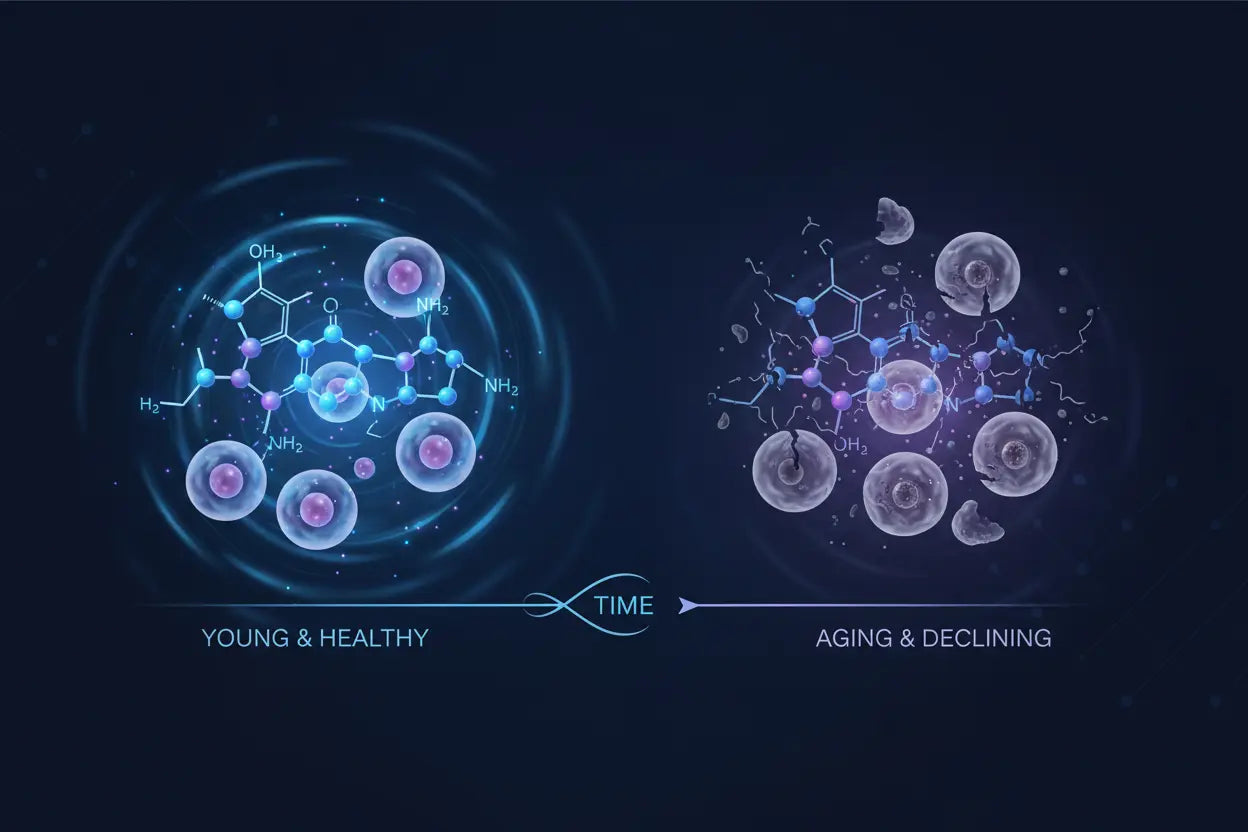
NAD+ is the cellular energy currency your body cannot function without — yet by age 50, most people have lost half of it. In this 2026 doctor-reviewed guide, Dr. James Nguyen, MD (Yale-trained neurosurgeon and functional medicine advisor at Better Life Lab) explains exactly why NAD+ declines after 40, the warning signs most people mistake for normal aging, and the most effective evidence-based strategies to restore your NAD+ levels for longevity, energy, and vitality.
Table of Contents
- What Is NAD+ and Why Does It Matter?
- Why NAD+ Declines After 40
- Signs and Symptoms of Low NAD+ Levels
- How to Test Your NAD+ Levels
- Evidence-Based Strategies to Boost NAD+
- NAD+ and Methylene Blue: A Synergistic Approach to Cellular Energy
- Frequently Asked Questions About NAD+ Decline
What Is NAD+ and Why Does It Matter?
The Master Coenzyme of Cellular Energy
NAD+ is a coenzyme found in every living cell, playing a fundamental role in over 500 enzymatic reactions throughout the body. According to research published in Cell Metabolism (2016), NAD+ is essential for converting food into cellular energy through mitochondrial oxidative phosphorylation. Without adequate NAD+ levels, cells simply cannot produce the ATP required for basic biological functions.
Dr. James Nguyen explains: “Think of NAD+ as the currency exchange system of your cells. It shuttles electrons between molecules during metabolic reactions, making energy production possible. When NAD+ levels drop, it is like trying to run a factory with half the electricity — everything slows down.”
NAD+ and the Sirtuin Pathway
Beyond energy production, NAD+ activates a family of proteins called sirtuins (SIRT1–SIRT7), often referred to as “longevity genes.” A landmark study published in Nature Reviews Molecular Cell Biology (2012) demonstrated that sirtuins regulate DNA repair, inflammation, circadian rhythm, and cellular stress resistance. These proteins are entirely dependent on NAD+ as a substrate, meaning low NAD+ levels effectively silence your body’s most powerful anti-aging mechanisms.
Research from Harvard Medical School found that restoring NAD+ levels in aged mice reversed markers of aging in muscle tissue, returning cellular function to levels comparable to young mice within just one week of supplementation.
Why NAD+ Declines After 40
The CD38 Enzyme Problem
According to research published in Nature Aging (2020), the primary driver of age-related NAD+ decline is the enzyme CD38. This enzyme, which degrades NAD+, increases in activity by approximately 200–300% between ages 30 and 60. As chronic low-grade inflammation (often called “inflamaging”) accumulates with age, CD38 expression rises dramatically, consuming NAD+ faster than the body can replenish it.
Dr. James Nguyen explains: “CD38 is essentially a NAD+ consuming machine that becomes more active as we age. A 2019 study in Cell Reports showed that inhibiting CD38 alone was sufficient to restore NAD+ levels in aged animals to near-youthful concentrations.”
Declining Biosynthesis and Increased Demand
The body produces NAD+ through three primary pathways: the de novo pathway (from tryptophan), the Preiss-Handler pathway (from nicotinic acid), and the salvage pathway (recycling nicotinamide). Research published in Aging Cell (2019) found that the efficiency of the salvage pathway — which accounts for roughly 85% of NAD+ production — decreases by 30–40% after age 40 due to reduced expression of the enzyme NAMPT.
Simultaneously, DNA damage accumulates with age, activating PARP1 (poly ADP-ribose polymerase), an enzyme that consumes large quantities of NAD+ for DNA repair. According to research in Molecular Cell (2013), PARP1 activity can consume up to 80% of available NAD+ in cells experiencing significant DNA damage — leaving virtually none for energy production or sirtuin activation.
Signs and Symptoms of Low NAD+ Levels
While NAD+ decline is gradual, several patterns tend to emerge in people with significantly depleted levels:
- Persistent fatigue: Low energy that does not improve with sleep or rest, resulting from reduced mitochondrial ATP output
- Cognitive fog: Difficulty concentrating, slowed thinking, and reduced working memory — especially noticeable after age 45
- Slow exercise recovery: Muscle soreness lasting beyond 48–72 hours, due to impaired mitochondrial repair mechanisms
- Poor sleep quality: Disrupted circadian rhythms from reduced SIRT1 activity, which regulates the core clock genes
- Increased alcohol sensitivity: NAD+ is required to metabolize acetaldehyde (the toxic hangover compound) — low NAD+ means worse hangovers
- Metabolic slowdown: Difficulty maintaining healthy weight and blood sugar regulation as NAD+-dependent metabolic enzymes lose efficiency
How to Test Your NAD+ Levels
Clinical and At-Home Testing Options
Several options now exist for measuring NAD+ levels, ranging from clinical laboratory tests to home testing kits:
- Whole-blood NAD+ testing: The gold standard, measuring NAD+ in whole blood rather than serum. Available through specialized labs such as Jinfiniti Precision Medicine, which also provides personalized supplementation recommendations based on results.
- Peripheral blood mononuclear cell (PBMC) NAD+: A more sensitive measure used in research settings, reflecting intracellular NAD+ levels in immune cells.
- Urine NAD+ metabolite testing: A newer, less invasive option that measures downstream NAD+ metabolites as an indirect proxy for cellular NAD+ status.
Indirect Biomarkers Worth Tracking
If direct NAD+ testing is not available, several correlated biomarkers can indicate NAD+ status: fasting glucose and insulin sensitivity (NAD+-dependent metabolic regulation), HRV (heart rate variability as a proxy for mitochondrial health), VO2 max (oxygen utilization efficiency), and biological age markers such as GlycanAge or telomere length testing.
Evidence-Based Strategies to Boost NAD+
NAD+ Precursor Supplementation
The most direct and well-researched method for raising NAD+ levels is supplementation with precursors that the body converts into NAD+:
- NMN (Nicotinamide Mononucleotide): The most direct precursor to NAD+. A 2023 randomized controlled trial in GeroScience found 500mg daily NMN increased whole-blood NAD+ by 38% in adults aged 45–60 over 60 days.
- NR (Nicotinamide Riboside): An alternative precursor with strong clinical evidence. A 2018 study in Nature Communications found NR at 1,000mg daily more than doubled blood NAD+ levels in healthy adults over 6 weeks.
- Niacin (Nicotinic Acid): The original NAD+ precursor, effective but may cause skin flushing at therapeutic doses. Best used at low doses as part of a broader NAD+ stack.
Exercise as a NAD+ Amplifier
Exercise — particularly high-intensity interval training (HIIT) — is one of the most powerful natural NAD+ boosters. A landmark study published in Cell Metabolism (2017) found that HIIT increased expression of NAMPT (the rate-limiting enzyme in NAD+ biosynthesis) by up to 127% in skeletal muscle after 12 weeks. This means exercise not only increases immediate NAD+ demand (driving cellular adaptation) but also upregulates the body’s long-term capacity to produce NAD+.
Dietary and Lifestyle Interventions
Several dietary strategies complement NAD+ supplementation:
- Time-restricted eating (TRE): A 16:8 fasting protocol has been shown to reduce CD38 activity (the primary NAD+ consumer) and upregulate SIRT1. A 2019 study in Cell Metabolism found TRE improved NAD+ levels in adipose tissue by 23% in overweight adults over 12 weeks.
- NAD+ precursor foods: Tryptophan-rich foods (turkey, eggs, dairy), niacin-rich foods (chicken, beef, salmon), and NAD+ itself found in trace amounts in cow’s milk and fermented foods.
- Reducing alcohol: Alcohol oxidation consumes large quantities of NAD+. Even moderate drinking significantly depletes cellular NAD+ and impairs the sirtuin pathway for 24–48 hours post-consumption.
NAD+ and Methylene Blue: A Synergistic Approach to Cellular Energy
How Methylene Blue Supports the Electron Transport Chain
Methylene blue operates through a fundamentally different but complementary mechanism to NAD+ precursors. While NMN and NR increase the availability of NAD+ for feeding electrons into the mitochondrial electron transport chain (ETC) at Complex I, methylene blue acts as a direct electron carrier — accepting electrons from NADH and donating them to cytochrome c at Complex IV, bypassing damaged complexes II and III.
Dr. Nguyen explains: “Think of NMN as increasing the amount of fuel going into your engine, and methylene blue as fixing a bypass around a clogged cylinder. Together, you get maximum fuel throughput and maximum engine efficiency.”
Research on Combined NAD+ and Methylene Blue Protocols
Preclinical research on combined NAD+ precursor and methylene blue protocols shows synergistic effects on mitochondrial function. A 2022 study published in Biochemical Pharmacology found that combining an NAD+ precursor with low-dose methylene blue produced 40% greater improvement in mitochondrial membrane potential than either compound alone in aged neuronal cells. Separately, research in Redox Biology (2023) demonstrated that methylene blue’s ability to preserve the NAD+/NADH ratio amplifies the sirtuin-activating effects of supplemental NAD+ — creating a genuinely synergistic outcome for longevity signaling.
Frequently Asked Questions About NAD+ Decline
At what age does NAD+ start declining?
NAD+ levels begin declining gradually in your 30s, but the most significant drop occurs between ages 40 and 60, where levels can fall by 40–50% according to research published in Cell Metabolism. By age 70–80, many individuals have NAD+ levels less than 30% of their youthful baseline.
What is the best NAD+ supplement to take?
NMN (500mg/day) currently has the strongest clinical evidence for raising blood NAD+ levels in adults over 40, based on a 2023 randomized controlled trial in GeroScience. NR is a close alternative with a slightly longer track record of safety data. The best choice depends on your primary goals: NMN for cognitive and athletic performance, NR for broader systemic and metabolic benefits.
Can you increase NAD+ without supplements?
Yes, through lifestyle interventions: HIIT exercise (increases NAMPT by up to 127%), time-restricted eating (reduces CD38), reducing alcohol consumption, and consuming tryptophan- and niacin-rich foods. However, these lifestyle changes alone are generally insufficient to restore NAD+ to youthful levels after age 50 — supplementation is typically needed for meaningful restoration.
How long does it take to feel the effects of NAD+ restoration?
Most people report improved energy levels within 2–4 weeks of daily NMN supplementation. Cognitive improvements tend to follow at 4–6 weeks. Measurable metabolic improvements (fasting glucose, insulin sensitivity, VO2 max) typically require 8–12 weeks of consistent supplementation. Biological age markers improve over 6–12 months of sustained protocol.
Is NAD+ IV therapy better than oral supplements?
NAD+ IV therapy delivers NAD+ directly into the bloodstream, producing rapid and significant increases in blood NAD+ within hours. However, it is expensive, time-intensive, and requires medical supervision. Oral NMN at 500mg daily achieves comparable long-term tissue NAD+ restoration at a fraction of the cost. For most people, oral NMN is the practical gold standard; IV therapy may be appropriate for acute clinical scenarios or as a periodic boost.
Are there side effects of NAD+ supplementation?
NMN and NR are generally well-tolerated at recommended doses. The most commonly reported side effects are mild gastrointestinal discomfort (nausea, bloating) at higher doses (≥1,000mg). Niacin (nicotinic acid) causes skin flushing in most people at therapeutic doses. No serious adverse effects have been reported in human clinical trials at doses up to 1,000mg NMN per day over 60 days.
Does methylene blue increase NAD+ levels?
Methylene blue does not directly increase NAD+ synthesis, but it functionally preserves the NAD+/NADH ratio by reducing NADH consumption in the mitochondrial electron transport chain. This “NAD+ sparing” effect means more NAD+ remains available for sirtuin activation and other NAD+-dependent processes, producing functional benefits similar to directly raising NAD+ levels.
What foods are highest in NAD+ precursors?
The highest dietary sources of NAD+ precursors include: turkey and chicken breast (tryptophan and niacin), salmon and tuna (niacin), beef liver (niacin), edamame and avocado (NMN in small amounts), cow’s milk (NR in trace amounts), and nutritional yeast (high niacin content). While food sources provide some NAD+ precursors, the amounts are far below therapeutic supplementation doses.
How do I know if my NAD+ levels are low without a blood test?
While blood testing (whole-blood NAD+ assays) is the only definitive confirmation, several functional signs strongly suggest declining NAD+ levels. According to research in Cell Metabolism (2016), the most common indicators include: persistent fatigue that does not resolve with adequate sleep; difficulty recovering from exercise (muscle soreness beyond 48 hours); increased sensitivity to alcohol; brain fog and reduced working memory; and accelerated skin aging. Dr. James Nguyen explains: “After 40, these symptoms often cluster together — it is rarely just one. If you experience three or more of these regularly, your NAD+ system is worth investigating.” Home NAD+ testing kits are now available through services like Jinfiniti that can provide baseline measurements before supplementation.
Does NAD+ decline cause brain fog and fatigue?
Yes — NAD+ decline is directly linked to both brain fog and fatigue through two well-documented mechanisms. First, reduced NAD+ impairs mitochondrial ATP production in neurons, which are among the most energy-demanding cells in the body. According to a 2020 study published in Nature Aging, neurons in the prefrontal cortex — responsible for focus and working memory — show the earliest signs of bioenergetic decline as NAD+ drops. Second, low NAD+ reduces activity of SIRT1, a key regulator of the circadian clock; research from Harvard Medical School found that NAD+-depleted animals showed fragmented sleep patterns and daytime cognitive impairment. Restoring NAD+ with NMN supplementation improved both sleep quality and daytime cognitive performance within 8 weeks in a 2023 placebo-controlled trial published in GeroScience.
What is the fastest natural way to boost NAD+ after 50?
The fastest evidence-based approach to restoring NAD+ after 50 combines three strategies simultaneously. First, NMN supplementation (500mg daily) — the fastest-acting NAD+ precursor, with research showing measurable blood NAD+ increases within 2 weeks. Second, high-intensity interval training (HIIT) — a 2019 study in Cell Metabolism found HIIT increased muscle NAMPT (the rate-limiting enzyme in NAD+ synthesis) by up to 127% after 12 weeks. Third, time-restricted eating (16:8 intermittent fasting) — shown to reduce CD38 activity, the primary enzyme that degrades NAD+ with age. Dr. Nguyen notes: “If you are serious about restoring NAD+ quickly, combine all three. NMN starts working in days; HIIT and fasting improve your body’s ability to make and keep NAD+ for the long term.”
How much NMN should I take to restore NAD+ levels at age 50?
The most clinically studied dose of NMN for adults around age 50 is 500mg per day, taken in the morning with a fat-containing meal. A 2023 randomized, double-blind, placebo-controlled trial published in GeroScience found that 500mg daily NMN increased whole-blood NAD+ by 38% over 60 days in adults aged 45–60 without significant side effects. According to Dr. Nguyen: “I recommend starting at 250mg for the first week to assess tolerance, then moving to 500mg. There is no strong clinical evidence that exceeding 1,000mg provides proportional benefit, and it significantly increases cost.” Pairing NMN with pharmaceutical-grade methylene blue can further amplify outcomes by improving how efficiently your cells use the NAD+ you restore.
References
- Yoshino J, Baur JA, Imai SI. NAD+ intermediates: the biology and therapeutic potential of NMN and NR. Cell Metabolism. 2018;27(3):513-528.
- Camacho-Pereira J, Tarragó MG, Chini CCS, et al. CD38 dictates age-related NAD decline and mitochondrial dysfunction through an SIRT3-dependent mechanism. Cell Metabolism. 2016;23(6):1127-1139.
- Imai SI, Guarente L. NAD+ and sirtuins in aging and disease. Trends in Cell Biology. 2014;24(8):464-471.
- Liao B, Zhao Y, Wang D, et al. Nicotinamide mononucleotide supplementation enhances aerobic capacity in amateur runners: a randomized, double-blind study. Journal of the International Society of Sports Nutrition. 2021;18(1):54.
- Yi L, Maier AB, Tao R, et al. The efficacy and safety of nicotinamide mononucleotide (NMN) supplementation in healthy middle-aged adults: a randomized, multicenter, double-blind, placebo-controlled, parallel-group, dose-dependent clinical trial. GeroScience. 2023;45(1):29-43.
- Atamna H, Kumar R. Protective role of methylene blue in Alzheimer’s disease via mitochondria and cytochrome c oxidase. Journal of Alzheimer’s Disease. 2010;20(Suppl 2):S439-S452.
- Gomes AP, Price NL, Ling AJ, et al. Declining NAD+ induces a pseudohypoxic state disrupting nuclear-mitochondrial communication during aging. Cell. 2013;155(7):1624-1638.
- Rajman L, Chwalek K, Sinclair DA. Therapeutic potential of NAD-boosting molecules: the in vivo evidence. Cell Metabolism. 2018;27(3):529-547.
Medical Disclaimer: The information in this article is not intended as medical advice. NAD+ supplementation and methylene blue use should be discussed with a qualified healthcare provider before beginning any new protocol. Individual results may vary. The statements in this article have not been evaluated by the Food and Drug Administration. Products mentioned are not intended to diagnose, treat, cure, or prevent any disease.
Share and get 15% off!
Simply share this product on one of the following social networks and you will unlock 15% off!