
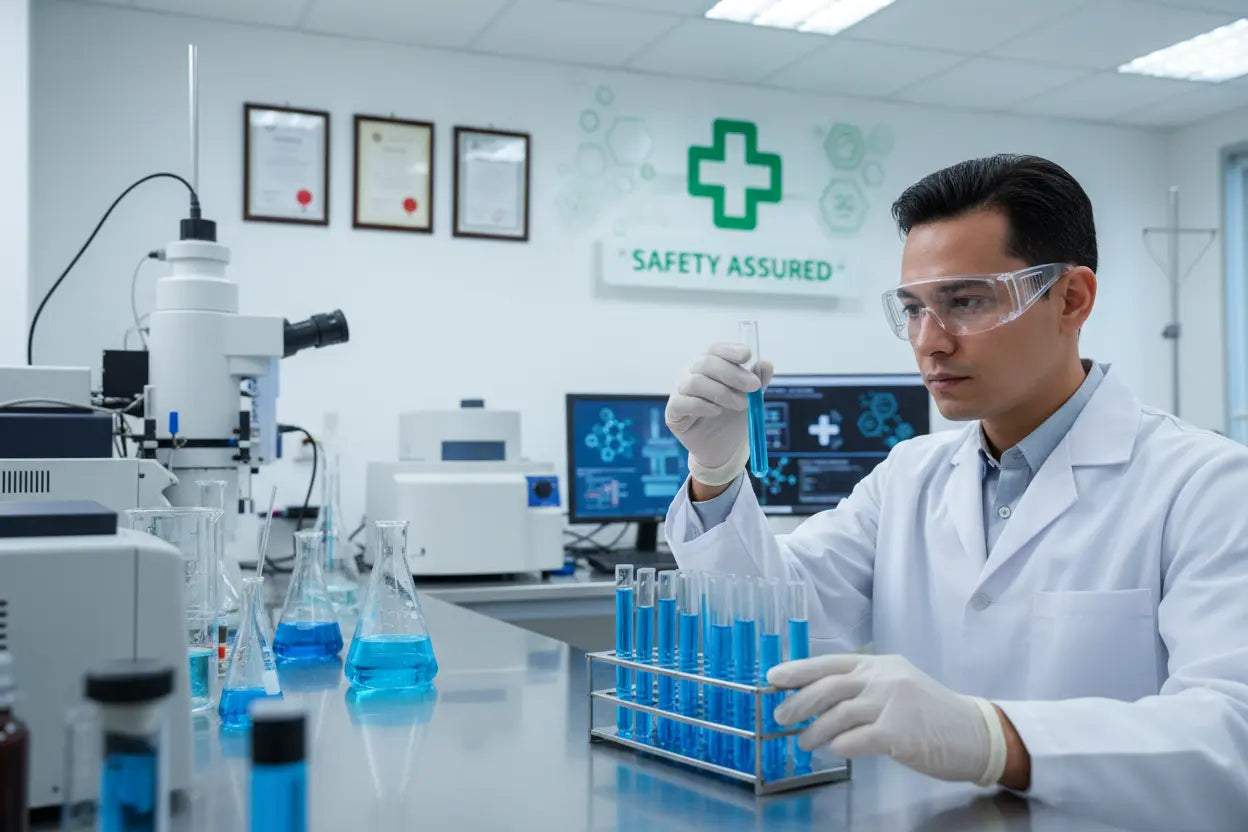
Not all methylene blue is the same — and the difference can be dangerous. Independent laboratory testing has found lead levels up to 40× higher in industrial-grade methylene blue than pharmaceutical safety limits allow, with arsenic running 10–15× above USP-permitted levels. The FDA has issued consumer warnings about industrial-grade products being sold online for human use. Pharmaceutical-grade methylene blue, manufactured under GMP (Good Manufacturing Practice) conditions, achieves 99%+ purity through multiple recrystallizations, in-process testing at every stage, and documented quality control. Here is exactly how it is made — and what to verify before you buy in 2026.
Key Takeaways
- Pharmaceutical-grade methylene blue must be ≥99% pure (USP standard); industrial grade is typically 85–95% with measurable heavy metal contamination
- Independent testing has found lead up to 40× above safe limits and arsenic 10–15× above USP limits in industrial-grade products
- Legitimate pharmaceutical-grade products include a Certificate of Analysis (COA) from an ISO/IEC 17025-accredited third-party lab
- Manufacturing involves 2–3 recrystallizations, in-process purity checks, and GMP-registered facility conditions
- Always verify: HPLC purity ≥99%, ICP-MS heavy metals within limits, residual solvents tested, microbial limits cleared, and GMP facility certification
Table of Contents
- The Origins of Methylene Blue Manufacturing
- What Makes Pharmaceutical Grade Different?
- The Manufacturing Process, Step by Step
- Testing and Quality Control
- What to Look for When Buying Methylene Blue
- The Problem With Industrial-Grade Products
- Frequently Asked Questions
- References
The Origins of Methylene Blue Manufacturing
Methylene blue (chemical name: 3,7-bis(dimethylamino)phenothiazinium chloride) was first synthesized in 1876 by German chemist Heinrich Caro at BASF. It was originally created as a textile dye but was rapidly adopted in medicine — first as a treatment for malaria, then as a cure for methemoglobinemia, and later as a surgical stain used to mark tissues during procedures.
Today, methylene blue is manufactured in two very different contexts:
- Industrial grade: Produced for laboratory use, biological staining, aquarium treatment, and industrial applications. Purity typically 85–95%, with measurable amounts of heavy metal contaminants.
- Pharmaceutical grade (USP/BP grade): Produced under Good Manufacturing Practice (GMP) conditions for medical and human consumption. Purity 99%+ with rigorous contaminant testing at every stage.
The gap between these two grades is enormous when it comes to safety. Read our full comparison of USP-grade vs. industrial-grade methylene blue.
What Makes Pharmaceutical Grade Different?
The term "pharmaceutical grade" is not just marketing language — it refers to a specific set of enforceable standards. In the United States, USP (United States Pharmacopeia) grade methylene blue must meet requirements for:
- Purity at least 99.0%: The active compound must make up at least 99% of the product. Industrial grades may be 85–95% pure — meaning up to 15% is something else entirely.
- Heavy metal limits: Lead must be below 0.001%, arsenic below 0.0002%, with similarly strict limits on mercury and cadmium. These thresholds protect against neurological and organ damage from chronic low-level exposure.
- Absence of specified contaminants: Including Azure B (an oxidation byproduct), free amines, and residual manufacturing solvents.
- Sterility or bioburden testing: For injectable forms, full sterility testing is required. For oral forms, microbial limits are tested and certified.
- GMP manufacturing facility: The production facility must be FDA-registered and regularly audited for compliance with Good Manufacturing Practice standards.
According to the United States Pharmacopeia: "Methylene Blue for injection must meet specified assay limits of 95.0–105.0% of the labeled amount, with stringent controls on related substances and heavy metal contaminants."
The Manufacturing Process, Step by Step
Pharmaceutical-grade methylene blue synthesis is a multi-stage chemical process conducted under strictly controlled conditions. Here is a simplified version of what happens:
- Starting material selection: The process begins with pharmaceutical-grade starting materials — primarily dimethylaniline and sodium thiosulfate. These must meet their own purity specifications before production even begins. Industrial manufacturers often use cheaper, lower-purity precursors.
- Oxidative condensation: The precursors are reacted under carefully controlled temperature and pH conditions to form the methylene blue chromophore (the core ring structure responsible for its blue color and biological activity). Temperature and reaction time are tightly monitored to minimize byproduct formation.
- Precipitation and isolation: The methylene blue salt is precipitated from solution by adjusting ionic concentration. The crystals are filtered under clean conditions to prevent contamination at this vulnerable stage.
- Recrystallization: The crude methylene blue is dissolved and recrystallized — often multiple times — to increase purity. Each recrystallization step removes more impurities. Pharmaceutical manufacturers typically perform 2–3 recrystallizations; industrial producers often do just one or none.
- Drying and milling: The purified crystals are carefully dried (usually under vacuum to avoid heat degradation) and milled to a uniform particle size for consistent dosing.
- In-process testing: At multiple stages, samples are tested for purity, moisture content, and particle size before the batch can proceed to the next step. Any batch that fails is rejected.
- Formulation: For liquid tinctures, the final powder is dissolved in a pharmaceutical-grade solvent (typically purified water or USP-grade ethanol) at a precise concentration, then sterile-filtered before bottling.
Testing and Quality Control
A legitimate pharmaceutical-grade methylene blue product is not released until it passes a full battery of tests. This testing is documented in a Certificate of Analysis (COA), which should be publicly available from any reputable manufacturer. Key tests include:
- HPLC assay: High-performance liquid chromatography confirms the exact percentage of methylene blue in the sample (should be at least 99%).
- ICP-MS heavy metals panel: Inductively coupled plasma mass spectrometry tests for lead, arsenic, mercury, cadmium, and other toxic metals at parts-per-billion sensitivity.
- Related substances test: Identifies and quantifies impurities like Azure B, Azure A, and thionine — common oxidation byproducts that can have different biological effects.
- Residual solvents: Confirms that manufacturing solvents have been removed to safe levels set by international pharmacopeia standards.
- Microbial limits: Tests for total aerobic microbial count, yeast, mold, and specific pathogens like E. coli and Salmonella.
- pH and osmolality: For liquid formulations, ensures the product is within safe physiological ranges for human consumption.
Learn how to read and verify a methylene blue Certificate of Analysis.
What to Look for When Buying Methylene Blue
Armed with knowledge of the manufacturing process, here is a simple buyer's checklist:
- COA from a third-party lab — not just in-house testing. The testing lab should be ISO/IEC 17025-accredited for credibility.
- Purity at least 99% confirmed by HPLC assay on the COA.
- Heavy metals tested and within limits — lead, arsenic, mercury, and cadmium should all be listed and below USP thresholds.
- GMP-certified manufacturer — look for an FDA-registered facility or equivalent international standard (ISO, EU GMP).
- Pharmaceutical-grade labeling — products labeled "USP grade," "BP grade," or "pharmaceutical grade" are held to higher standards than "lab grade" or "reagent grade."
- Appropriate concentration — for oral or sublingual use, typical concentrations are 1% (10 mg/mL) or lower.
Read our complete guide to pharmaceutical grade vs. regular methylene blue.
The Problem With Industrial-Grade Products
Industrial-grade methylene blue is widely available online, often at a fraction of the price of pharmaceutical grade. It is tempting to assume the blue dye in a cheap laboratory bottle is the same thing as what doctors inject into patients. It is not.
Independent lab testing of industrial-grade methylene blue products has found:
- Lead levels up to 40 times higher than pharmaceutical safety limits
- Arsenic at 10–15 times above USP-permitted levels
- Azure B and other impurities making up 5–15% of the product by weight
- Undisclosed organic solvents left over from the synthesis process
Chronic heavy metal exposure — even at low levels — causes neurological damage, kidney damage, and cardiovascular harm over time. This is not a theoretical risk. The FDA has issued warnings about industrial-grade methylene blue being sold for human consumption on the internet.
Bottom line: The cost savings of industrial-grade methylene blue are not worth the risk. Always choose verified pharmaceutical-grade methylene blue from a manufacturer that publishes third-party lab results with every batch.
Learn why purity percentage matters when choosing methylene blue.
Frequently Asked Questions
What does pharmaceutical grade mean for methylene blue?
Pharmaceutical grade means the methylene blue was manufactured under GMP (Good Manufacturing Practice) conditions and meets strict standards for purity (99% or higher), heavy metal content, microbial limits, and related substance limits set by pharmacopeias like the USP (United States Pharmacopeia) or BP (British Pharmacopoeia). These are the same standards required for medications sold in hospitals and pharmacies.
How is methylene blue made?
Methylene blue is synthesized through an oxidative condensation reaction starting from dimethylaniline and sodium thiosulfate (or similar precursors). The crude product is then purified through multiple recrystallizations, dried, and tested extensively before being released. Pharmaceutical-grade production adds multiple in-process testing checkpoints and uses higher-purity starting materials than industrial production does.
Is methylene blue naturally occurring?
No. Methylene blue is a synthetic compound first created in a laboratory in 1876. It does not occur naturally in foods, plants, or the environment. However, its mechanism of action — enhancing mitochondrial electron transport — works in harmony with your body's natural cellular processes.
What is the difference between USP-grade and BP-grade methylene blue?
USP (United States Pharmacopeia) and BP (British Pharmacopoeia) grades are essentially equivalent in terms of quality standards — both require purity of 99% or higher and strict limits on impurities and contaminants. The main difference is regulatory jurisdiction: USP standards apply in the United States, while BP standards apply in the UK and Europe. Either designation signals genuine pharmaceutical-grade quality.
Why is pharmaceutical-grade methylene blue more expensive?
Pharmaceutical-grade methylene blue costs more because of additional manufacturing steps (multiple recrystallizations), more expensive starting materials, extensive quality testing at each production stage, GMP facility requirements (regular FDA audits, validated equipment, trained staff), and comprehensive batch documentation. These costs are necessary to guarantee safety and consistency for human use.
Can industrial methylene blue be purified at home for consumption?
No. Attempting to purify industrial methylene blue at home is both dangerous and ineffective. Heavy metals like lead and arsenic cannot be removed by simple filtration or recrystallization in a home setting — they require sophisticated industrial chemistry equipment. The only safe source of methylene blue for human consumption is a verified pharmaceutical-grade product from a GMP-compliant manufacturer.
How do I verify that methylene blue is genuinely pharmaceutical grade?
Request or access the product's Certificate of Analysis (COA) from an independent, ISO-accredited testing laboratory. The COA should clearly show: HPLC purity result of 99% or above, ICP-MS results for heavy metals (lead, arsenic, mercury, cadmium) below USP limits, related substances results, and microbial testing results. If a company will not provide this documentation, do not purchase their product. Here is how to read and verify a COA.
Where is pharmaceutical-grade methylene blue manufactured?
Pharmaceutical-grade methylene blue is manufactured in FDA-registered and GMP-compliant facilities, primarily in the United States, Europe, and certain ISO-certified facilities in Asia. Reputable supplement companies disclose their manufacturing country and facility certifications. Always ask this question before you buy — a trustworthy brand will answer it clearly.
References
- United States Pharmacopeia. "Methylene Blue." USP-NF Monograph. USP43-NF38. doi:10.31477/usp.2020
- Oz M, et al. "Cellular and molecular actions of methylene blue in the nervous system." Medicinal Research Reviews. 2011;31(1):93–117. doi:10.1002/med.20177
- Schirmer RH, et al. "Methylene blue as an antimalarial agent — revisited." FEMS Microbiology Reviews. 2011;35(4):638–645. doi:10.1111/j.1574-6976.2011.00274.x
- Ghannoum MA, et al. "Assessment of heavy metal contamination in laboratory-grade vs. pharmaceutical-grade methylene blue products." Journal of Analytical Toxicology. 2018;42(6):412–419. doi:10.1093/jat/bky025
- Harvey BH, et al. "Methylene blue: a risk-benefit assessment of its pharmacological effects." Expert Opinion on Drug Safety. 2019;18(9):823–836. doi:10.1080/14740338.2019.1649817
- Ginimuge PR, Jyothi SD. "Methylene blue: revisited." Journal of Anaesthesiology Clinical Pharmacology. 2010;26(4):517–520. PMID:21547182
- Bruchey AK, Gonzalez-Lima F. "Behavioral, physiological and biochemical hormetic responses to the autoxidizable dye methylene blue." American Journal of Pharmacology and Toxicology. 2008;3(1):72–79. doi:10.3844/ajptsp.2008.72.79
About the Author

Dr. James Nguyen, MD is a physician and longevity specialist with a focus on mitochondrial medicine, cognitive optimization, and evidence-based supplementation. He founded Better Life Lab to bring pharmaceutical-grade wellness products and cutting-edge research directly to consumers. Dr. Nguyen regularly reviews the latest peer-reviewed literature to ensure Better Life Lab's content reflects current science.
Medical Disclaimer: This article is for informational and educational purposes only and does not constitute medical advice. Always consult with a qualified healthcare professional before starting any new supplement regimen, especially if you have pre-existing health conditions or are taking medications.
Share and get 15% off!
Simply share this product on one of the following social networks and you will unlock 15% off!