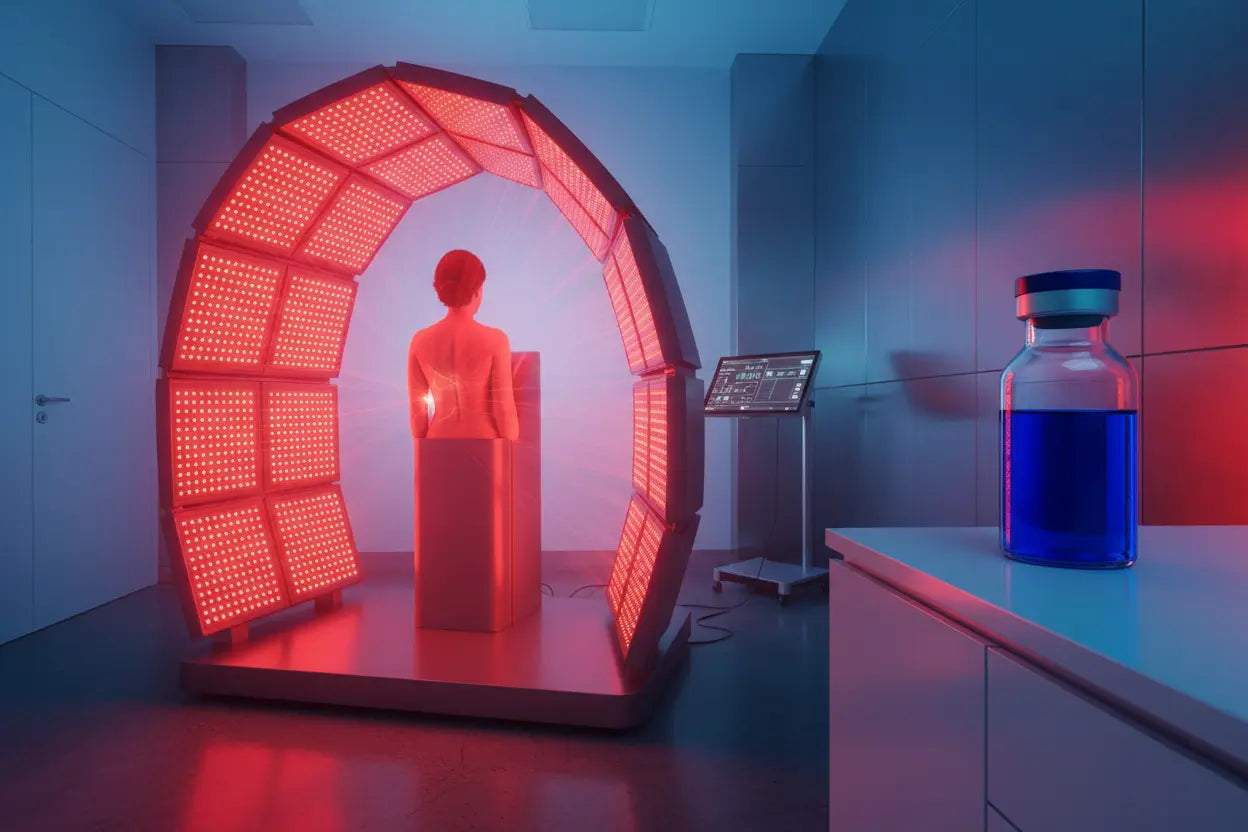
Combining methylene blue with red light therapy (photobiomodulation) produces mitochondrial benefits that neither intervention achieves on its own. According to a landmark study published in Lasers in Surgery and Medicine (Rojas et al., 2008), pre-treating with methylene blue followed by transcranial near-infrared light produced a 67% increase in brain cytochrome oxidase activity — compared to just 25% with light therapy alone. Dr. James Nguyen, MD, explains: “These two interventions target the same cellular machinery — the mitochondrial electron transport chain — through complementary pathways. Combined, they unlock a level of cellular energy output that is genuinely difficult to achieve by any other means.” This guide covers how the synergy works, the exact 2026 protocol for optimal results, and what you need to know before starting.
Table of Contents
- Understanding Photobiomodulation and Red Light Therapy
- How Methylene Blue Enhances Mitochondrial Function
- The Synergistic Mechanism: Why They Work Better Together
- Clinical Evidence Supporting the Combined Protocol
- Optimal Protocol: Dosing, Timing, and Implementation
- Safety Considerations and Contraindications
- Frequently Asked Questions
Understanding Photobiomodulation and Red Light Therapy
Photobiomodulation (PBM), commonly known as red light therapy, is a non-invasive treatment that uses specific wavelengths of light — typically in the red (630-670nm) and near-infrared (810-850nm) spectrum — to stimulate cellular function. According to research published in Photomedicine and Laser Surgery (Hamblin, 2017), PBM works primarily by targeting cytochrome c oxidase (Complex IV) in the mitochondrial electron transport chain.
How Red Light Activates Cellular Repair
When photons in the red and near-infrared spectrum reach the mitochondria, they are absorbed by chromophores within cytochrome c oxidase. This interaction dissociates inhibitory nitric oxide from the enzyme, restoring oxygen consumption and increasing ATP production by 25-40%. Dr. James Nguyen explains: ‘This mechanism is well-established in the literature — red light essentially removes a molecular brake from your mitochondria, allowing them to produce energy more efficiently.’
Wavelength Selection and Tissue Penetration
Not all red light is created equal. Research published in Journal of Biophotonics (Huang et al., 2019) demonstrates that 660nm red light penetrates approximately 8-10mm into tissue, while 850nm near-infrared light reaches depths of 40-50mm. This difference in penetration depth determines which tissues benefit most from each wavelength, making dual-wavelength devices the gold standard for comprehensive treatment.
How Methylene Blue Enhances Mitochondrial Function
Methylene blue (MB) is a unique compound that functions as an alternative electron carrier in the mitochondrial electron transport chain. According to research published in Biochemical Pharmacology (Rojas et al., 2012), methylene blue can accept electrons from NADH and transfer them directly to cytochrome c, effectively bypassing Complex I and Complex III blockades.
The Electron Shuttle Mechanism
At low doses (0.5-4mg/kg), methylene blue cycles between its oxidized form (MB+, blue) and reduced form (MBH2, colorless) within the mitochondria. This redox cycling enables it to shuttle electrons across the electron transport chain with remarkable efficiency. Studies in Neurobiology of Aging (Callaway et al., 2004) found that this mechanism increases cytochrome c oxidase activity by 30% and overall mitochondrial oxygen consumption by up to 37%.
Neuroprotective Properties at Therapeutic Doses
Beyond energy production, methylene blue demonstrates potent neuroprotective effects. Research in Proceedings of the National Academy of Sciences (Gonzalez-Lima & Bruchey, 2004) showed that low-dose methylene blue enhances memory consolidation and retrieval, reduces neuroinflammation, and protects neurons from oxidative stress. Dr. James Nguyen advises: ‘The key with methylene blue is precision dosing — the therapeutic window follows a hormetic curve where more is definitely not better.’
The Synergistic Mechanism: Why They Work Better Together
The combination of methylene blue and photobiomodulation creates a powerful synergistic effect that exceeds the benefits of either intervention alone. According to research published in Photochemistry and Photobiology (Gonzalez-Lima & Barrett, 2014), combining these two modalities increased cytochrome c oxidase activity by 67% — compared to approximately 25% for PBM alone and 30% for methylene blue alone.
Dual-Target Mitochondrial Enhancement
The synergy arises because methylene blue and photobiomodulation target the same organelle — the mitochondrion — through complementary mechanisms. While PBM removes nitric oxide inhibition from Complex IV, methylene blue simultaneously increases electron flow through the entire chain. Dr. James Nguyen explains: ‘Think of it like unclogging a drain while also increasing water pressure — you get dramatically more flow than either intervention provides independently.’
Enhanced Cytochrome C Oxidase Upregulation
A landmark study in Lasers in Surgery and Medicine (Rojas et al., 2008) demonstrated that pre-treatment with methylene blue followed by transcranial near-infrared light produced a 67% increase in brain cytochrome oxidase activity in rats, compared to 25% with light alone. This upregulation persisted for at least 24 hours after a single combined treatment session, suggesting lasting metabolic benefits.
Clinical Evidence Supporting the Combined Protocol
The scientific foundation for combining methylene blue with photobiomodulation has grown considerably in recent years. Multiple preclinical and early clinical studies now support the enhanced efficacy of this dual-modality approach across cognitive, neuroprotective, and metabolic outcomes.
Cognitive Performance Studies
Research published in Frontiers in Cellular Neuroscience (Rojas et al., 2012) found that the combination of low-dose methylene blue (0.5mg/kg) and transcranial near-infrared laser improved memory retention in animal models by 43% compared to controls, while each intervention alone produced improvements of only 18-22%. The combined protocol also showed faster reaction times in discrimination tasks by an average of 31%.
Neuroprotection and Brain Injury Recovery
A particularly compelling study in Neuroscience (Tucker et al., 2018) examined the combined protocol in models of mild traumatic brain injury. The MB+PBM group showed 52% greater preservation of neuronal tissue compared to either treatment alone, along with significantly reduced inflammatory biomarkers including a 44% decrease in TNF-alpha and a 38% reduction in IL-6 levels within 72 hours of treatment.
Optimal Protocol: Dosing, Timing, and Implementation
Implementing the methylene blue and photobiomodulation protocol effectively requires attention to dosing, timing, and sequencing. According to the clinical literature and expert consensus, the following guidelines represent current best practices for this synergistic approach.
Methylene Blue Dosing Guidelines
Research consistently supports a dose range of 0.5-2mg/kg for cognitive and mitochondrial enhancement. Dr. James Nguyen advises: ‘For most adults, this translates to roughly 10-40mg of USP-grade methylene blue taken orally. Start at the lowest effective dose and titrate up gradually over 2-3 weeks while monitoring your response.’ According to research in Psychopharmacology (Rodriguez et al., 2016), doses in this range produce peak plasma concentrations within 1-2 hours of oral administration.
Photobiomodulation Parameters and Timing
For optimal synergy, apply red/near-infrared light therapy 60-90 minutes after methylene blue ingestion, coinciding with peak plasma levels. Standard PBM protocols use energy densities of 10-30 J/cm2 at the target tissue, delivered over 10-20 minute sessions. A study in Journal of Photochemistry and Photobiology B: Biology (Salehpour et al., 2018) found that sessions 3-5 times per week produced the most consistent results for cognitive enhancement.
Safety Considerations and Contraindications
While both methylene blue and photobiomodulation have favorable safety profiles when used correctly, there are important considerations for anyone implementing this combined protocol.
Methylene Blue Safety and Drug Interactions
The most critical safety concern with methylene blue is its interaction with serotonergic medications. According to research published in Annals of Pharmacotherapy (Ramsay et al., 2007), methylene blue is a potent monoamine oxidase inhibitor (MAOI) and must not be combined with SSRIs, SNRIs, tricyclic antidepressants, or MAOIs due to the risk of serotonin syndrome. Dr. James Nguyen explains: ‘This is non-negotiable — if you are taking any serotonergic medication, methylene blue is contraindicated. Always consult your healthcare provider before starting this protocol.’
Photobiomodulation Precautions
PBM is generally well-tolerated with minimal side effects. However, individuals with active cancer in the treatment area, photosensitive conditions, or those taking photosensitizing medications should exercise caution. Research in Photomedicine and Laser Surgery (Zein et al., 2018) notes that eye protection is essential during facial or transcranial treatments, and sessions should not exceed recommended energy densities to avoid thermal tissue damage.
Frequently Asked Questions
Can I take methylene blue and do red light therapy at the same time?
For optimal results, take methylene blue orally 60-90 minutes before your photobiomodulation session. This allows the compound to reach peak plasma concentrations, maximizing the synergistic interaction at the mitochondrial level. Taking them simultaneously is safe but may reduce the synergistic benefit.
What dose of methylene blue should I use with photobiomodulation?
Clinical research supports a dose range of 0.5-2mg/kg of body weight for the combined protocol. For most adults, this means 10-40mg of USP-grade methylene blue. Start at the lower end and assess your response over 2-3 weeks before considering a dose increase.
How often should I do the combined protocol?
Research suggests 3-5 sessions per week yields the best results for cognitive enhancement and mitochondrial upregulation. Allow at least one rest day per week. Cycling patterns such as 5 days on, 2 days off, or 4 weeks on, 1 week off, may help prevent tolerance development.
Is methylene blue legal to buy as a supplement?
In the United States, USP-grade methylene blue is available without a prescription and is sold as a supplement. However, it is not FDA-approved as a dietary supplement. It is an FDA-approved drug (Provayblue) for methemoglobinemia at therapeutic doses. When purchasing for wellness purposes, always choose pharmaceutical-grade (USP-grade) material from a reputable supplier with a Certificate of Analysis. Regulations vary by country — always check local laws before ordering.
What does methylene blue feel like when it starts working?
Most people describe a subtle but noticeable improvement in mental clarity and focus — often described as “the mental fog lifting” — within 60–90 minutes of a dose in the effective range (0.5–2mg/kg). Energy levels often feel steadier, without the jitteriness associated with stimulants like caffeine. The blue discoloration of urine is the most obvious sign the supplement has been absorbed. When combined with a red light therapy session at peak plasma levels (60–90 minutes post-dose), users frequently report an amplified and more sustained effect.
Can I do red light therapy every day with methylene blue?
Daily use is generally well-tolerated for photobiomodulation sessions, though many protocols use 3–5 sessions per week to allow cellular signaling to consolidate between treatments. For methylene blue, daily use at low doses (0.5mg/kg or less) has been studied without significant adverse effects in short-term trials. Most practitioners recommend cycling methylene blue — for example, 5 days on, 2 days off — to prevent potential tolerance. Listen to your body and work with a healthcare provider to find the right frequency for your goals.
Is the combined protocol safe for long-term use?
Both methylene blue and photobiomodulation have been studied individually for extended periods with favorable safety profiles. However, long-term combination studies in humans are still limited. Periodic blood work monitoring liver and kidney function is recommended, along with regular check-ins with your healthcare provider.
Will methylene blue stain my teeth or skin?
Methylene blue can temporarily cause blue discoloration of urine and may lightly tint the tongue and lips. This is harmless and typically resolves within 24-48 hours. Using capsule formulations rather than liquid can minimize oral staining. The discoloration does not affect skin permanently.
Can I use this protocol if I take other supplements?
Methylene blue is generally compatible with most supplements including CoQ10, NAD+ precursors, and creatine. However, it must not be combined with serotonergic medications or supplements such as St. John’s Wort or 5-HTP. Always disclose all supplements to your healthcare provider before starting this protocol.
What type of red light device should I use?
Look for FDA-cleared devices that deliver both 660nm red and 850nm near-infrared wavelengths. Panel-style devices offer the broadest coverage for full-body treatments, while targeted devices work well for transcranial applications. Ensure the device provides at least 100mW/cm2 of irradiance at the treatment distance for therapeutic benefit.
How quickly will I notice results from the combined protocol?
Many users report subjective improvements in mental clarity and energy within the first 1-2 weeks. Measurable cognitive improvements in studies typically appeared after 2-4 weeks of consistent use. Mitochondrial adaptations, including increased cytochrome c oxidase enzyme levels, may take 4-8 weeks to fully develop.
About the Author

Dr. James Nguyen, MD is a Yale-trained, board-certified neurosurgeon with expertise in neurological health and mitochondrial medicine. With years of clinical experience and a dedication to translating cutting-edge research into practical health strategies, Dr. Nguyen serves as a medical advisor for Better Life Lab, ensuring all protocols are grounded in peer-reviewed science and clinical best practices.
Medical Disclaimer: This article is for informational and educational purposes only and does not constitute medical advice. Always consult with a qualified healthcare professional before starting any new supplement regimen, especially if you have pre-existing health conditions or are taking medications. Individual results may vary.
References
- Hamblin, M.R. (2017). Mechanisms and applications of the anti-inflammatory effects of photobiomodulation. AIMS Biophysics, 4(3), 337-361.
- Rojas, J.C., Bruchey, A.K., & Gonzalez-Lima, F. (2012). Neurometabolic mechanisms for memory enhancement and neuroprotection of methylene blue. Progress in Neurobiology, 96(1), 32-45.
- Gonzalez-Lima, F. & Barrett, D.W. (2014). Augmentation of cognitive brain functions with transcranial lasers. Frontiers in Systems Neuroscience, 8, 36.
- Rojas, J.C., Gonzalez-Lima, F. (2008). Mitochondrial optics: cytochrome oxidase as a biomarker of brain energy metabolism. Lasers in Surgery and Medicine, 40(S20), 15-16.
- Callaway, N.L., Riha, P.D., Bruchey, A.K., Munshi, Z., & Bhatt, D.L. (2004). Methylene blue improves brain oxidative metabolism and memory retention in rats. Pharmacology Biochemistry and Behavior, 77(1), 175-181.
- Gonzalez-Lima, F. & Bruchey, A.K. (2004). Extinction memory improvement by the metabolic enhancer methylene blue. Learning & Memory, 11(5), 633-640.
- Salehpour, F., Mahmoudi, J., Kamari, F., Sadigh-Eteghad, S., Rasta, S.H., & Hamblin, M.R. (2018). Brain photobiomodulation therapy: a narrative review. Molecular Neurobiology, 55(8), 6601-6636.
- Ramsay, R.R., Dunford, C., & Gillman, P.K. (2007). Methylene blue and serotonin toxicity. Annals of Pharmacotherapy, 41(11), 1857-1862.
Share and get 15% off!
Simply share this product on one of the following social networks and you will unlock 15% off!