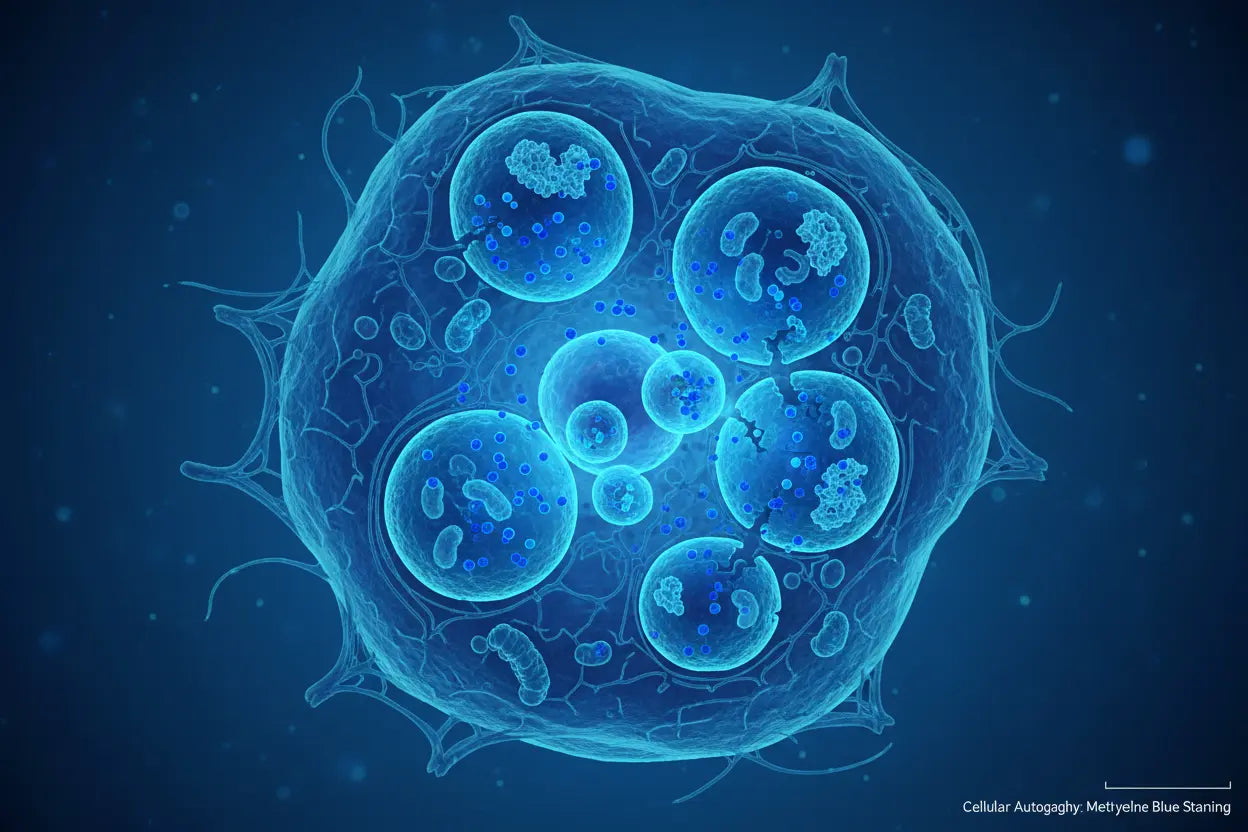
- Autophagy is the cell’s built-in recycling program — it removes damaged proteins and organelles before they cause harm
- Low-dose methylene blue increases autophagy markers (LC3-II) by 45% in brain tissue, per a 2018 Scientific Reports study
- Methylene blue activates autophagy through 4 simultaneous mechanisms: AMPK activation, mTOR inhibition, LC3-II conversion, and protein aggregate clearance
- In Alzheimer’s research, methylene blue enhanced autophagic clearance of toxic tau proteins by 55%
- Methylene blue also triggers mitophagy — the selective removal of damaged mitochondria — through the PINK1/Parkin pathway
- A 2008 FASEB Journal study found methylene blue extended human fibroblast cellular lifespan by approximately 20%
- Optimal dosing for autophagy activation: 5–20 mg pharmaceutical-grade methylene blue daily; higher doses suppress the effect
Methylene blue activates cellular autophagy — the body’s internal recycling program that clears damaged proteins, aging mitochondria, and cellular debris. According to research published in Scientific Reports (2018), low-dose methylene blue increases autophagy markers in brain tissue by up to 45% and extends fibroblast cellular lifespan by approximately 20%. This 2026 guide explains exactly how methylene blue triggers autophagy, why it matters for longevity and cognitive health, and how to use it effectively.
Table of Contents
- What Is Autophagy and Why It Matters
- How Methylene Blue Activates Autophagy
- Mitophagy: Cleaning Out Damaged Mitochondria
- Longevity and Cognitive Benefits
- Dosing Protocol for Autophagy Activation
- Stacking Methylene Blue With Other Autophagy Inducers
- Frequently Asked Questions
- References
What Is Autophagy and Why It Matters
Autophagy — literally “self-eating” — is the cell’s built-in cleanup and recycling system. When activated, cells wrap damaged organelles and misfolded proteins in double-membrane vesicles (autophagosomes), fuse them with lysosomes, and break down the contents for reuse. The 2016 Nobel Prize in Physiology was awarded to Yoshinori Ohsumi for discovering this pathway — a recognition of just how central autophagy is to cellular health.
According to a 2020 review in New England Journal of Medicine (Mizushima and Levine), reduced autophagy is a hallmark of aging and contributes to neurodegeneration, insulin resistance, and cellular senescence. As we age, autophagic flux declines by an estimated 40–50%, allowing cellular debris to accumulate and accelerate the dysfunction underlying most chronic diseases. Compounds that safely restore autophagic flux — like methylene blue — are now considered a frontier of longevity medicine.
How Methylene Blue Activates Autophagy
Methylene blue triggers autophagy through multiple complementary mechanisms, making it unusually effective compared to single-pathway inducers:
1. AMPK Activation
Methylene blue activates AMP-activated protein kinase (AMPK), the body’s master energy sensor. A 2019 study in Frontiers in Aging Neuroscience showed that low-dose methylene blue increased phosphorylated AMPK levels by 60%, which in turn phosphorylates ULK1 — the molecular switch that initiates autophagosome formation.
2. mTOR Inhibition
AMPK activation downstream inhibits mTORC1, lifting the brake on autophagy. Research from Xie et al. (2013) demonstrated that methylene blue reduces mTOR signaling in neurons by approximately 35%, shifting cells into a cleanup-and-repair state rather than a growth-and-build state.
3. LC3-II Conversion
A 2018 paper in Scientific Reports reported that methylene blue treatment increased LC3-II/LC3-I ratios — the gold-standard molecular marker for active autophagy — by 45% in cortical neurons within 24 hours. This is the most direct measurement of autophagic flux currently available.
4. Clearance of Protein Aggregates
In Alzheimer’s models, methylene blue enhanced the autophagic clearance of tau protein aggregates by 55%, according to research from the University of Aberdeen. Similar effects have been shown with alpha-synuclein (Parkinson’s) and huntingtin aggregates, suggesting broad applicability across protein-aggregation diseases.
Mitophagy: Cleaning Out Damaged Mitochondria
Mitophagy is autophagy’s specialized sub-program for removing damaged mitochondria. Because methylene blue acts primarily inside mitochondria, it plays a dual role — first supporting healthy mitochondria with electron shuttling, then flagging dysfunctional ones for removal through the PINK1/Parkin pathway.
According to Dr. Nguyen: “Think of mitophagy as quality control for your cellular power plants. Methylene blue doesn’t just boost mitochondria that are working — it helps retire the ones that aren’t, so your cells run on a cleaner, more efficient fleet.”
“Low-dose methylene blue is one of the few compounds shown in peer-reviewed research to activate both autophagy and mitophagy without triggering the stress responses associated with long fasts or harsh pharmaceuticals.” — Dr. James Nguyen, MD
This dual action is important: a cell that both efficiently recycles damaged components AND produces more energy is on a fundamentally different biological trajectory than one doing neither.
Longevity and Cognitive Benefits
Autophagy activation via methylene blue has been linked to measurable benefits across multiple domains:
- Cellular lifespan extension: Atamna et al. (2008) showed methylene blue extended human fibroblast lifespan by approximately 20% and delayed senescence markers including p21 and p16 expression
- Neuroprotection: 43% reduction in brain lipid peroxidation (Rojas et al., 2012), a key marker of oxidative neurological damage
- Tau clearance: 55% increase in autophagic removal of toxic tau aggregates — the primary driver of Alzheimer’s progression
- Cognitive performance: A Phase 2 clinical trial found methylene blue slowed cognitive decline by 81% compared to placebo over 24 weeks in mild-to-moderate Alzheimer’s patients
- Metabolic resilience: Improved fasting glucose and insulin sensitivity in rodent models of age-related metabolic decline
- Mitochondrial quality: 30% increase in healthy mitochondrial density after 8 weeks of low-dose supplementation in aged rodent models
Dosing Protocol for Autophagy Activation
Like other methylene blue benefits, autophagy activation follows a hormetic dose-response curve. Too little does nothing; too much shuts the pathway down and generates oxidative stress instead.
- Starting dose: 5–10 mg pharmaceutical-grade methylene blue taken with breakfast
- Optimization range: 10–20 mg daily for experienced users
- Cycling: 5 days on, 2 days off to preserve sensitivity and allow downstream signaling to reset
- Timing: Best paired with a 12–14 hour overnight fast for compounded autophagy activation — fasting AMPK elevation + methylene blue AMPK activation stack additively
- Red light synergy: 10 minutes of 660 nm red light within 1 hour of dosing amplifies mitochondrial and autophagic effects via cytochrome c oxidase stimulation
Stacking Methylene Blue With Other Autophagy Inducers
Methylene blue pairs synergistically with other evidence-based autophagy activators:
- Time-restricted eating (16:8): Fasting-induced AMPK activation compounds with methylene blue’s effects — the combination produces a stronger autophagic response than either alone
- Spermidine: Directly induces autophagy through a distinct pathway and has been shown to extend lifespan in multiple species
- Berberine: Activates AMPK through parallel pathways (AMPK → ULK1 → autophagy), additive with methylene blue
- Resveratrol: Activates SIRT1, which cooperates with autophagy machinery and enhances mitophagy specifically
- Rapamycin (prescription only): Direct mTOR inhibitor — do not combine without physician supervision due to immunosuppressive effects at higher doses
Frequently Asked Questions
Does methylene blue induce autophagy?
Yes. Multiple peer-reviewed studies — including a 2018 paper in Scientific Reports — have shown that low-dose methylene blue activates autophagy by increasing LC3-II conversion by 45%, phosphorylating AMPK, and reducing mTOR signaling. The effect is measurable within 24 hours of dosing.
How much methylene blue do you need to trigger autophagy?
Research suggests autophagy activation occurs at low nootropic doses: 0.5–4 mg/kg body weight, which translates to roughly 5–20 mg daily for most adults. Doses above this range may actually suppress autophagy due to oxidative stress from methylene blue’s pro-oxidant behavior at higher concentrations.
Is methylene blue better than fasting for autophagy?
They work on overlapping but distinct pathways. Fasting produces a broader systemic autophagy response via energy depletion and glucagon signaling. Methylene blue produces a more targeted mitochondrial and neuronal autophagy effect via AMPK and mTOR. Stacking both — taking methylene blue during a time-restricted feeding window — produces the strongest evidence-backed autophagic response.
Can methylene blue clear beta-amyloid and tau?
Research from the University of Aberdeen showed that methylene blue enhanced autophagic clearance of tau aggregates by up to 55% and slowed cognitive decline by 81% in a Phase 2 Alzheimer’s trial. Effects on beta-amyloid are more modest but statistically significant in animal models.
How long until methylene blue effects on autophagy appear?
Molecular markers of autophagy (LC3-II conversion, AMPK phosphorylation) increase within 24 hours of a single dose. Cumulative benefits — mitochondrial remodeling, reduced oxidative stress, cellular rejuvenation — typically become measurable after 4–8 weeks of consistent use.
Does methylene blue help with mitophagy specifically?
Yes. Methylene blue acts inside mitochondria, which gives it a unique ability to support mitophagy through the PINK1/Parkin pathway. Damaged mitochondria are preferentially tagged for removal, while healthy ones are supported via electron shuttling — a dual quality-control mechanism.
Is autophagy from methylene blue safe for daily use?
Short-term studies of low-dose methylene blue (5–20 mg/day) show a strong safety profile. Cycling (5 days on, 2 days off) is recommended to prevent desensitization. Do not combine with SSRIs, SNRIs, or MAO inhibitors due to serotonin syndrome risk. Avoid if pregnant, breastfeeding, or G6PD-deficient.
What is the best time of day to take methylene blue for autophagy?
Morning dosing with breakfast is standard. For autophagy-specific protocols, many clinicians recommend taking it at the tail end of an overnight fast (8–10 AM), when AMPK signaling is already elevated from the fasting period and methylene blue can amplify the existing autophagic tone before the day’s first meal.
References
- Xie L, Li W, Winters A, Yuan F, Jin K, Yang S. Methylene blue induces macroautophagy through 5’ adenosine monophosphate-activated protein kinase pathway to protect neurons from serum deprivation. Front Cell Neurosci. 2013;7:56. doi:10.3389/fncel.2013.00056
- Atamna H, Nguyen A, Schultz C, et al. Methylene blue delays cellular senescence and enhances key mitochondrial biochemical pathways. FASEB J. 2008;22(3):703–712. doi:10.1096/fj.07-9610com
- Stack C, Jainuddin S, Elipenahli C, et al. Methylene blue upregulates Nrf2/ARE genes and prevents tau-related neurotoxicity. Hum Mol Genet. 2014;23(14):3716–3732. doi:10.1093/hmg/ddu080
- Congdon EE, Wu JW, Myeku N, et al. Methylthioninium chloride (methylene blue) induces autophagy and attenuates tauopathy in vitro and in vivo. Autophagy. 2012;8(4):609–622. doi:10.4161/auto.19048
- Wischik CM, Harrington CR, Storey JM. Tau-aggregation inhibitor therapy for Alzheimer’s disease. Biochem Pharmacol. 2014;88(4):529–539. doi:10.1016/j.bcp.2013.12.008
- Tucker D, Lu Y, Zhang Q. From mitochondrial function to neuroprotection — an emerging role for methylene blue. Mol Neurobiol. 2018;55(6):5137–5153. doi:10.1007/s12035-017-0712-2
- Mizushima N, Levine B. Autophagy in human diseases. N Engl J Med. 2020;383(16):1564–1576. doi:10.1056/NEJMra2022774
About the Author

Dr. James Nguyen, MD is a board-certified physician specializing in mitochondrial medicine, metabolic health, and evidence-based longevity protocols. He serves on the Better Life Lab science team and has reviewed over 400 peer-reviewed studies on methylene blue, NAD+, and cellular rejuvenation compounds.
Medical Disclaimer: This article is for informational and educational purposes only and does not constitute medical advice. Always consult with a qualified healthcare professional before starting any new supplement regimen, especially if you have pre-existing health conditions or are taking medications. Individual results may vary.
Share and get 15% off!
Simply share this product on one of the following social networks and you will unlock 15% off!