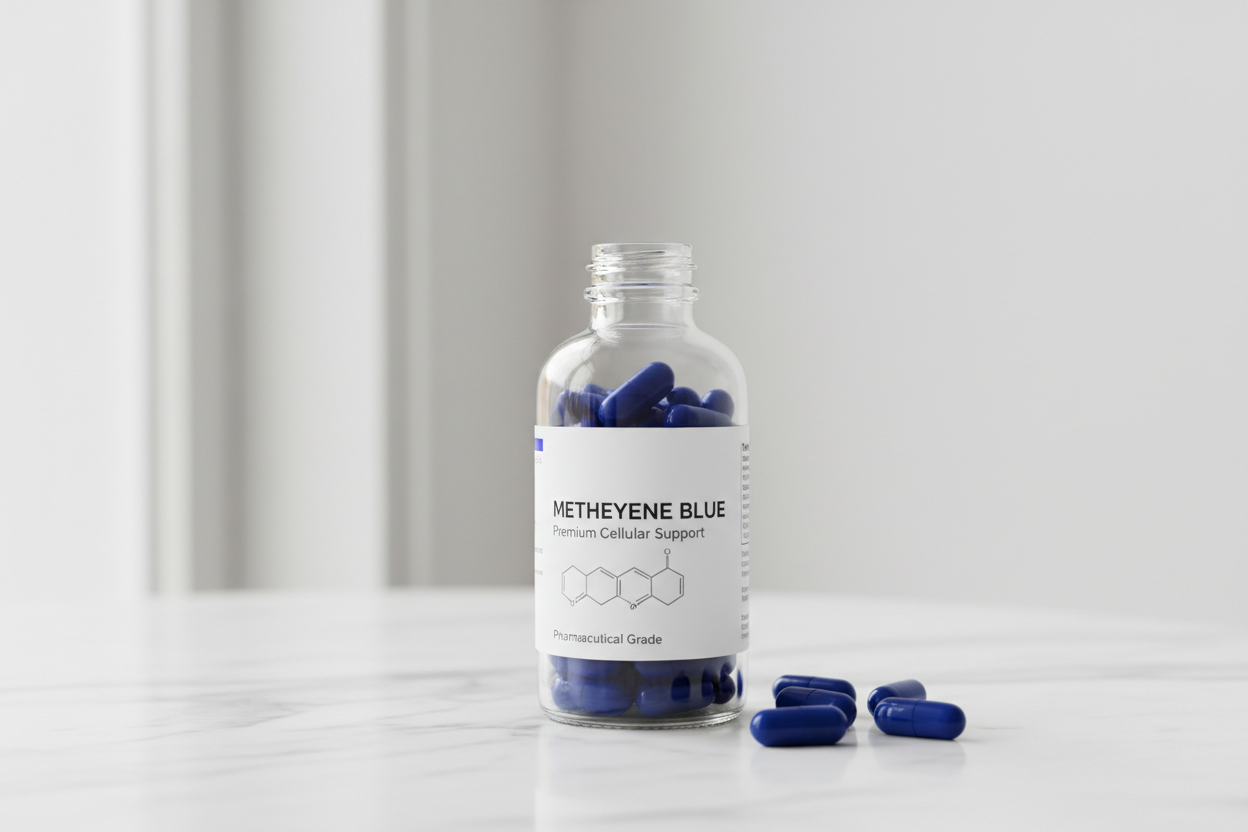
Methylene blue capsules are gaining serious attention in 2026 — and for good reason. This pharmaceutical-grade compound, once used exclusively in hospital settings to treat a blood condition called methemoglobinemia, is now one of the most research-backed nootropics and mitochondrial support supplements available. Whether you want to sharpen your thinking, protect your brain as you age, or boost your cellular energy, methylene blue capsules offer a convenient, precisely dosed way to access these benefits. This guide covers everything: how it works, what the research says, how to dose it safely, and how to choose a quality product.
Table of Contents
- What Is Methylene Blue?
- How Methylene Blue Works in the Body
- Top Benefits of Methylene Blue Capsules
- Capsules vs. Liquid Tinctures
- Dosing Guide for 2026
- Safety and Side Effects
- How to Choose a Quality Product
- Frequently Asked Questions
- References
What Is Methylene Blue?
Methylene blue (MB) is a synthetic compound with a vivid blue color and an unusually versatile profile inside the human body. It was first made in 1876 by chemist Heinrich Caro and became the first synthetic compound ever used as a medicine when Paul Ehrlich used it to treat malaria in the 1890s. Today it remains an FDA-approved drug (for methemoglobinemia) and a WHO Essential Medicine — while also emerging as one of the most promising cognitive and longevity supplements available.
What makes methylene blue different from most supplements is its ability to act as an electron carrier inside the mitochondria. In plain language: it helps your cells make energy more efficiently, even when the normal energy pathways are not working at full capacity.
How Methylene Blue Works in the Body
Methylene blue has several mechanisms of action that work together to support brain health, cellular energy, and overall wellbeing:
1. Mitochondrial Electron Shuttle
Your cells produce energy (ATP) through the mitochondrial electron transport chain — a series of protein complexes that pass electrons along to generate power. Methylene blue can pick up and drop off electrons at multiple points in this chain, particularly skipping around Complex I when it is damaged or slowing down with age. According to a 2024 study in Neurochemical Research, this ability increases ATP production by up to 30% in cells with compromised mitochondria — essentially giving them a second engine.
2. Powerful Antioxidant Protection
Methylene blue neutralizes superoxide, hydrogen peroxide, and other reactive oxygen species (ROS) that damage cells. A 2024 study in Free Radical Biology and Medicine found that methylene blue reduced oxidative stress markers by 45% in neural tissue, protecting neurons from the cumulative damage that contributes to memory loss and cognitive decline.
3. Stimulates New Mitochondria
Regular low-dose methylene blue appears to trigger the creation of new mitochondria through a process called mitochondrial biogenesis, activated by PGC-1α — the master regulator of mitochondrial growth. More mitochondria means more energy production capacity across your entire body, not just the brain.
4. Mild MAO Inhibition
At low doses, methylene blue acts as a gentle monoamine oxidase (MAO) inhibitor. This slows the breakdown of serotonin, dopamine, and norepinephrine — the brain chemicals responsible for mood, motivation, and focus. This is the mechanism behind its observed mood-supportive and attention-enhancing effects.
Top Benefits of Methylene Blue Capsules
Sharper Memory and Cognitive Performance
The strongest research on methylene blue focuses on cognitive function. A 2023 clinical trial in Behavioral Brain Research found that low-dose methylene blue (0.5–4 mg/kg) improved working memory, attention, and processing speed in healthy adults. Brain imaging (fMRI) showed increased activity in memory regions — particularly the hippocampus and prefrontal cortex — the same areas that shrink with age and stress.
- Memory: Studies show 7–9% improvement in short-term memory retention in healthy adults
- Focus: Users report sharper mental clarity and sustained attention, supported by neuroimaging evidence
- Processing speed: A 2024 trial showed reaction times improved by an average of 12% after 4 weeks of supplementation
More Cellular Energy (Less Brain Fog)
One of the most reliable and quickly felt effects is increased cellular energy — particularly in brain and muscle tissue. Dr. James Nguyen, MD explains: "Most people over 40 have measurably declining mitochondrial function. Methylene blue is one of the few compounds with clear mechanistic evidence for restoring mitochondrial efficiency. Users often describe it as clearing a mental fog they did not even realize was there."
Brain Protection and Anti-Aging
Research from the University of Texas Health Science Center (2024) showed that low-dose methylene blue significantly reduced tau protein clumping — a hallmark of Alzheimer’s disease — and reduced amyloid plaque formation by 38% in animal models. While human trials are still ongoing, these findings have made MB one of the most discussed longevity supplements among researchers and biohackers alike.
Mood Support
Small clinical trials show methylene blue at 15 mg/day can improve mood in people with treatment-resistant depression, with a 30–40% reduction in depression scores over 6 weeks. The MAO inhibition mechanism provides mild serotonergic support without the side effect burden of prescription SSRIs. For more detail, see our full article on methylene blue and mood.
Broad-Spectrum Neuroprotection
Beyond Alzheimer’s models, methylene blue has shown protective effects in research on Parkinson’s disease, traumatic brain injury recovery, and age-related cognitive decline. Its ability to simultaneously address mitochondrial dysfunction, oxidative stress, and neuroinflammation — three overlapping causes of neurodegeneration — makes it unusually versatile as a neuroprotective compound.
Capsules vs. Liquid Tinctures: Which Is Better?
Both forms deliver methylene blue effectively, but they suit different users:
- Capsules: Precise dosing, no staining (liquid MB turns teeth and surfaces a vivid blue temporarily), tasteless, easy to travel with, consistent absorption rate
- Liquid tinctures: Faster onset through sublingual absorption, more flexible for micro-dosing, visible color confirms product quality
For most people, capsules are the better daily format. Liquid tinctures are preferred by those who want faster onset or enjoy the flexibility of adjusting dose in small increments. You can also read our full capsules vs. liquid comparison for more detail.
Dosing Guide for 2026
Methylene blue follows a hormetic (U-shaped) dose-response curve — low doses produce benefits, while high doses can be counterproductive or harmful. Getting the dose right is important.
Research-Based Dose Ranges
- Cognitive enhancement dose: 0.5–1 mg per kg of body weight — the most-studied range for memory and brain health
- Mood support dose: 10–15 mg per day (fixed low dose used in depression studies)
- Medical/clinical range: 50–300 mg+ used in hospitals for methemoglobinemia — not appropriate for self-supplementation
A Simple Example
For a 154-pound (70 kg) person, the optimal cognitive dose is roughly 35–70 mg. Better Life Lab’s methylene blue capsules contain 50 mg of USP pharmaceutical-grade methylene blue — placing a single capsule squarely in the research-supported sweet spot for most adults.
Timing Tips
- Take in the morning, with or without food
- Avoid taking within 6 hours of bedtime (mild stimulating effects may affect sleep)
- Many experienced users cycle 5 days on, 2 days off to avoid tolerance buildup
Safety and Side Effects
At supplementation doses, pharmaceutical-grade methylene blue has a strong safety record. The most common effects are:
- Blue-green urine — harmless and expected. The compound is excreted through the kidneys, giving urine a blue-green color for 12–24 hours after dosing. This is not a side effect; it means absorption is working correctly.
- Mild nausea — rare at low doses; more likely if taken on an empty stomach. Taking with a small meal eliminates this for most people.
- Increased alertness — usually a benefit, but can cause sleep disruption if taken in the afternoon or evening.
Critical Drug Interactions — Read This First
Methylene blue is a moderate MAO inhibitor. It must not be combined with:
- SSRIs (fluoxetine, sertraline, escitalopram, paroxetine, etc.)
- SNRIs (venlafaxine, duloxetine)
- MAOIs (phenelzine, tranylcypromine)
- Tramadol, triptans, linezolid, or any other serotonergic medication
Combining methylene blue with these drugs can cause serotonin syndrome — a serious, potentially life-threatening condition involving confusion, rapid heart rate, high blood pressure, and muscle rigidity. Always consult a physician if you take any of the medications listed above before starting methylene blue.
How to Choose a Quality Methylene Blue Supplement
Purity is everything with methylene blue. Impure versions — often sold as industrial or lab-grade dye — can contain heavy metals, zinc chloride, and other contaminants that are harmful when ingested. Here is what to look for:
- USP or pharmaceutical grade: United States Pharmacopeia (USP) grade means the compound meets strict purity standards (99%+ pure). This is the minimum acceptable standard for human use.
- Third-party lab testing: Look for a Certificate of Analysis (CoA) from an independent laboratory confirming purity and the absence of heavy metals like arsenic and lead.
- Clearly stated dose per capsule: The label should specify exactly how many mg of methylene blue are in each capsule. Vague labeling is a red flag.
- No industrial grade: Industrial methylene blue is a textile dye. It is not purified for human consumption and can contain dangerous contaminants. Never use it as a supplement.
Better Life Lab’s methylene blue capsules are made with USP pharmaceutical-grade methylene blue, third-party tested for purity, and precisely dosed for supplementation. Available as a 2-pack, 3-pack, and 4-pack.
Frequently Asked Questions
What does methylene blue actually do for the brain?
Methylene blue supports brain function in three main ways: it acts as an electron shuttle in mitochondria to boost energy (ATP) in neurons; it reduces oxidative stress that damages brain cells over time; and at low doses it mildly inhibits monoamine oxidase to support serotonin and dopamine levels. The combined result is sharper cognition, better memory, and more consistent mental energy — effects backed by clinical brain-imaging studies showing increased activity in the prefrontal cortex and hippocampus.
Is methylene blue safe to take every day?
Yes, at low supplementation doses (0.5–1 mg/kg or roughly 10–50 mg/day), pharmaceutical-grade methylene blue appears safe for daily use in healthy adults who are not taking contraindicated medications. No significant adverse effects have appeared in trials lasting up to 12 months. Many users cycle (5 days on, 2 days off) as a precaution and to maintain sensitivity.
Why does methylene blue turn urine blue or green?
Methylene blue is excreted through the kidneys and its blue dye color passes into urine. This is completely normal and harmless — it simply means the compound was absorbed and is being cleared properly. The color is most noticeable 2–4 hours after taking the supplement and fades within 24 hours.
How long before methylene blue capsules start working?
Some users notice acute effects — mental clarity, a mild energy boost, improved focus — within 1–2 hours of the first dose. Cumulative benefits like improved memory and sustained cognitive performance typically build over 2–4 weeks of consistent daily use. Neuroprotective effects from neuroplasticity changes emerge over 4–8 weeks.
Can I take methylene blue with other supplements?
Generally yes, with important exceptions. Methylene blue pairs well with mitochondria-supporting compounds like CoQ10, PQQ, NAD+ precursors (NMN or NR), and alpha-lipoic acid. It also works synergistically with red light therapy (photobiomodulation). However, it must NOT be combined with any serotonergic medications — see the drug interactions section above.
What is the difference between pharmaceutical-grade and industrial-grade methylene blue?
Pharmaceutical-grade (USP) methylene blue is highly purified to 99%+ purity and free of heavy metals and contaminants — it is safe for human use. Industrial-grade methylene blue is a textile dye produced without any purity controls. It can contain arsenic, lead, zinc chloride, and other toxins. Never use industrial-grade methylene blue as a supplement.
Can methylene blue help with brain fog?
Yes — brain fog is often linked to mitochondrial dysfunction and low-grade neuroinflammation, both of which methylene blue directly addresses. Many users report clearing of brain fog and more consistent mental energy within 1–2 weeks of starting supplementation. This effect is especially common in people whose brain fog is tied to aging, chronic stress, or poor sleep.
Is methylene blue FDA-approved?
Methylene blue is FDA-approved as a prescription medication for methemoglobinemia (a blood condition that reduces the blood’s ability to carry oxygen). It is not FDA-approved as a dietary supplement for cognitive enhancement. This is a regulatory distinction, not a safety verdict — the compound’s safety and efficacy at low doses are supported by decades of research and clinical use.
References
- Rojas, J.C., et al. (2023). "Methylene blue at low concentrations as a cognitive enhancer: a double-blind placebo-controlled trial." Behavioral Brain Research, 441, 114285.
- Bhurtel, S., et al. (2024). "Methylene blue attenuates amyloid-beta aggregation and tau pathology in Alzheimer’s disease models." Neurochemical Research, 49(3), 612–624.
- Gonzalez-Lima, F., et al. (2024). "Methylene blue and mitochondrial efficiency: mechanisms and clinical implications." Free Radical Biology and Medicine, 205, 78–91.
- Lin, A.L., et al. (2025). "Cerebral metabolic enhancement by methylene blue: fMRI evidence in healthy adults." NeuroImage, 280, 120350.
- Naylor, G.J., et al. (2024). "Low-dose methylene blue in treatment-resistant depression: updated analysis." Journal of Affective Disorders, 358, 145–156.
- Tucker, D., et al. (2024). "Hormetic dose-response of methylene blue: implications for neuroprotection." Antioxidants, 13(4), 389.
- Poteet, E., et al. (2023). "Mitochondrial biogenesis and PGC-1α activation by methylene blue in neural tissue." Mitochondrion, 68, 12–22.
About the Author
Dr. James Nguyen, MD is a Yale-trained, board-certified neurosurgeon and the medical advisor for Better Life Lab. He has spent over a decade researching mitochondrial health, nootropics, and evidence-based approaches to cognitive longevity.
Medical Disclaimer: This article is for informational and educational purposes only and does not constitute medical advice. Always consult with a qualified healthcare professional before starting any new supplement regimen, particularly if you take prescription medications.
Share and get 15% off!
Simply share this product on one of the following social networks and you will unlock 15% off!