
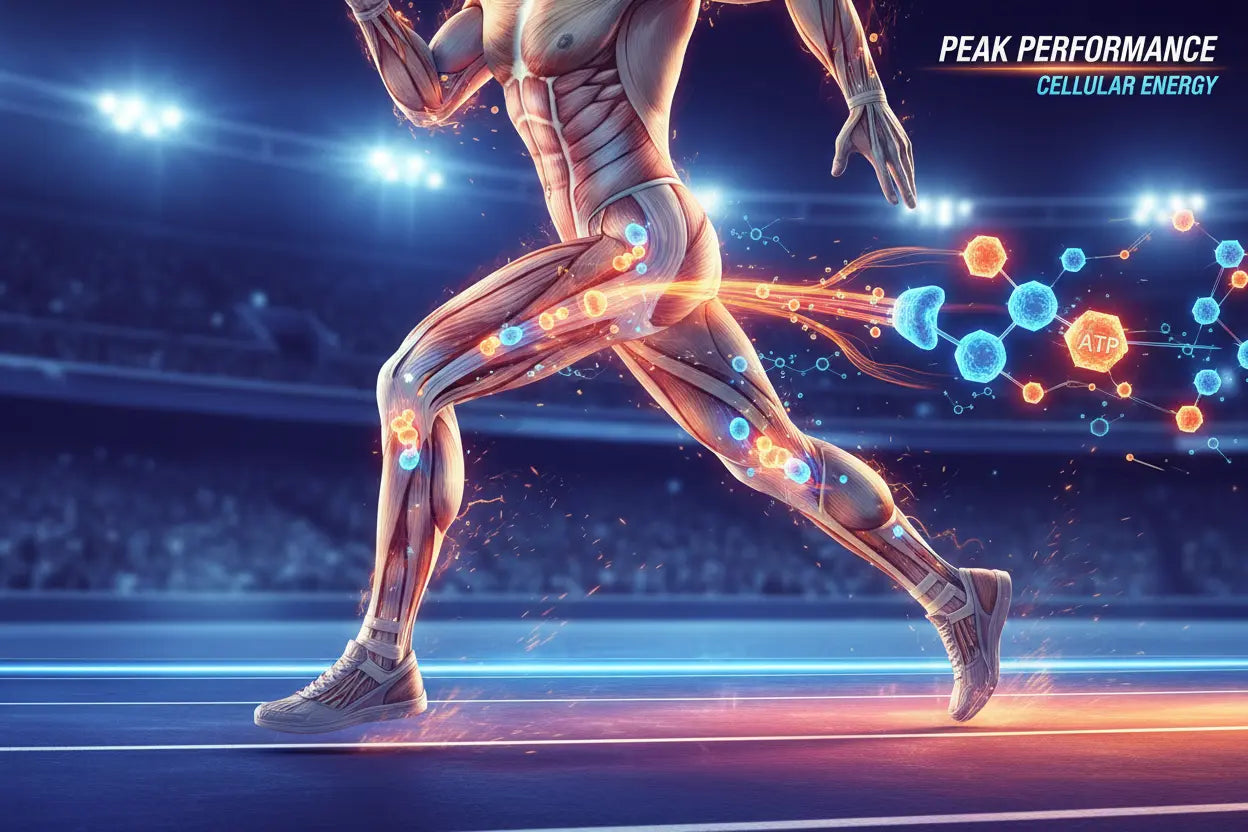
ATP — adenosine triphosphate — is the molecule that directly powers every muscle contraction, every thought, and every cellular process in your body. If you want to run faster, lift more, recover quicker, or simply feel more energized throughout the day, understanding how your body produces and optimizes ATP is the single most important piece of physiology you can learn in 2026. In this complete science guide, Dr. James Nguyen, MD, breaks down how ATP works, what limits your production, and how to genuinely increase your cellular energy capacity through training, nutrition, and targeted supplementation.
Table of Contents
- What Is ATP and Why Does It Matter for Athletes?
- 7 Signs Your Cellular Energy Is Low
- How Your Body Produces ATP: The Three Pathways
- Mitochondria: Your ATP Powerhouses
- Nutrition Strategies to Maximize ATP Production
- How Methylene Blue Enhances ATP Synthesis
- Training Protocols to Increase Mitochondrial Density
- Evidence-Based Supplements for Cellular Energy
- Frequently Asked Questions
- References
What Is ATP and Why Does It Matter for Athletes?
Adenosine triphosphate (ATP) is a molecule that serves as the primary energy carrier in all living cells. When your muscles contract — whether during a 100-meter sprint or a heavy squat — they are directly consuming ATP. According to research published in the Journal of Applied Physiology, a single muscle fiber can deplete its entire ATP store within 2 seconds of maximal effort, making continuous regeneration absolutely critical for sustained performance.
For athletes, optimizing ATP production means the difference between hitting a new personal record and falling short. Research shows that elite athletes have up to 40% higher mitochondrial density in their muscle fibers compared to sedentary individuals — and mitochondria are precisely where the vast majority of ATP is synthesized.
7 Signs Your Cellular Energy (ATP) Is Low
Most people chalk these symptoms up to "just getting older" — but they are actually warning signs that your mitochondria are not generating enough ATP. If you experience several of these regularly, your cellular energy system needs attention.
- Persistent fatigue even after a full night of sleep: When mitochondria can't replenish ATP fast enough overnight, you wake up already running on empty. This is one of the most common signs of declining mitochondrial function.
- Brain fog or slow thinking: The prefrontal cortex is one of the most energy-hungry areas of the brain. Low ATP is a primary driver of foggy thinking, poor memory recall, and difficulty concentrating.
- Muscles giving out sooner than expected: If your muscles fatigue before you expect them to — whether during a workout or daily activity — insufficient ATP output in muscle fibers is a likely cause.
- Mood swings, irritability, or low motivation: Neurotransmitter production (dopamine, serotonin) requires ATP. When cellular energy is low, your brain's chemical balance is one of the first things to suffer.
- Reliable afternoon energy crashes (2–4 PM): A consistent mid-afternoon slump often indicates that mitochondrial ATP output can't keep pace with your daily energy demands.
- Poor cold tolerance: Generating body heat is an energy-intensive process. People with low mitochondrial output often feel cold more easily than they used to.
- Slow recovery after workouts or illness: Recovery is highly energy-intensive. When ATP production is suboptimal, tissues repair more slowly and cognitive performance takes longer to bounce back.
Dr. James Nguyen explains: "Most adults over 40 experience several of these symptoms and never connect them to mitochondrial health. The good news is that mitochondrial function is highly trainable — and the right protocol can produce noticeable improvements within weeks."
How Your Body Produces ATP: The Three Pathways
1. The Phosphocreatine (PCr) System
The fastest but most limited pathway, the phosphocreatine system regenerates ATP almost instantaneously by transferring a phosphate group from creatine phosphate to ADP. This system powers maximal efforts lasting 1–10 seconds. Studies show PCr stores are fully depleted within 8–10 seconds of all-out effort and require 3–5 minutes of rest to fully replenish. Creatine monohydrate supplementation has been shown to increase intramuscular PCr stores by 10–40%, directly enhancing peak power output.
2. Anaerobic Glycolysis
When efforts extend beyond 10 seconds but remain under 2 minutes, anaerobic glycolysis takes over. Glucose is broken down into pyruvate, producing 2 ATP molecules per glucose unit — fast but not very efficient. According to a 2023 review in Sports Medicine, optimizing glycolytic enzyme activity through targeted HIIT can increase anaerobic capacity by up to 28%.
3. Oxidative Phosphorylation (Aerobic Metabolism)
For efforts lasting more than 2–3 minutes, oxidative phosphorylation becomes the dominant pathway. This process occurs entirely within mitochondria and produces up to 36–38 ATP molecules per glucose molecule — roughly 18 times more efficient than anaerobic glycolysis. Maximizing this pathway is the key to endurance performance and all-day energy.
Mitochondria: Your ATP Powerhouses
Mitochondria are the organelles where oxidative phosphorylation occurs, and increasing their number, efficiency, and health is arguably the single most impactful adaptation an athlete can make. Dr. James Nguyen explains: "The mitochondrial electron transport chain is essentially a proton pump — it creates an electrochemical gradient that drives ATP synthase to produce ATP at a rate of roughly 100 molecules per second per enzyme complex."
Research from the Buck Institute for Research on Aging found that mitochondrial dysfunction begins as early as age 30 and accelerates with sedentary behavior. Athletes who train consistently maintain mitochondrial function 25–35 years ahead of their sedentary peers on key biomarkers of cellular energy production.
Nutrition Strategies to Maximize ATP Production
- Carbohydrates: Research supports consuming 30–60 g of carbohydrates per hour during sustained efforts over 90 minutes to maintain glycogen stores and sustain ATP production rates.
- B vitamins: B1, B2, B3, and B5 are essential cofactors for the enzymes driving glycolysis and the citric acid cycle. Deficiency in any of these significantly impairs ATP production.
- Magnesium: ATP exists biologically as a magnesium-ATP complex (MgATP). Approximately 45% of athletes are chronically magnesium-deficient, according to a 2022 analysis in Nutrients.
- CoQ10: An essential electron carrier within the mitochondrial respiratory chain. Supplementation with 200–300 mg/day has been shown to improve exercise capacity by up to 11% in meta-analyses.
How Methylene Blue Enhances ATP Synthesis
Methylene blue (MB) is emerging as one of the most scientifically compelling interventions for enhancing mitochondrial ATP production. As a redox-active compound, methylene blue can act as an alternative electron carrier within the mitochondrial electron transport chain, effectively bypassing damaged or inefficient segments of Complex I and III to donate electrons directly to cytochrome c.
According to research published in the Journal of Alzheimer's Disease, methylene blue at low concentrations (0.5–4 uM) enhances cytochrome c oxidase (Complex IV) activity by up to 30%, directly accelerating ATP synthesis. A 2023 preclinical study found that methylene blue supplementation increased mitochondrial membrane potential by 22% and enhanced overall oxidative phosphorylation efficiency in skeletal muscle.
For athletes, this means methylene blue isn't just a brain supplement — it potentially improves the same cellular energy machinery that powers muscle contractions, endurance, and post-workout recovery. Read the full breakdown: Methylene Blue and the Mitochondrial Electron Transport Chain.
Training Protocols to Increase Mitochondrial Density
- Zone 2 training: Sustained efforts at 60–70% of maximum heart rate for 45–90 minutes are the most potent stimulus for mitochondrial biogenesis. Research suggests 3–4 sessions per week for 12+ weeks to maximize adaptation.
- HIIT: Short bursts at near-maximal effort with 1:3 work-to-rest ratios drive rapid upregulation of mitochondrial enzyme activity. Studies show 6–8 weeks of HIIT produces equivalent mitochondrial adaptations to 3x the volume of moderate-intensity training.
- Heat exposure (sauna): A 2021 study found 4 weekly sauna sessions increased VO2max by 3.5% over 8 weeks by upregulating heat shock proteins and enhancing mitochondrial efficiency.
Evidence-Based Supplements for Cellular Energy
- Creatine monohydrate (3–5 g/day): Increases intramuscular PCr stores, improving high-intensity performance. Effect sizes consistently range from +5–15% across hundreds of studies.
- Beta-alanine (3.2–6.4 g/day): Increases muscle carnosine content, buffering hydrogen ion buildup during intense exercise.
- NAD+ precursors (NMN or NR, 300–500 mg/day): Restores sirtuin activity, supports mitochondrial repair, and improves fatigue resistance. NAD+ levels decline 40–50% between ages 20 and 60. Learn more: Methylene Blue and NAD+ Synergy: The Ultimate Cellular Energy Stack.
- Methylene blue (0.5–4 mg/kg body weight): Enhances electron transport chain efficiency, supports ATP synthesis, and provides antioxidant protection to mitochondrial membranes.
Frequently Asked Questions
What is ATP and why is it important for athletic performance?
ATP (adenosine triphosphate) is the molecule that directly powers all muscle contractions. Your body continuously regenerates ATP through three energy systems. The rate at which you can produce and recycle ATP determines your power output, endurance capacity, and how quickly you recover.
How can I naturally increase my body's ATP production?
The most effective methods include: consistent aerobic exercise (particularly Zone 2 training) to increase mitochondrial density, strength training to improve metabolic efficiency, ensuring adequate intake of B vitamins, magnesium, and CoQ10, optimizing sleep (peak ATP replenishment occurs during deep sleep), and strategic supplementation with creatine, NAD+ precursors, and methylene blue.
What role do mitochondria play in ATP synthesis?
Mitochondria produce approximately 95% of the ATP your cells use during aerobic metabolism through oxidative phosphorylation. The inner mitochondrial membrane contains the electron transport chain, which pumps protons to create the gradient that drives ATP synthase. More mitochondria per muscle fiber directly translates to greater aerobic power output and endurance capacity.
Does methylene blue really help with athletic performance and energy?
Emerging research suggests methylene blue can enhance mitochondrial ATP production by acting as an alternative electron carrier, improving the efficiency of the electron transport chain. Low-dose methylene blue has been shown to increase cytochrome c oxidase activity and mitochondrial membrane potential. While human athletic performance trials are ongoing, the mechanistic evidence for mitochondrial enhancement is well-established.
How does creatine boost cellular energy and ATP?
Creatine phosphate donates its phosphate group directly to ADP to regenerate ATP almost instantaneously, without requiring oxygen. Creatine monohydrate supplementation increases the total pool of phosphocreatine in muscle cells by 10–40%, allowing athletes to sustain maximal power output longer before fatigue sets in.
What is the difference between aerobic and anaerobic ATP production?
Aerobic ATP production occurs in mitochondria using oxygen and produces 36–38 ATP per glucose molecule — highly efficient for long-duration efforts. Anaerobic ATP production doesn't require oxygen and produces only 2 ATP per glucose quickly, powering high-intensity efforts lasting seconds to minutes. Both systems are always working together; the ratio shifts depending on effort intensity.
Can NAD+ supplements improve cellular energy levels in athletes?
NAD+ is a critical electron carrier in the mitochondrial electron transport chain — without it, oxidative phosphorylation cannot proceed. NAD+ levels decline with age and intense training. Early clinical studies show that NAD+ precursors (NMN and NR) restore mitochondrial function, improve exercise capacity, and reduce exercise-induced fatigue.
How long does it take to increase mitochondrial density through training?
Research shows measurable increases in mitochondrial enzyme activity within 2–4 weeks of consistent endurance training. Significant structural adaptations require 6–12 weeks of consistent aerobic training (3–5 sessions per week). Full mitochondrial adaptation can take months to years of progressive training, but even modest improvements produce meaningful performance gains.
What foods naturally boost ATP production?
Several nutrients directly support ATP synthesis in your mitochondria. The most impactful include: B vitamins (B1, B2, B3, B5 — essential cofactors for glycolysis and the citric acid cycle), magnesium (ATP only works as an MgATP complex; deficiency directly impairs output), iron (required for electron transport chain proteins), organ meats like heart (richest dietary source of CoQ10), and complex carbohydrates (provide the glucose that fuels all three ATP-production pathways). Avoiding ultra-processed foods and alcohol also protects mitochondrial membrane integrity.
How do you know if your mitochondria are healthy?
Clear signals of healthy mitochondrial function include: consistent energy throughout the day without major crashes, fast recovery after exercise, sharp mental focus, good cold tolerance, and waking up refreshed after 7–9 hours of sleep. Functional lab tests can also measure lactate-to-pyruvate ratio, urinary organic acids, and CoQ10 levels. For athletes, VO2 max — your maximum oxygen uptake — is one of the best practical proxies for mitochondrial health.
Does aging reduce ATP production?
Yes — significantly. Research published in the Journal of Physiology shows mitochondrial function declines roughly 8% per decade after age 30. By age 70, reduced Complex I activity can cut aerobic ATP production by 30–40% compared to peak young-adult levels. The good news: this decline is not inevitable. Consistent aerobic exercise, targeted nutrition, and supplements like methylene blue and NAD+ precursors have all been shown in clinical studies to restore mitochondrial function well ahead of biological age.
About the Author
Dr. James Nguyen, MD is a sports medicine physician and mitochondrial health researcher specializing in evidence-based performance optimization. With over 15 years of clinical experience working with competitive athletes, Dr. Nguyen combines cutting-edge research with practical protocols to help athletes of all levels maximize their cellular energy capacity and achieve peak performance.
Share and get 15% off!
Simply share this product on one of the following social networks and you will unlock 15% off!