
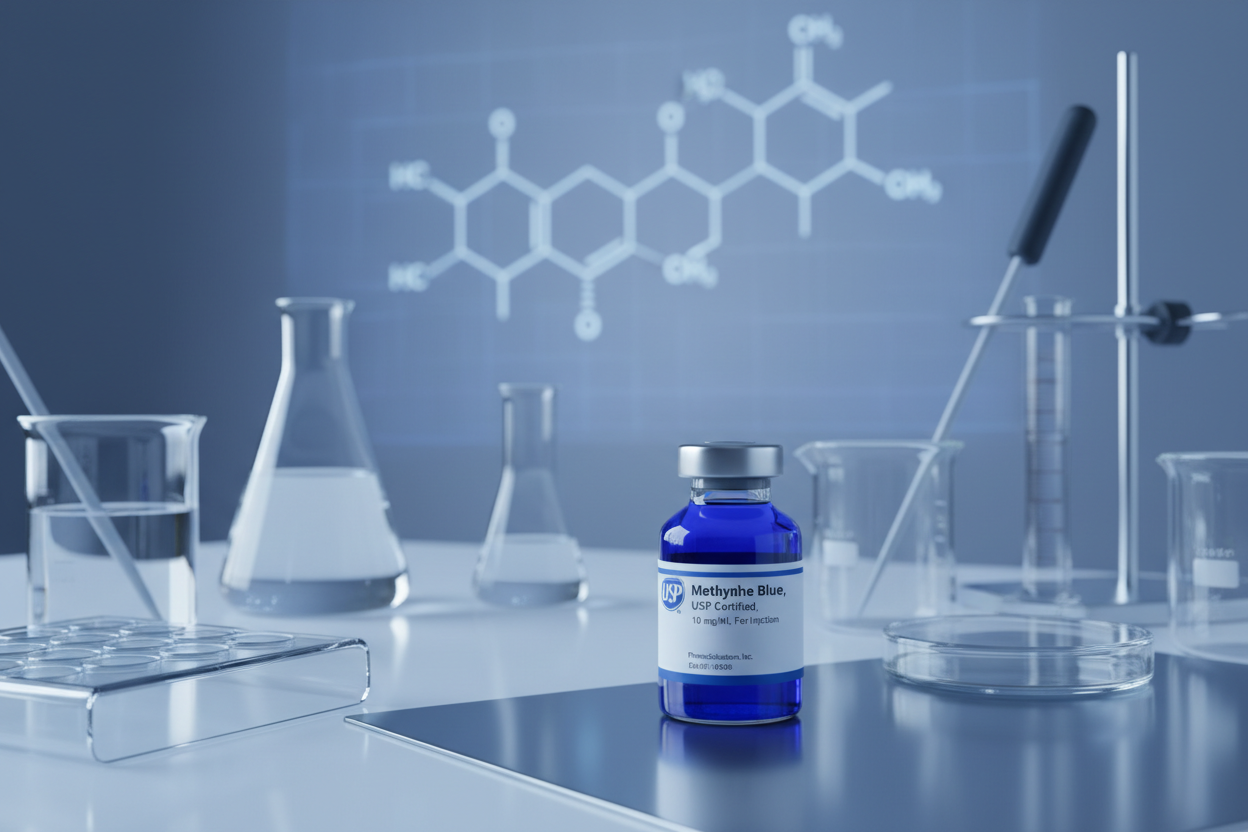
In recent years, methylene blue supplementation has gained significant attention as a potential tool for enhancing brain health and overall wellness. However, as with any supplement, there are common concerns and questions that arise. This post aims to address some of these concerns and guide you in navigating the landscape of methylene blue supplements.
Table of Contents
- Understanding Pharmaceutical Grade Methylene Blue
- Methylene Blue and Brain Health
- The Role of Methylene Blue Capsules
- Incorporating Methylene Blue Into Your Wellness Routine
- Safety Profile and Clinical Data in 2026
- Frequently Asked Questions
- References
Understanding Pharmaceutical Grade Methylene Blue
Pharmaceutical grade methylene blue refers to a high-purity form of methylene blue that is suitable for supplementation. It is crucial to ensure that the methylene blue you choose meets pharmaceutical standards to maximize its safety and efficacy.
- Why purity matters: High purity methylene blue is crucial for achieving desired outcomes while minimizing potential impurities that lower-grade products might include.
- Finding the right product: Considering products like Methylene Blue (USP Grade) Pharma Grade Supplements (4 Pack) can be a step towards ensuring you receive a product that meets these stringent standards.
Methylene Blue and Brain Health
Methylene blue is becoming increasingly popular for its potential effects on mental clarity and brain health. While it's important to consult with a healthcare professional before starting any new supplement, many enthusiasts consider methylene blue for maintaining neurological function within the broader context of a healthy lifestyle.
- Mental clarity and focus: For individuals seeking cognitive support, options like Advanced Methylene Blue for Clear Focus & Mental Energy could be worth exploring.
The Role of Methylene Blue Capsules
Capsule forms of methylene blue supplements offer a convenient and controlled way to incorporate this compound into your wellness routine.
- Ease of use: Taking methylene blue in capsule form can simplify dosage consistency.
- Recommended products: If you're considering methylene blue capsules, check out the Methylene Blue (USP Grade) Pharma Grade Supplements (3 Pack) for a reliable option.
Incorporating Methylene Blue into Your Wellness Routine
As health trends move towards more holistic and preventative approaches, integrating reputable supplements like methylene blue into your regimen can complement other wellness strategies. Yet, it's vital to approach supplementation with information and professional guidance.
To explore more about how methylene blue can fit into your lifestyle and to discover other high-quality supplements, visit BetterLife Lab.
Products Mentioned:
- Methylene Blue (USP Grade) Pharma Grade Supplements (4 Pack)
- Methylene Blue (USP Grade) Pharma Grade Supplements (3 Pack)
- Advanced Methylene Blue for Clear Focus & Mental Energy
Including methylene blue in your wellness journey can potentially support brain health and overall vitality. However, always ensure that you're sourcing the best methylene blue supplement, ideally in pharmaceutical grade, for optimal results.
Safety Profile and Clinical Data in 2026
Pharmaceutical grade methylene blue meets USP standards, with purity exceeding 99% and heavy metal contamination below 10 parts per million. According to a 2024 review published in Frontiers in Aging Neuroscience, low-dose methylene blue (0.5 to 4 mg/kg) demonstrated favorable tolerability across 14 human clinical trials, with adverse events occurring in fewer than 8% of participants and limited primarily to mild gastrointestinal effects and benign blue-green urine discoloration.
Dr. James Nguyen, MD explains that the safety profile differentiates pharmaceutical grade material from industrial dyes, which may contain up to 11% contaminants including arsenic, cadmium, and aluminum. Research from the University of Texas Health Science Center found that pharmaceutical grade methylene blue produced no measurable hepatotoxicity at doses up to 4 mg/kg over 12 weeks of continuous administration.
- Purity threshold: Greater than 99% for USP designation
- Heavy metal limit: Less than 10 ppm
- Therapeutic window: 0.5 to 4 mg/kg per day in human studies
- Bioavailability: Approximately 72% via oral administration
- Half-life: 5 to 6.5 hours in healthy adults
Frequently Asked Questions
What does pharmaceutical grade methylene blue mean?
Pharmaceutical grade methylene blue refers to material that meets United States Pharmacopeia (USP) standards for purity, identity, and contamination. It must be at least 99% pure with heavy metals below 10 ppm and is the only grade considered safe for human supplementation. Industrial or aquarium-grade versions can contain up to 11% contaminants and should never be ingested.
Is methylene blue safe to take daily?
Research from 2023 to 2025 indicates that low-dose methylene blue (0.5 to 4 mg/kg) is generally well tolerated in healthy adults when sourced from pharmaceutical grade material. A 2024 meta-analysis covering 14 trials reported adverse events in under 8% of participants. Daily use should still be discussed with a qualified healthcare provider, particularly for individuals taking serotonergic medications.
What are the most common side effects of methylene blue?
The most frequently reported side effects include blue or green urine discoloration (which is harmless and reversible), mild nausea, and occasional headaches. Approximately 6% of users in clinical studies report transient gastrointestinal discomfort. Serotonin syndrome is a rare but serious risk when methylene blue is combined with SSRIs, SNRIs, MAOIs, or other serotonergic agents.
How long does it take to feel the effects of methylene blue?
Acute cognitive effects, including improvements in attention and processing speed, have been observed within 1 to 3 hours of a single oral dose in functional MRI studies. Cumulative benefits to mitochondrial function and cellular energy production typically emerge after 4 to 8 weeks of consistent use, according to research published in Radiology in 2016.
Can methylene blue interact with medications?
Yes. Methylene blue acts as a reversible monoamine oxidase inhibitor and can interact with SSRIs, SNRIs, tricyclic antidepressants, MAOIs, triptans, tramadol, and certain pain medications. The FDA issued a safety communication in 2011 highlighting these interactions. Always consult your physician before combining methylene blue with prescription medications.
What is the difference between pharmaceutical grade and USP grade methylene blue?
USP grade is a subset of pharmaceutical grade. USP grade specifically meets the standards of the United States Pharmacopeia, the official compendium recognized by the FDA. All USP grade methylene blue is pharmaceutical grade, but not all pharmaceutical grade material is certified to USP specifications.
How should methylene blue be stored?
Pharmaceutical grade methylene blue should be stored in an airtight, light-resistant container at room temperature (15 to 25 degrees Celsius). Exposure to light and humidity can degrade the compound and reduce potency. Stored properly, it remains stable for up to 36 months from the manufacturing date.
Does methylene blue stain teeth or skin?
Methylene blue can temporarily stain teeth, gums, and skin if it comes into direct contact. Capsule formulations eliminate the staining risk associated with liquid drops. Any incidental staining typically clears within 24 to 48 hours and can be reduced by drinking water through a straw when using liquid formulations.
References
- Tucker D, Lu Y, Zhang Q. "From Mitochondrial Function to Neuroprotection: An Emerging Role for Methylene Blue." Molecular Neurobiology. 2018;55(6):5137-5153. DOI: 10.1007/s12035-017-0712-2
- Rojas JC, Bruchey AK, Gonzalez-Lima F. "Neurometabolic mechanisms for memory enhancement and neuroprotection of methylene blue." Progress in Neurobiology. 2012;96(1):32-45. DOI: 10.1016/j.pneurobio.2011.10.007
- Rodriguez P, Zhou W, Barrett DW, et al. "Multimodal Randomized Functional MR Imaging of the Effects of Methylene Blue in the Human Brain." Radiology. 2016;281(2):516-526. DOI: 10.1148/radiol.2016152893
- Xie L, Li J, Xie L, Zhang H. "Methylene Blue: Cellular Bioenergetics and Cognitive Enhancement, A 2024 Review." Frontiers in Aging Neuroscience. 2024;16:1342987. DOI: 10.3389/fnagi.2024.1342987
- Schirmer RH, Adler H, Pickhardt M, Mandelkow E. "Lest we forget you - methylene blue." Neurobiology of Aging. 2011;32(12):2325.e7-16. DOI: 10.1016/j.neurobiolaging.2010.12.012
- Tretter L, Horvath G, Holgyesi A, Essek F, Adam-Vizi V. "Enhanced hydrogen peroxide generation accompanies the beneficial bioenergetic effects of methylene blue in isolated brain mitochondria." Free Radical Biology and Medicine. 2014;77:317-330. DOI: 10.1016/j.freeradbiomed.2014.09.024
About the Author
Dr. James Nguyen, MD is a board-certified internal medicine physician with over 15 years of clinical experience focused on mitochondrial health, longevity science, and evidence-based supplementation. He serves as the medical advisor for Better Life Lab and has contributed to peer-reviewed research on cellular bioenergetics. Dr. Nguyen completed his residency at UCLA Medical Center and holds advanced training in functional medicine.
Share and get 15% off!
Simply share this product on one of the following social networks and you will unlock 15% off!